A friend of mine told me that an old flame put the moves on him recently after plying him with drinks. Acknowledging the futility of the attempt to rekindle, the old flame apologized for her brazenness. But she offered this excellent excuse: “It’s spring, and I’m a mammal.”
Well, it’s spring, and I’m a blogger. So here’s some link love…
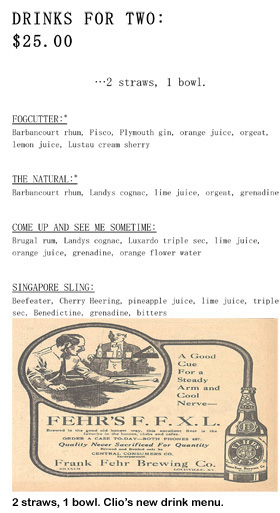
» LUPEC Boston reviews Todd Maul’s new bar menu at Clio, which leaves all previous bar menus at Clio in the dust. “The 80-plus drinks … run the gamut,” say the Ladies United for the Preservation of Endangered Cocktails, “from aperitifs ($9) to drinks for two ($25) to tiki drinks & daiquiris ($13), and feature a blend of pre-Prohibition and modern classics.” Many of the offerings are designed to pair nicely with the raw delights at Uni, the sushi bar adjacent to the Clio bar.
» Speaking of tiki drinks … doesn’t the balmy spring weather make you thirsty for the serious Donn Beach/Trader Vic-style versions of these rum-tastic cocktails? Sure, you can get them on demand at Drink, Eastern Standard and now, of course, Clio, among a smattering of other spots. But could somebody open up a REAL tiki bar in Boston, already? This city was once a tiki mecca, and, well, how ’bout sprucing up down-on-its-luck Downtown Crossing with a ridiculously fun bar? Silvertone and Stoddard’s (yes, it’s finally open!) can’t do it all by themselves. Sheesh.
» Speaking of LUPEC Boston and new joints, one of the Ladies, Jane Robertson (aka Pinky Gonzales), does an astute write-up of Harvard Square’s new Russell House Tavern for Joonbug (which reviewed drinkboston’s Bartenders on the Rise event not long ago). She pretty much echoes drinkboston’s first impressions of the place: it’s got some baggage to overcome, but its bright spots — including the cocktail list and the horseshoe-shaped, marble bar downstairs — make us root for the place.
» Congrats to these talented barmen and women — who work in some of drinkboston’s fave joints — for making the Improper Bostonian magazine’s long-running Boston’s Beloved Bartenders list: Trina Sturm of Trina’s Starlite Lounge, Scott Marshall of Drink, Corey Bunnewith of Coppa and Ned Greene of Hungry Mother.
» Speaking of alcohol, history and lectures, I’m also attending Boston Beer: a History with Michael Reiskind at the Boston Public Library on May 12. Oh, and speaking of beer, don’t forget that the annual American Craft Beer Fest is coming up at the Seaport World Trade Center June 18-19.
» If you like to drive your car to Boston-area bars but don’t want to risk a DUI (or worse) on your way home, Boston’s Designated Driver is a good service to know about. I haven’t tried it out yet and would love to hear from anyone who has — leave a comment, will you?
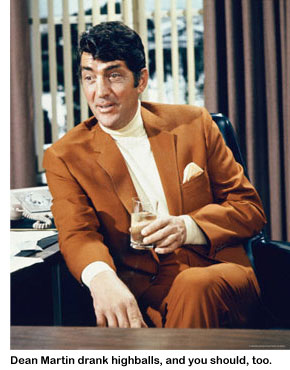
» Hey, did you know that drinkboston and Trina’s Starlite Lounge are having a Highballs party on Sunday, May 9? Reserve your ticket at 617-576-0006 or info@trinastarlitelounge.com and come party like it’s 1965. See you there!
West Coast cocktail writers Camper English and Paul Clarke have sparked a debate that I can’t resist joining, because it’s oh so familiar.
A trio of recent articles by these gentlemen, and especially the comments those articles have generated, show that there is some, ah, disagreement over bartenders’ approach to customers in the world of craft cocktails.
English got things started with a piece in the San Francisco Chronicle called “Bartenders shift from lecture to nurture.” He observes that bartenders at many successful craft cocktail bars (including Boston’s Drink) are softening their attitude toward those who haven’t converted to the Church of the Serious Cocktail and are instead winning drinkers’ hearts and minds with good, old hospitality. The article generated comments ranging from this:
[Cocktail] MENUS??? What…. like Free Range BOURBON? Geeezus gimme a break…shot o’ Jack in a dirty glass thank you very much. And yeah.. the bartender works for ME. He’ll take my order and LIKE IT. Belch.
to this:
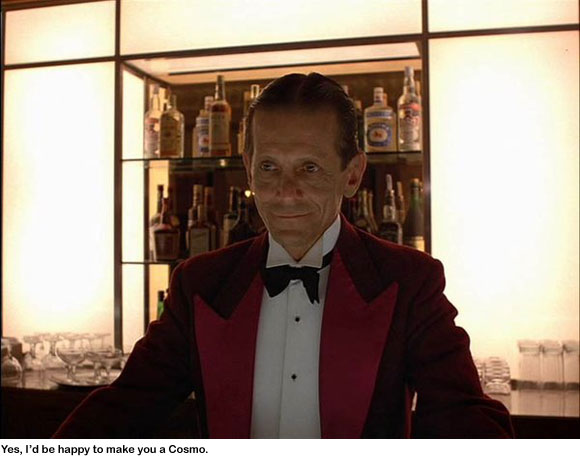
Just about every single person who commented completely missed the mark. You don’t walk into a corner liquor store in the Tenderloin if you want fine champagne and you don’t go to the K&L Wines on 4th street if you want malt liquor. Bars like the Rickhouse pride themselves on quality drinks. If you want a Cosmo there 999 other places that will make it for you. They don’t need your business. They have plenty.
Most bartenders employ some aspect of the “Customer is always right” principle. If the ingredients are available, they will make the requested drink. But does the customer have a responsibility as well? Possibly to distinguish the types of drinks they’ll order based on the type of bar they’re visiting?
Yes, Paul. At least, the customer should have that responsibility. And it is up to mixology-minded bartenders to help the customer understand that. That means continually educating guests — most of whom don’t read cocktail blogs — about the fact that in certain places, bartending has reached a new level and that the drinks there are different. Many people, like Mr. Shot O’ Jack above, will start out thinking it’s all just a pretentious fad. But once they sample a few really well-made drinks and notice that more and more of their friends are doing the same, they’ll come around. The thing is, it always takes more time than the passionate early converts realize.
All this has happened before with food, wine and beer. It wasn’t all that long ago that lettuce was Iceberg, wine was Inglenook in a jug, and beer was Bud in a can. Anyone who clamored for more variety and better quality was considered a fussy elitist. Now, regular Joes at your average chain restaurant consume arugula, Chardonnay and India pale ale without comment.
I experienced this kind of change first-hand during my brief stint in the craft brewing industry in the late ’90s. Even though craft beer had been proliferating for over a decade at that point, people would still walk into a brewpub and order a Miller Lite. The bartender would explain that there was no Miller Lite on tap, that the establishment sold only beer that was made on the premises, and he would suggest a golden ale — milder than the pub’s other beers but still way more flavorful than mass-produced light lager. The customer would either leave or try the golden ale. If he tried it and liked it enough, he might get adventuresome later on and order an IPA or a porter. It was a process, and it didn’t happen overnight.
Did my fellow brewers and I privately snicker at those Miller Lite-ordering rubes? Yes — just as today’s craft bartenders do with the Cosmo set. But luckily for both beer nerds and cocktail geeks, the impulse to win over the unenlightened triumphs over the impulse to mock them. A little less zealotry, a little more diplomacy. Which means that, in a few years’ time, Mr. Shot O’ Jack might walk into a bar, glance at the cocktail menu without raising an eyebrow, and respectfully ask the bartender to suggest a rye for his Sazerac.
Heads up, drinkbostonians: Josey Packard, one of Boston’s best bartenders, will appear tonight on the Rachel Maddow Show on MSNBC (9:00 p.m. EST) to mix up a flaming bowl of Christmas Rum Punch. Go, Josey, go!
Regular viewers know that Maddow often closes her political talk show with a bit on cocktails — I recall Dale DeGroff mixing Irish coffees on the set earlier this year. More recently, Maddow shared with her audience an investigative coup: an actual drink menu from one of the Obamas’ regular White House cocktail parties. As you see in the short video segment above, she not only described the cocktails (the Emerson, the Stone Fence and the Frost) but explained some of their ingredients (applejack, maraschino liqueur), named and photographed the bartenders who served them (Derek Brown and Adam Bernbach), pointed out that bartending is an American invention, and signed off with this delicious nugget: “And remember, Martinis do not contain vodka.”
Packard, a friend of Maddow’s who did guest spots about cocktails on the latter’s radio show back in her Air America days, will make a punch recipe adapted from the 1949 edition of Esquire’s Handbook for Hosts, about which Paul Clarke writes humorously on Cocktail Chronicles. I got a live preview at a recent Christmas party as Josey did a (not so) dry run of the flaming punch for the assembled guests. It was very cool, what with all the spices and orange oil making sparks as they were tossed into the bowl. Even the sternest Scrooge would be uplifted by this vessel of flaming goodness.
Watch the show, congratulate Josey the next time you’re at Drink, and have a merry Christmas!
There are two things drinkboston normally doesn’t talk about: stupid drinks described in press releases and stupid celebrity scandals. I don’t want to call any extra attention to these scourges. And yet, how could I not pipe up about something that came over the transom today?
The local PR firm Image Unlimited Communications sent a press release about a cocktail that Za Za restaurant in Saugus (oh, Saugus) is promoting. Here is a verbatim excerpt (complete with rampant quotation marks, random capitalization and a missing apostrophe).
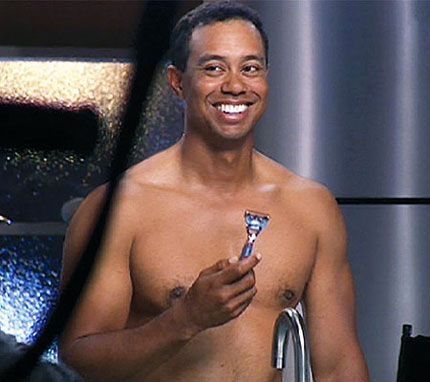
Who’s fiercer, the cougar or the tiger? Experience them both at Za Za Restaurant off of Route 1 in Saugus, MA. Based on the recent escapades of Tiger Woods, the “Two-Timing Tiger” ($9.50) cocktail is a deceivingly delicious blend of grey goose vodka, olive juice (extra dirty), and 14 blue cheesy stuffed olives in honor of each of the “man of the hours” alleged transgressions. You might have to beat back a few “Cougars” to reach the “Tiger” at Za Za – but stop in and enjoy it.
Ingredients:
3 oz. Grey Goose Vodka
1 oz. Olive Juice
Blue Cheese Stuffed Olives
Directions: Combine Grey Goose Vodka and olive juice in a shaker filled with ice and shake until the shaker is frosted. Strain into a chilled martini glass and garnish with blue cheese stuffed olives. Take a sip and get out on the prowl.
Eww. I need a shower.
It’s not that there isn’t a time and a place for silly drinks. And as cocktail historians know, plenty of drinks were invented to capitalize on seedy current events (hello, Ward Eight). But the Two-Timing Tiger blows these quaint traditions out of the water. It’s a mind-boggling combination of bad concepts and lame jokes in one Big Gulp martini glass:
Grey Goose vodka (the official drink of tools)
Extra olive juice (get it? Extra dirty…)
Blue cheese-stuffed olives. Fourteen of them. (Speared on a golf club-shaped cocktail pick, I hope.)
A celebrity scandal (a professional athlete slept with 14 skanks? I’m shocked, shocked…)
Cougars (way to work that Big Cat theme … and insult the very women who are supposedly your customers)
The use of the phrases “deceivingly delicious” and “blue cheesy stuffed olives” in one sentence.
Every political and cultural movement has a common enemy who is held up as a threat to the movement’s cherished ideals. Liberals have Sarah Palin. Conservatives have Nancy Pelosi. Letterman fans have Jay Leno. And now, cocktail enthusiasts have the Two-Timing Tiger. Rowwwrrr.
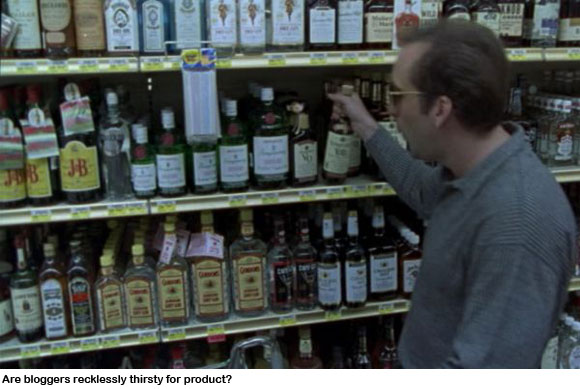
Bloggers have arrived. It’s true, because the Federal Trade Commission recently decided to impose rules on us. All together now: Wooo … hey, wait a minute!
Starting December 1, bloggers, and even users of Twitter and Facebook, “who review products must disclose any connection with advertisers, including, in most cases, the receipt of free products and whether or not they were paid in any way by advertisers, as occurs frequently,” reported the New York Times. “For bloggers who review products, this means that the days of an unimpeded flow of giveaways may be over. More broadly, the move suggests that the government is intent on bringing to bear on the Internet the same sorts of regulations that have governed other forms of media, like television or print.”
Hmmm, where to start. Disclosure? Well of course people should disclose when they’re compensated for endorsing stuff. But what is “compensation?” What is “endorsing?” Do I have to spell out that free booze is involved whenever I write about a promotional event hosted by a liquor company? Then there are product reviews. Those aren’t generally my game, but, given that this is a blog about drinking, I do discuss products from time to time — products I’ve paid for and products I haven’t. In this review of ri(1) whiskey, was it enough to disclose that I got a bottle of the stuff in the mail and let readers make the assumption? Or do I have to come right out and say that it was a gift, or, let’s cut to the chase, a bribe? Does the fact that I didn’t exactly endorse the whiskey count for anything? Or does merely devoting a post to it mean that I’m promoting it? Can you say can o’ worms?
The FTC ruling is aimed partly at celebrity bloggers who don’t disclose their ties to companies. Fair enough. But most bloggers aren’t celebrities, and I’m guessing most would laugh at the notion that they’re recipients of “an unimpeded flow of giveaways.” Certainly, there are bloggers out there who act as stealth spokesmen. I’ve been approached by some small companies — you know, people who make novelty coasters and stuff — asking if I’d write a positive review of their products in exchange for a little cash. Ewww. Like I’m going to whore myself out to these guys for $50. But some people do just that, or such solicitations wouldn’t exist. The thing is, it’s pretty easy to ID the bloggers who are only in it for free product — their blogs are boring, and no one reads them.
The other issue here is, are bloggers and the rest of the social media world being unfairly singled out? Some people think so. But … don’t the FTC’s rules about deceptive advertising practices apply to other forms of media? That’s why movie producers are always getting slapped with big fines for product placement in their films, and travel writers are punished for free hotel-room stays, and the beer newspaper I once wrote for was ordered to cease and desist the practice of taking free samples of IPA.
Right.
So why make a point of applying the rulebook to social media without renewing the commitment to crack down on pay-for-play in the traditional media? Because, as the Times article points out, “sites like Twitter and Facebook, as well as blogs, have offered companies new opportunities to pitch products with endorsements that carry a veneer of authenticity because they seem to be straight from the mouth — or keyboard — of an individual consumer.” In other words, it’s worse to be deceived by a close friend than by a stranger.
Very few social media mavens are losing sleep over any of this, of course. I mean, besides the fact that there are a couple hundred million of us for the FTC to monitor, we realize that the regulators are lagging adorably behind reality. Sure, a few people have no doubt been tricked into buying Nikes because some celeb got paid to blog about sneakers. But the online world evolves quickly, and, personally, I think its denizens are more savvy than they get credit for. Plus, if the feds came after me for not disclosing that those drinks I had at the Grand Marnier party were free, I’d gain such notoriety that I probably could get an endorsement deal. Hello, Beefeater?
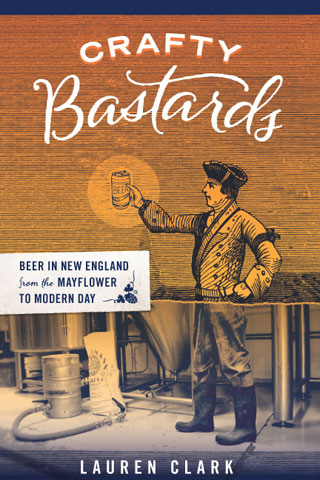
"Lauren Clark takes readers on a supremely sudsy tour of New England ales, lagers, pilsners, and porters. This is the New England the Puritans warned everybody about, but few have chronicled."
– Wayne Curtis, And a Bottle of Rum: A History of the New World in 10 Cocktails
 A friend of mine told me that an old flame put the moves on him recently after plying him with drinks. Acknowledging the futility of the attempt to rekindle, the old flame apologized for her brazenness. But she offered this excellent excuse: “It’s spring, and I’m a mammal.”
 » If you like to drive your car to Boston-area bars but don’t want to risk a DUI (or worse) on your way home, Boston’s Designated Driver is a good service to know about. I haven’t tried it out yet and would love to hear from anyone who has — leave a comment, will you?