Archive for the ‘Cocktails’ Category
July 14th, 2010
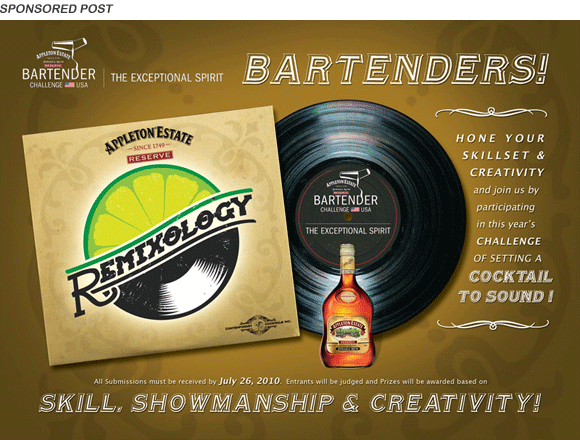
Boston bar professionals, think of a song that really grabs you — one that makes you want to jump up on a table and sing into an empty beer bottle, or slow-ride in a convertible down Mass Ave., or grab a dark-haired stranger in a Buenos Aires cafe and do the tango. Translate that song into a cocktail with Appleton Estate Reserve Jamaica Rum. Submit your recipe and the tale of its musical inspiration by July 26. Why? You could win a trip to Jamaica — and global renown.
There are cocktail contests that are about chops and style, and there are cocktail contests that are about mixology and heritage. Then there’s Remixology. The brainchild of former Boston bartender Willy Shine and his consulting company, Contemporary Cocktails, Remixology mashes both traditions together — to the tune of your favorite song and featuring a quality rum. Here’s how it goes:
- Once all submissions are entered by July 26, 15 contestants will be chosen and featured on the Appleton Reserve Mixology Challenge and Contemporary Cocktails websites and in press materials.
- Five of the 15 will be selected to compete in August at Drink. This will involve “performing” your cocktail to the tune that inspired it, as well as mixing a second cocktail that is locally inspired (“No Charles River ice,” warns Willy.) Yes, you can sing and dance — but you don’t have to. Get creative. We’re not talking Tom Cruise or Coyote Ugly — you’re cooler than that.
- The top Boston finisher moves on to the finals in Manhattan August 30-31 to show bartenders from the other competing cities — NYC, Miami and San Francisco — who’s boss.
- The winner of the finals wins a red-carpet, all-expenses-paid trip to Jamaica in October to participate in the Global Showcase with bartenders from nine other countries.
How cool is that? Get all the details here. Represent for Beantown!
Tags: Appleton Estate Reserve Rum, bartending contest, cocktail contest, Contemporary Cocktails, music, Remixology
Posted in Bartenders, Cocktails, Rum | 3 Comments »
July 13th, 2010
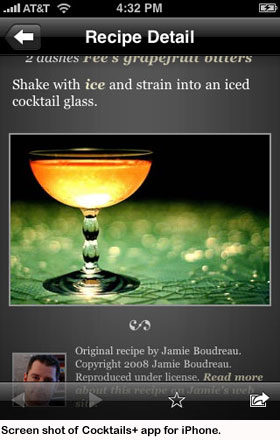 When it comes to iPhone apps, I’m a minimalist. Until a friend suggested recently that I write about cocktail apps, I only had one on my phone: Cocktails+. It was developed in part by Ted Haigh and Martin Doudoroff, the team behind the cocktail website I frequent most: the Internet Cocktail Database, or CocktailDB.com. I like the Cocktails+ app. It’s heavy on historic drinks, it includes the source(s) for each recipe, and it’s attractive and easy to read. Honestly, though, I have only used it a handful of times. That’s because my actual favorite cocktail app is a talented bartender. I mean, who needs to consult a mobile device when you have a person in front of you who can help you choose a great drink and tell you the story behind it?
Oh right. We’re not always in bars with talented bartenders, and we’re not always in bars, period. And we don’t carry our cocktail-book libraries around with us. So I figured I’d do a little research for the team to see which cocktail apps are worthwhile for us discerning drinkers. It took me about five minutes to figure out that most of the stuff listed in the iTunes app store was unworthy (to put it kindly), unless drinkboston readers secretly yearn to possess 7,000 recipes for flavored-vodka shooters. It took me about another 30 minutes on the Google, the Facebook and the Twitter to tease out which apps the drinkerati have approved. Here are the fruits of my hard labor.
Cocktails+ $2.99. “The authoritative cocktail reference for the iPhone.” The 2,000+ recipes include mostly classics, but there are many contemporary recipes by Jamie Boudreau, Dale DeGroff and Goncalo Monteiro. Cool feature: share recipes not only via email (which most of these apps do) but also Facebook and Twitter.
Flip n’ Drink $3.99. Authors Gary and Mardee Regan, the folks behind Ardent Spirits, selected and tested the hundreds of recipes on this attractive app, and they are continually adding more from an impressive list of contributors. Cool features: cocktail recommendations based on your current selection, and “cocktail conversations” — fun facts related to each recipe. Beware: the app’s over 20MB, so I got a message saying I had to download it via a computer rather than wirelessly.
Cocktails Made Easy $2.99. Based on a solid concept: 500 recipes that you can make with just 14 different spirits (plus mixers). The recipes are from diffordsguide.com by British drinks industry guru Simon Difford. Cool feature: click on the bottles of liquor you currently have in your inventory, and get a list of the drinks you can make.
101 Cocktails $1.99. “Do I really need 14,000 cocktail recipes?” asks L.A. blogger Jimmy Patrick (Jimmy’s Cocktail Hour), who developed this blessedly streamlined app. For those times when you just want the basics, this is perfect.
Tiki+ $3.99. More than 150 authentic tiki recipes culled from Beachbum Berry’s books. Illustrated with vintage drink photos and art, the app lets you share recipes via Facebook and Twitter. NOTE: Tiki+ is currently being upgraded for iPad compatibility, but it will be back on sale soon.
Please comment if there’s a great cocktail app out there that I missed — and also if you have a go-to beer or wine app. Meanwhile, I need an app with real-time info on the best bars and up-to-date schedules of my favorite bartenders.
Tags: app, iphone
Posted in Books & resources, Cocktails | 11 Comments »
July 3rd, 2010
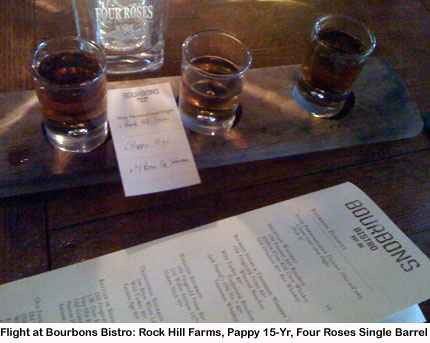
The Kentucky bourbon trail is were you learn all about how bourbon is made. But to really drink the stuff, head to Louisville — that’s where the bourbon bars are. Here are some brief reviews of those “urban bourbon trail” bars, as well as a couple spots in Midway and Frankfort that are well worth a visit.
Bourbons Bistro. It’s “bourbons,” plural. Boy, is it ever. You sit at the bar and contemplate a wall of 130+ different bottles. You peruse the lengthy menu, including several of the flights it helpfully suggests. Then you consult your knowledgeable but laid-back bartender, who tailors a flight to your exact desires. You kick back, sip the tawny goodness, and eavesdrop on what everyone else is ordering. You wish you could come back every night for at least a week to sample even half of the bourbons here, soak it up with high-class southern tavern food, and decompress to the tune of Kentucky accents.
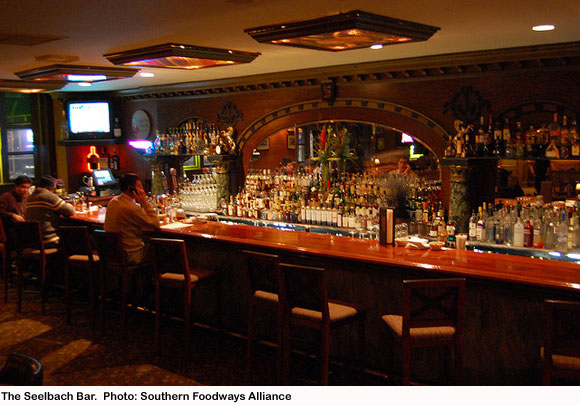
The Old Seelbach Bar. A fixture on numerous “best bars” lists, this landmark hotel watering hole has over 40 bourbons on the back bar. The Seelbach is a grand, early-1900s-era hotel whose plush rooms seem like a real value compared to similar accommodations in bigger cities like New York and San Francisco. I splurged on a room there and happily nursed my bourbon hangover with a giant plate of biscuits and sausage gravy in bed. The one bummer about the Seelbach Bar: like Locke-Ober and its sub-par Ward Eight cocktail, this establishment serves the worst example I’ve ever encountered of its signature Seelbach cocktail — too much liqueur, semi-flat sparkling wine, and only a wan expression of bourbon and bitters.
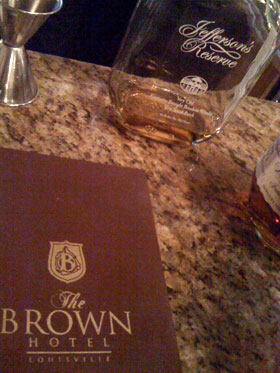 The Brown Hotel Bar. This is in the opulent, marble-enclosed lobby of Louisville’s other grand, old hotel, built in 1923. The comparatively tiny bar nonetheless carries a wide selection of bourbons. I sipped on a Jefferson’s Reserve (a very small-batch whiskey launched by writer and bourbon historian Chet Zoeller) and struck up a conversation with the bourbon drinker sitting next to me. He turned out to be an Australian linguist and alumnus of my daytime employer (MIT) who teaches theater in prisons. This is why I go to bars.
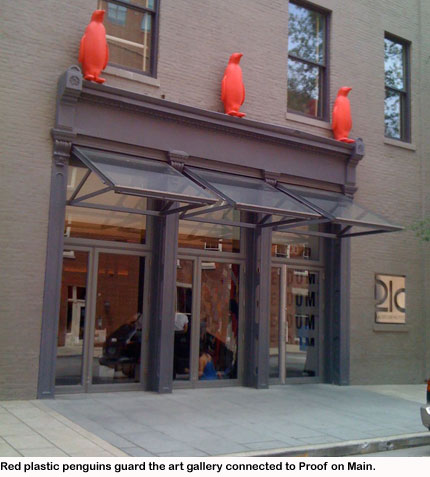
Proof on Main. Proof that Louisville has a hip side. This cocktail bar and restaurant is part of the 21c Museum Hotel — a boutique hotel in a historic, stone building whose lobby houses kick-ass contemporary art installations. I had a delicious Gold Rush — Woodford Reserve bourbon, honey syrup, lemon juice — and would have taken a flight of a few of the 50+ bourbons on the menu had it not been lunchtime. I have to shout out to Bill Samuels Jr., president of Maker’s Mark, for taking me to Proof (and bringing me down to Kentucky to taste the new Maker’s 46). It’s not every day that I get to talk about bourbon and bourbon tourism with a rocket scientist-turned-lawyer-turned-distiller who deserves much of the credit for the reemergence of bourbon as a premium spirit over the last 30 years.
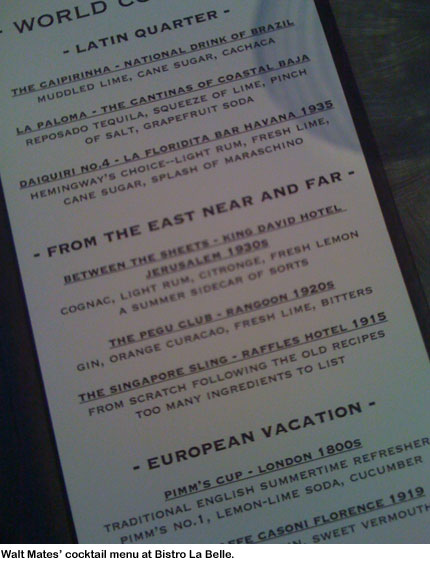
Bistro La Belle. This fine restaurant and cocktail bar in Midway, which is only a 15-minute drive from either Frankfort or Lexington, is soooo worth seeking out. Midway is a) a picturesque town of under 2,000 where a railroad runs smack down the middle of Main Street and b) a gathering place for an international clientele connected to the business of breeding and racing horses. Walt Mates, who became a fan of drinkboston a few years back while he was transitioning from bookstore owner to classic mixologist, welcomed us to his bar and mixed us real-deal Singapore Slings and Palomas before we sat down to an absolutely delicious dinner. Thanks again to Walt and owner Laura Wolfrom for your hospitality (and for recommending a nightcap at the pleasantly dive-y Dragon Pub on the Kentucky River in Frankfort, where we had shots of Buffalo Trace’s downmarket aged bourbon — Ancient Ancient Age, or “Triple-A” — with Bud chasers and listened to the karaoke contest taking place upstairs).
Tags: Bill Samuels Jr., Bistro La Belle, bourbon, Bourbons Bistro, Brown Hotel, Frankfort, Kentucky, Louisville, Midway, Proof on Main, Seelbach Hotel
Posted in Cocktails, Whiskey | 3 Comments »
June 9th, 2010
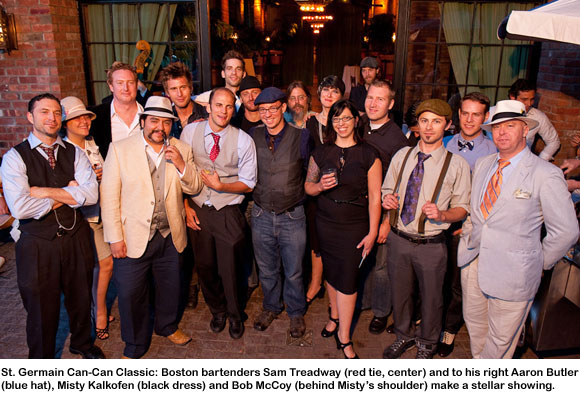
Four Boston bartenders competed in yesterday’s third annual St. Germain Can-Can Classic at the Bowery Hotel in New York City, and two of them took home the top two prizes. Congrats to Bob McCoy of Eastern Standard for his 1st place, $5K win and to Misty Kalkofen of Drink for her 2nd place, $2K win.
Three cheers as well to competitors Aaron Butler of Russell House Tavern and Sam Treadway of Drink for rounding out Boston’s prowess in this mixology event. Each of the four bartenders became eligible to compete in the Can-Can by winning St. Germain’s monthly cocktail contests.
McCoy, who also employed the elderflower liqueur to great effect at drinkboston’s Bartenders on the Rise event, impressed this year’s Can-Can judges with the mixture below. More recipes and tidbits to come as I get them.
Elixir Alpestre
By Bob McCoy
2 oz Bols Genever
3/4 oz St. Germain
1/4 oz Becherovka
1 dash Angostura Orange Bitters
6 drops Pernod Absinthe
Combine all ingredients in a mixing glass, add ice and stir. Strain into a coupe glass and garnish with a lemon twist.
Tags: Aaron Butler, Bob McCoy, cocktail competition, Misty Kalkofen, Sam Treadway, St. Germain
Posted in Bartenders, Cocktails, Liqueur | 5 Comments »
June 3rd, 2010
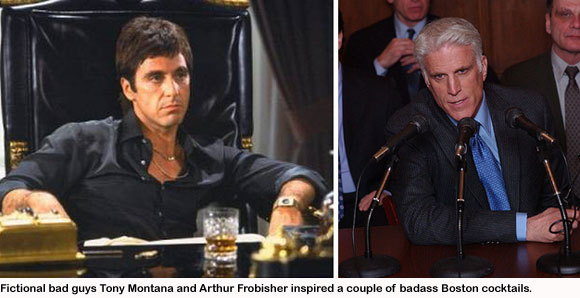
The latest happenings in and thoughts on Boston’s world of drink… First, ‘bad guy’ cocktails. OK, two cocktails does not make a trend, but maybe more will follow from this post, and then we’ll have conveniently manufactured one. (I love social media!) What I’m getting at are Eastern Standard‘s Frobisher and the Starlite Lounge‘s Tony Montana.
I was delighted when Jackson Cannon, who, like me, is a devotée of the FX series Damages, told me he was naming a new cocktail on the menu after Arthur Frobisher, the Enron-inspired CEO played by Ted Danson. Frobisher stands out as a bad guy in a show populated almost entirely by bad guys (and girls — the protagonist is the ruthless high-stakes litigator Patty Hewes, played by Glenn Close). That’s because Danson has elevated playing an unmitigated tool to a high art form. Cannon celebrates that achievement with a stirred, straight-up mixture of 2 oz Oxley gin, 3/4 oz ES’ own rose vermouth, 1/4 oz Luxardo maraschino liqueur, orange oil and a Luxardo cherry.
Then there’s the Tony Montana, which Beau Sturm is known to serve while uttering its name in the Cuban accent with which Al Pacino menaces his way through the gangster training video Scarface. The recipe: 2 oz Pyrat rum, 3/4 oz Carpano Antica, 1 barspoon Benedictine and 1 dash orange bitters, stirred well and strained. The thing about these drinks is that they’re not just ridiculous concoctions slapped with a badass name to get people to drink them. The cocktails themselves are badass — all spirits, straight up, not to be trifled with. Never mind that both Frobisher’s and Montana’s substance of choice is powdery and white, not fiery and wet.
» Stoddard’s (48 Temple Place). My first impressions are pretty positive. The place looks beautiful, with its brick walls, massive, century-old bar imported from England, prints of old Boston, and local artifacts including old street lamps and corsets from an early incarnation of the Stoddard’s space (before its days as a cutlery shop of the same name). The lamb sausage sandwich and the steak frites over braised oxtail were really good, as was our bar service by Jamie Walsh. The Gin Sling and Stone Sour, both tall drinks over ice, were well made, but the Brandy Crusta was a bit watered down, and the Pegu Club was out-of-whack — too heavy on the Plymouth gin and without Angostura bitters to balance the orange flavors, as Stoddard’s house recipe strangely dictates.
We were fortunate to get a peek at the already infamous, not-yet-open private club downstairs. For a membership fee of $2,000, you get your own key and entrance (in the Winter Place alleyway right next to Locke-Ober) to this low-lit den, plus privileges to use the space for meetings and parties. Stoddard’s was taken to task several months before it opened when a rumor circulated that the club would be men-only. That’s not the case, although Stoddard’s seems to really, really want to skew its demo to recreate a late-19th-century gentlemen’s bar, albeit with TVs. The bar staff appears to be entirely male, and General Manager Billy Lyons said that while membership for the private club is building, only two women have bought in so far.
» If, the next time you go to Drink in Fort Point, you notice a lot more Europeans than usual, blame John Gertsen. He recently traveled to the 2010 Cocktails Spirits expo in Paris as the representative of an American cocktail bar. He gave a well-received presentation about his landmark bar, including a demo of the Chee Hoo Fizz, a cocktail invented by Randy Wong of the exotica orchestra Waitiki, which spearheaded Drink’s now famous summer Sunday tiki nights. While at the expo, Gertsen also encountered a bunch of rare spirits like Portuguese tequila from 1920 and a 1917 vipérine — booze flavored with a big, ol’ poisonous snake. Here’s a video of a good chunk of John’s presentation, and here’s another one of him and fellow Boston barman Scott Holliday (of Rendezvous) looking at the vipérine and other rare liquids with spirits collector George Dos Santos. (Thanks to Jörg Meyer of Le Lion Bar in Hamburg, Germany, for those videos.) Congrats, John!
» Citizen Public House & Oyster Bar. A new outpost of the growing Franklin South End/Franklin Southie empire, the Citizen will open on Boylston St. overlooking Fenway Park in July. Joy Richard, whom drinkboston has mentioned several times as a cocktail contest winner and founding member of LUPEC Boston, will oversee the bar as she does at the other two restaurants. Expect good cocktails, beer and wine but, most important of all, a whiskey bar! In fact, Joy and I happen to be heading to Kentucky next week to visit several distilleries along the Bourbon Trail, starting with Maker’s Mark and a tasting of its new whiskey, Maker’s 46. I’ll be sending regular communiqués via Twitter from that jaunt. Until then…
Tags: Arthur Frobisher, Bourbon Trail, Chee Hoo Fizz, Citizen Pub, Damages, john gertsen, Paris Cocktails Spirits, Scarface, Stoddard's, Ted Danson, Tony Montana
Posted in Boston bars, Cocktails, Gin, Nips, Rum, Whiskey | 10 Comments »