Archive for the ‘Liqueur’ Category
November 23rd, 2010
As my friend Senator John aptly tweeted during the grand finale of the year-long Cocktail Wars at Woodward Tavern in the Ames Hotel, “If you dropped a bomb on the Ames Hotel, we’d be drinking light beer and screwdrivers for months.”
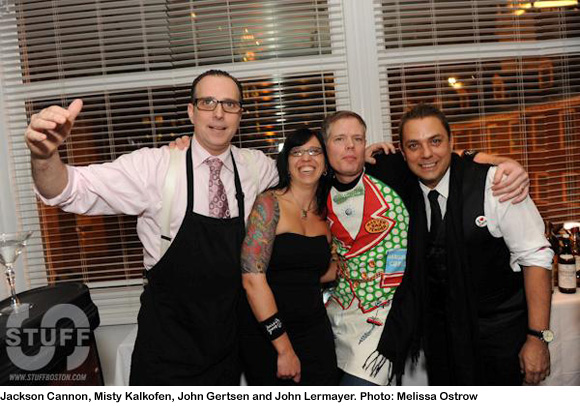
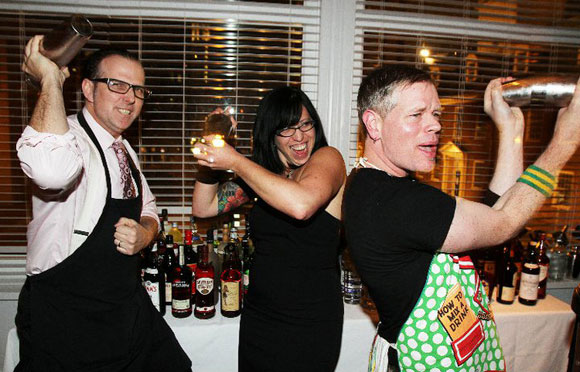
Arguably Boston’s three best bartenders — Jackson Cannon of Eastern Standard and John Gertsen and Misty Kalkofen of Drink — competed against each other and Miami’s finest, John Lermayer, in a showdown that capped a series of drink-mixing battles between Boston bartenders (and sometimes their colleagues from other cities). And there to cheer the competitors on was seemingly every other bartender of note who wasn’t on the stick that night. Thankfully, no bombs were dropped. Except for this one: the guy from Miami won.
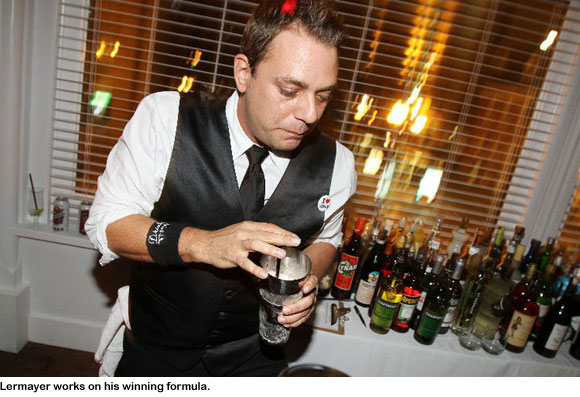
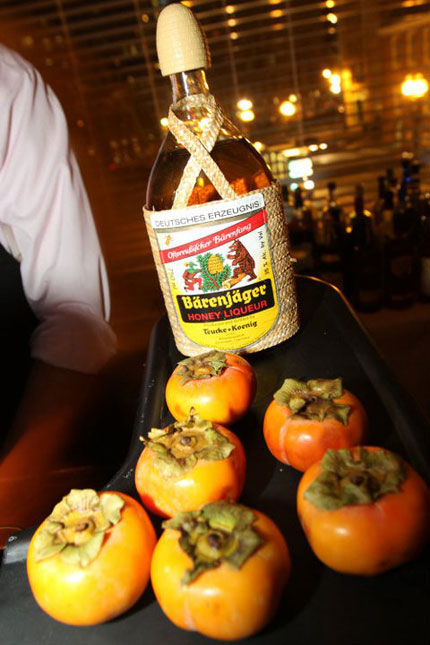
That’s right, John Lermayer, who tends bar at the Florida Room and consults for hotel bars around the world, bested his Beantown colleagues fair and square. I should know, because I was one of the judges. His winning cocktail, the Misty Morning Sour (see below), hit all the criteria admirably: quality, creativity, presentation and use of surprise ingredients — persimmon and Barenjager honey liqueur. Misty Kalkofen took second place for her mezcal-based Per Simon. In the quality department, all the cocktails got high marks on my ledger — particularly considering they were each created in an astonishing 20 minutes.
Here are some pics from the bash, plus the recipes that each of the four competitors came up with. What a pleasure it was to literally drink in their talents.
Misty Morning Sour
John Lermayer
Persimmon (a couple slices)
Strawberry (one or two)
1 1/2 oz Plymouth gin
3/4 oz Aperol
3/4 oz Barenjager
3/4 oz lemon juice
1/4 oz simple syrup
2 drops orange blossom water
Egg white
Muddle persimmon and strawberry in a mixing glass. Add remaining ingredients and dry-shake. Shake all again well over ice. Strain into cocktail glass with sliced strawberry and persimmon garnish. The name: inspired by how John imagined his fellow contestant, Misty, would feel the next morning.
Per Simon
Misty Kalkofen
Half a persimmon
2 oz Del Maguey Mezcal Vida
1/2 oz Plymouth sloe gin
1/2 oz Barenjager
1/2 oz lemon juice
1/2 oz agave nectar
1/2 oz Amontillado sherry
6 drops Bittermens grapefruit bitters
Nutmeg garnish
Muddle persimmon in a mixing glass. Add all other ingredients except nutmeg and shake well over ice. Strain into a cocktail glass and garnish with fresh grated nutmeg. The name: a play on one of the surprise ingredients and on the name of one of the judges, Simon Ford, international ambassador for Plymouth gin.

Once in a Blue Persim-moon
Jackson Cannon
Persimmon (couple slices)
1 1/2 oz Barenjager
1 oz Plymouth gin
1/2 oz lemon juice
1 egg white
Dash Peychaud’s bitters
Sparkling wine
Dry-shake first four ingredients and strain through a tea strainer. Dry-shake strained ingredients with egg white. Shake all again with ice. Strain into a champagne flute, top with Peychaud’s and sparkling wine. The name: inspired by the blue moon in the sky that evening.
Wasp Bite
John Gertsen
2 oz persimmon infused* Plymouth gin
1/2 oz lemon juice
1/2 oz Barenjager
1 tsp black pepper
Barenjager soaked persimmon skin “twist”
Muddle pepper in mixing glass. Add all ingredients except twist. Add ice, shake and double strain into a chilled coupe. Garnish with the twist. The name: a play on Drink’s peppery Bee Sting, which is itself a play on the classic Bee’s Knees.
*The Plymouth Gin was infused using a quick infusion technique known as nitrogen cavitation. Gertsen used a 1 liter iSi profi whip canister, added 375 ml of Plymouth Gin and the pulp from 4 medium-sized persimmons, and charged the canister twice with nitrogen.
Except for top photo, all photos by Mark Andrew Deley of Crammed Media.
Tags: Ames Hotel, Barenjager, cocktail contest, Jackson Cannon, john gertsen, John Lermayer, Misty Kalkofen, persimmon, Woodward Tavern
Posted in Bartenders, Cocktails, Events, Liqueur | No Comments »
October 24th, 2010
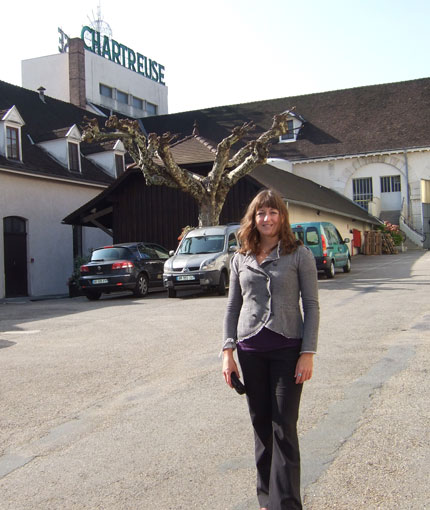
The Great October Strike of 2010 hadn’t begun yet when I flew into Paris on the morning of the 11th, so I was able to catch a super-speedy-smooth TGV train to Lyon right away. I would spend the night there en route to the distillery at the foot of the French Alps that produces the venerable herbal liqueur Chartreuse.
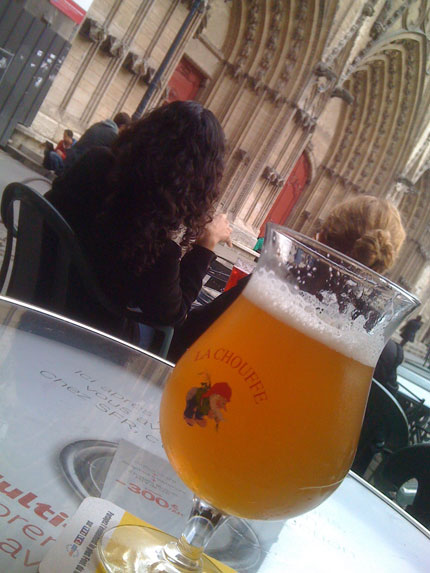
France’s second-largest city after Paris, Lyon is situated amid the comely geography of the Rhone and Saone rivers. I checked into the groovy Hotelo near the Rhone side of things and wandered across the city to the Saone side — the oldest part of the city. I did the mandatory climb up an endless set of stairs for a view of the Lyon Cathedral and its plaza, then rewarded myself with a La Chouffe Belgian ale at an outdoor cafe in said plaza. Right then it was official — I was on vacation in France!
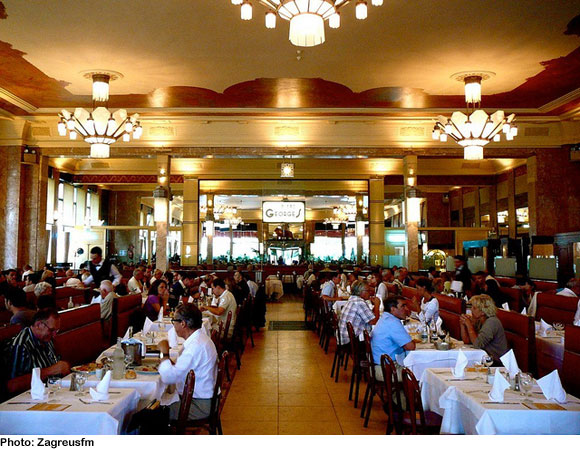
A cab driver suggested I check out Brasserie Georges for dinner. Its largeness and big neon sign (albeit in cool, Art Deco lettering) gave me pause — this place has as much chance of being really cheesy as being really good, I thought. But it was conveniently located right across the street from my hotel… The verdict: really good. Brasserie Georges is a real brasserie, i.e. beer is brewed on the premises. I ordered a slightly cloudy, dry Belgian-style amber and enjoyed the hustle and bustle, the hearty regional fare (calf’s-foot and lentil salad, anyone?) and the swift, sure service that all characterize a good, urban brasserie. If you’re ever in Lyon, it’s well worth checking out.
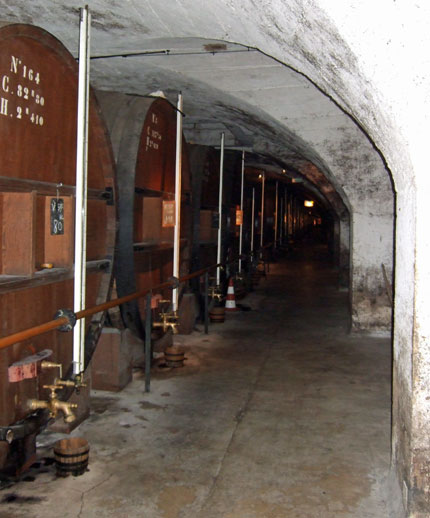
The next day was the first official day of the strike, but, blessedly, the train to Voiron managed to roll out of the station. I got there just in time to meet my tour guide from Chartreuse, the gracious and multi-lingual Florence Donnier-Blanc. The distillery and its cellars receive hundreds of thousands of visitors each year. She showed me around the cellar, informing me that it is the largest liqueur cellar in the world. Two million liters of green and yellow Chartreuse rest there in oak casks the size of Humvees. Many of these casks, whose wood comes primarily from Russia and Hungary, are 100 years old. (Oh, the herbaceous aroma of that aging liqueur!)
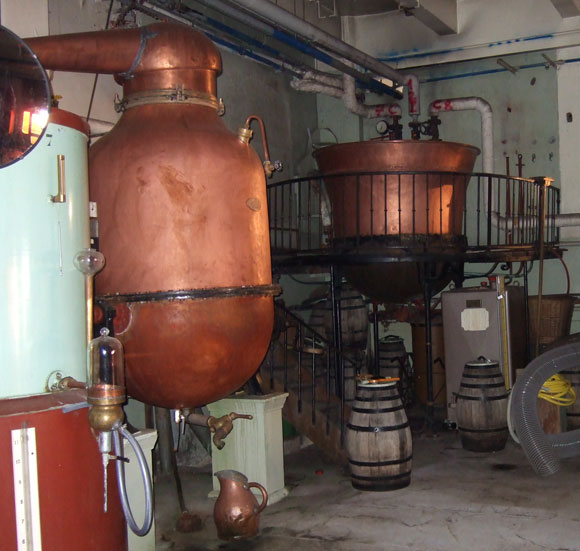
You may have heard that only two brothers of the Carthusian Order — the 900-year-old monastic order that created its “elixir of long life” in 1737 — know the recipe for Chartreuse, which in the green variety involves 130 different botanicals. But those two monks, with one helper, are also responsible for producing the entire world’s supply — in part using small, copper pot stills that are 200 years old. Now that is god’s work.

It was a treat to sample some special-edition bottles of Chartreuse unavailable in the U.S., including a version of yellow Chartreuse made in partnership with some of France’s noted sommeliers and a version of the green called 1605, an homage to the birthday of the original recipe for the elixir that was perfected 132 years later. The 1605 is an enchantingly dry-ish sibling of the standard green Chartreuse. The brothers also produce a line of berry liqueurs that just cry out for sparkling wine and aromatic Alpine specialties like Genepi (which smells similar to Chartreuse and is made from flowers that only grow in the Alps) and La Gentiane (similar to France’s famous yellow, bitter liqueur Suze). The distillery’s tasting room boasts eye-catching displays of vintage Chartreuse, as well as various “imposter” bottles whose liquid is frighteningly Nyquil-colored.

Next, Florence and I hopped in one of the distillery’s Chartreuse-mobiles and made the scenic, winding drive up to the mountains…

…for a lunch of fondue and white wine at a cute, little auberge frequented by hikers and skiiers. It was a ridiculously gorgeous day as we sat there enjoying the view of Chamechaude, the highest peak in the Chartreuse range of the Alps. (Florence insisted that Paramount Pictures nabbed this peak for its logo.)
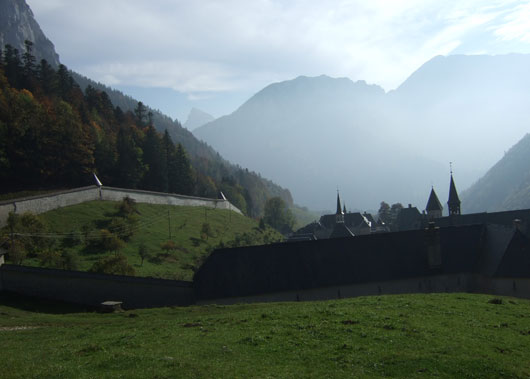
After lunch we drove to the site of La Grande Chartreuse — the main monastery of the Carthusian Order, which has existed on that site since 1084. The lower house of the monastery houses a museum, the other (above), a short hike away, houses the hermitage where the brothers live. We took in the view of the hermitage on a little hill bearing a crucifix and waxed philosophical about religion, family and life in general. In the woods below, we spied the occasional white-robed monk walking slowly, contemplatively. Labor strikes and other worldly turmoil seemed very far away.

Tags: Carthusian Order, chartreuse, French Alps, Lyon, monks, Voiron
Posted in France, Liqueur | 4 Comments »
June 9th, 2010
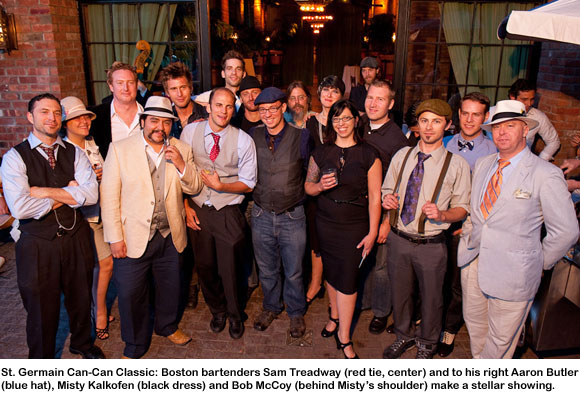
Four Boston bartenders competed in yesterday’s third annual St. Germain Can-Can Classic at the Bowery Hotel in New York City, and two of them took home the top two prizes. Congrats to Bob McCoy of Eastern Standard for his 1st place, $5K win and to Misty Kalkofen of Drink for her 2nd place, $2K win.
Three cheers as well to competitors Aaron Butler of Russell House Tavern and Sam Treadway of Drink for rounding out Boston’s prowess in this mixology event. Each of the four bartenders became eligible to compete in the Can-Can by winning St. Germain’s monthly cocktail contests.
McCoy, who also employed the elderflower liqueur to great effect at drinkboston’s Bartenders on the Rise event, impressed this year’s Can-Can judges with the mixture below. More recipes and tidbits to come as I get them.
Elixir Alpestre
By Bob McCoy
2 oz Bols Genever
3/4 oz St. Germain
1/4 oz Becherovka
1 dash Angostura Orange Bitters
6 drops Pernod Absinthe
Combine all ingredients in a mixing glass, add ice and stir. Strain into a coupe glass and garnish with a lemon twist.
Tags: Aaron Butler, Bob McCoy, cocktail competition, Misty Kalkofen, Sam Treadway, St. Germain
Posted in Bartenders, Cocktails, Liqueur | 5 Comments »
January 25th, 2010
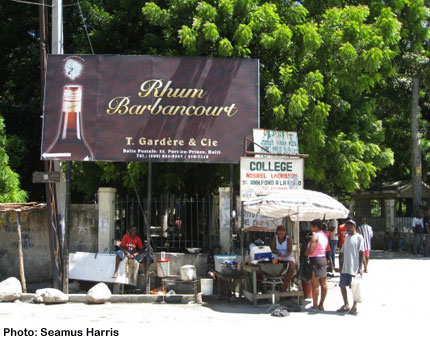
» HAITI. Like a lot of people responding to the needs of disaster-striken Haiti, I’ve been texting donations to the Red Cross, over-tipping Creole-speaking cab drivers, and ordering Haitian rum (or rhum) at bars. Recently, Drink joined several bars across the country in fundraising for Haiti by creating a menu of drinks using quality rhums agricoles and donating some of the proceeds to Doctors Without Borders. If you’re near Fort Point this week, pop by and raise a glass to an urgent cause.
» BENEDICTINE. Congrats to Jackson Cannon of Eastern Standard for being one of five finalists from around the country in Benedictine Liqueur’s “Alchemists of Our Age” cocktail contest. The contest, which marked the 500th anniversary of the French herbal elixir, announced its winner earlier this month: Damon Dyer of Louis 649 in New York City. The finalists, along with their cocktails, are featured in the January 2010 issue of Esquire. Check out Boston Herald writer Julia Rappaport’s blog post about Boston bartenders and Benedictine, and Dyer’s and Cannon’s recipes below.
Monte Cassino
Damon Dyer
3/4 part Benedictine Liqueur
3/4 part yellow Chartreuse
3/4 part fresh lemon juice
3/4 part Rittenhouse Rye
Shake, fine-strain into a chilled coupe (or small cocktail glass). Lemon twist garnish.
Vincelli Fizz
Jackson Cannon
1 egg white
1 1/2 part Benedictine Liqueur
1 1/2 part house-made rose vermouth
1/2 part fresh squeezed lemon juice
Dry-shake above ingredients to emulsify. Add ice and shake again until well chilled. Pour into a coupe glass. Top with 1 ounce Champagne. Garnish with flamed madjool date essence. Proportions to be adjusted as needed for variations in vermouth and citrus.
» IRISH WHISKEY. My friend Lew Bryson, a beer and spirits writer based in PA, recently called to pick my brain about Irish whiskey. We both admitted being confounded over the assertion (made by Spirit Journal editor Paul Pacult, among others) that Irish is the fastest-growing spirits category in the U.S. That’s because neither of us are noticing it being downed in greater-than-usual quantity, at least not in the places we drink. How is all this whiskey being consumed, we asked? As shots alongside a Guinness (my fave method)? On the rocks, like Scotch? In cocktails? We guessed one of the first two, since there just aren’t a lot of cocktails containing Irish whiskey.
I addressed that dearth recently when I brought my brother to Drink for his birthday and introduced him to the fabulous Red Breast, pot-still Irish whiskey. Misty Kalkofen gamely created a cocktail with the stuff, which was delicious and needs a name: 2 1/4 oz Red Breast Irish whiskey, 1/4 oz Punt e Mes, 1/4 oz green Chartreuse, stirred well over ice and strained into a chilled rocks glass.
» ULTIMATE BEVERAGE CHALLENGE. Speaking of Paul Pacult, he is leading the launch of the Ultimate Spirits Challenge, a judging event that aims to evaluate spirits with the “most authoritative, accurate and consistent results.” Part of the overall Ultimate Beverage Challenge, the first-ever spirits challenge takes place March 1-3 at Astor Center in New York City, followed by the Ultimate Cocktail Challenge in April. Check it out.
» SCOFFLAW. Did you know that January 16 was the anniversary of the official coining of the term “scofflaw,” for which the Scofflaw cocktail is named? And that the word came about as the result of a contest held by the Boston Herald in 1923? I didn’t either! It was one of those “I can’t believe I didn’t freakin’ know about this” revelations.
“The Scofflaw drink followed the coining of the actual term by less than two weeks,” writes Ted Haigh in Vintage Spirits and Forgotten Cocktails. “Another invention of Harry’s New York Bar in Paris, the cocktail hilariously baited Prohibition sensibilities.” Read more about it in the intro to Robert “DrinkBoy” Hess’ video about the Scofflaw. And thanks to Paul Harrington for being perhaps the first modern drinks writer to mention the history of the word and the cocktail.
» BOSTON DRINKING SOCIALS. Finally, this just in from Stuff Boston: Great Minds Drink Alike: Local booze crews give the term “social drinking” a whole new meaning.
Tags: Benedictine, Boston clubs, Haiti, Irish whiskey, Paul Pacult, rhum agricole, Scofflaw, Ultimate Beverage Challenge
Posted in Books & resources, Cocktails, Liqueur, Nips, Rum, Whiskey | 17 Comments »
January 6th, 2010
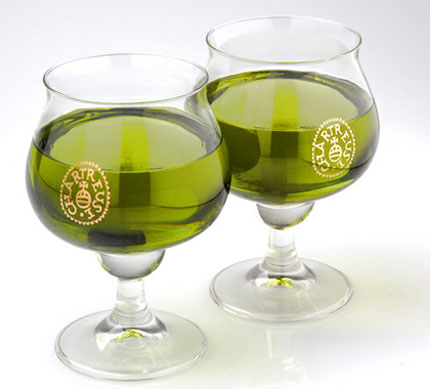
And the Franklin-drinkboston Industry Night series continues… This month’s ingredient? Chartreuse. Which makes us pioneers of a new decade, according to Derek Brown of the Atlantic online.
Next Thursday night starting at 8:00 p.m., bar manager Joy Richard and the gang at the Franklin Southie will stock the bar with many, many bottles of the Carthusian monks’ famous herbal liqueur for our cocktailing pleasure. Original and classic drinks with both green and yellow Chartreuse will be on the evening’s menu and will be a steal at $6. Another steal–$7 shots of VEP Chartreuse in iced shot glasses. Yes, I said $7 shots of VEP Chartreuse in iced shot glasses.
Not to mention a $5 bar menu starting at 9:00 p.m. and some coveted Chartreuse swag (while supplies last).
And if you are as inspired as we are by the charitable ways of the monks, bring in a canned food item to be donated to the Greater Boston Food Bank, and you’ll be entered into a drawing for a Very Special Gift from Chartreuse.
Whether you’re industry, or you just like hobnobbing with industry, or you just like Chartreuse, come join us for some botanical shenanigans.
Tags: chartreuse, Franklin Southie
Posted in Events, Liqueur | 2 Comments »