Archive for the ‘Whiskey’ Category
June 13th, 2010
I couldn’t resist spending a night in Chicago for a taste of the bar scene before continuing on to Kentucky for my first excursion on the bourbon trail. I hit up a storied tavern and two craft cocktail bars. It was a fine whistle-whetting that only left me thirsting for more.
Billy Goat Tavern. Why I had never been informed of this place I have no idea. I was beckoned here by a large “Billy Goat Tavern” sign on a Michigan Ave. overpass, then another that said “Cheezborger, cheezborger, cheezborger” and something about this being the birthplace of the 1970s Saturday Night Live skit that also brought us the catchphrase, “No Coke, Pepsi.” The dark doorway looked a bit sketchy, but I bet that there was a gem awaiting me on the inside, and I was right. The tavern moved to its current location in 1964 and appears not to have changed since. One side of the room is a diner, the other side a bar. A formica bar. With Schlitz on tap. And a bartender who has worked there for a really long time. He told me about how the tavern became a shrine to the Cubs, and how it was a hangout for hard-drinking newspapermen back when there was such a thing. Luckily, no one seemed to think it was an abomination when I set my laptop on the bar to get a bit of work done. In fact, the regular sitting next to me said in a tone of pleasant surprise, “They have wi-fi here?”

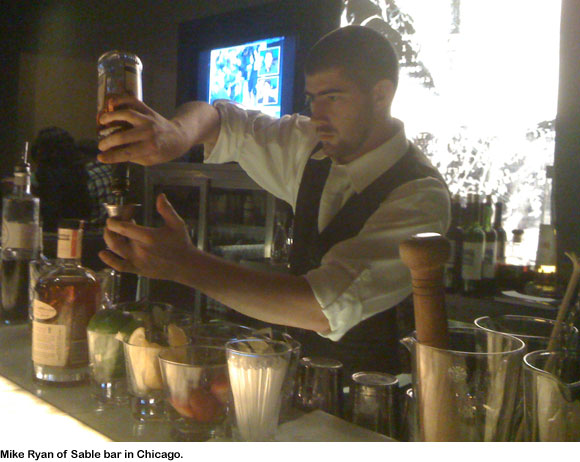
Sable Kitchen & Bar. New, sleek spot next to the Palomar Hotel with a futuristic glowing service bar and LCD screen playing a roaring fire. Mike Ryan, formerly of the Violet Hour, was tending bar that night. With an understated, gentlemanly manner, a sweet smile and a tattoo of bacon strips on his forearm, Ryan mixed a strong Ti Punch (La Favorite rhum agricole, cane syrup, limes) and then poured a flight of unusual and tasty whiskies, including Templeton rye from Iowa, Amrut single malt “scotch” from India and a “white dog” (unaged whiskey) made from spelt at Chicago’s Koval distillery. Sable boasts some superlative bar snacks, including BLT sliders where the B is (pork) belly.
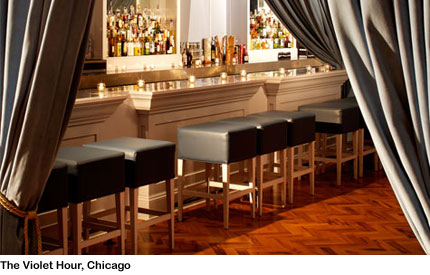
Violet Hour. You take a cab a little way out of downtown, past what’s left of the infamous Cabrini-Green housing project, and look for an unmarked door on North Damen Ave. Wow, is this a romantic spot. Even if great classic and classic-inspired cocktails could not be found here, it would be worth spending an evening swathed in the dusty-violet aura of this sort of Gilded Age parlor gone minimalist. It gets its name and concept from the oft-quoted-in-cocktail-circles The Hour by Bernard DeVoto (which, coincidentally, has just been re-published): “This is the violet hour, the hour of hush and wonder, when the affections glow again and valor is reborn, when the shadows deepen magically along the edge of the forest and we believe that, if we watch carefully, at any moment we may see the unicorn.”
After my delicious Hush and Wonder (Methusalem rum, creme de violette, fresh lime, grapefruit bitters), I saw no unicorns, but I did see a night in my future when I’d return to Chi-Town for some more quality drinking.
Tags: Billy Goat Tavern, Sable Kitchen & Bar, Violet Hour
Posted in Chicago, Rum, Whiskey | No Comments »
June 3rd, 2010
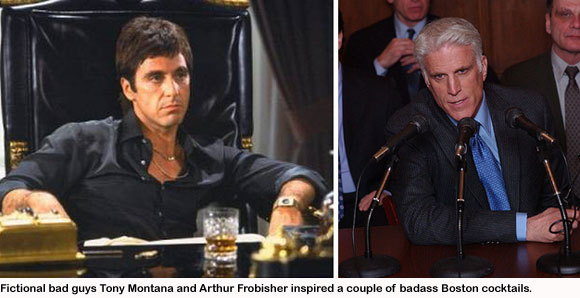
The latest happenings in and thoughts on Boston’s world of drink… First, ‘bad guy’ cocktails. OK, two cocktails does not make a trend, but maybe more will follow from this post, and then we’ll have conveniently manufactured one. (I love social media!) What I’m getting at are Eastern Standard‘s Frobisher and the Starlite Lounge‘s Tony Montana.
I was delighted when Jackson Cannon, who, like me, is a devotée of the FX series Damages, told me he was naming a new cocktail on the menu after Arthur Frobisher, the Enron-inspired CEO played by Ted Danson. Frobisher stands out as a bad guy in a show populated almost entirely by bad guys (and girls — the protagonist is the ruthless high-stakes litigator Patty Hewes, played by Glenn Close). That’s because Danson has elevated playing an unmitigated tool to a high art form. Cannon celebrates that achievement with a stirred, straight-up mixture of 2 oz Oxley gin, 3/4 oz ES’ own rose vermouth, 1/4 oz Luxardo maraschino liqueur, orange oil and a Luxardo cherry.
Then there’s the Tony Montana, which Beau Sturm is known to serve while uttering its name in the Cuban accent with which Al Pacino menaces his way through the gangster training video Scarface. The recipe: 2 oz Pyrat rum, 3/4 oz Carpano Antica, 1 barspoon Benedictine and 1 dash orange bitters, stirred well and strained. The thing about these drinks is that they’re not just ridiculous concoctions slapped with a badass name to get people to drink them. The cocktails themselves are badass — all spirits, straight up, not to be trifled with. Never mind that both Frobisher’s and Montana’s substance of choice is powdery and white, not fiery and wet.
» Stoddard’s (48 Temple Place). My first impressions are pretty positive. The place looks beautiful, with its brick walls, massive, century-old bar imported from England, prints of old Boston, and local artifacts including old street lamps and corsets from an early incarnation of the Stoddard’s space (before its days as a cutlery shop of the same name). The lamb sausage sandwich and the steak frites over braised oxtail were really good, as was our bar service by Jamie Walsh. The Gin Sling and Stone Sour, both tall drinks over ice, were well made, but the Brandy Crusta was a bit watered down, and the Pegu Club was out-of-whack — too heavy on the Plymouth gin and without Angostura bitters to balance the orange flavors, as Stoddard’s house recipe strangely dictates.
We were fortunate to get a peek at the already infamous, not-yet-open private club downstairs. For a membership fee of $2,000, you get your own key and entrance (in the Winter Place alleyway right next to Locke-Ober) to this low-lit den, plus privileges to use the space for meetings and parties. Stoddard’s was taken to task several months before it opened when a rumor circulated that the club would be men-only. That’s not the case, although Stoddard’s seems to really, really want to skew its demo to recreate a late-19th-century gentlemen’s bar, albeit with TVs. The bar staff appears to be entirely male, and General Manager Billy Lyons said that while membership for the private club is building, only two women have bought in so far.
» If, the next time you go to Drink in Fort Point, you notice a lot more Europeans than usual, blame John Gertsen. He recently traveled to the 2010 Cocktails Spirits expo in Paris as the representative of an American cocktail bar. He gave a well-received presentation about his landmark bar, including a demo of the Chee Hoo Fizz, a cocktail invented by Randy Wong of the exotica orchestra Waitiki, which spearheaded Drink’s now famous summer Sunday tiki nights. While at the expo, Gertsen also encountered a bunch of rare spirits like Portuguese tequila from 1920 and a 1917 vipérine — booze flavored with a big, ol’ poisonous snake. Here’s a video of a good chunk of John’s presentation, and here’s another one of him and fellow Boston barman Scott Holliday (of Rendezvous) looking at the vipérine and other rare liquids with spirits collector George Dos Santos. (Thanks to Jörg Meyer of Le Lion Bar in Hamburg, Germany, for those videos.) Congrats, John!
» Citizen Public House & Oyster Bar. A new outpost of the growing Franklin South End/Franklin Southie empire, the Citizen will open on Boylston St. overlooking Fenway Park in July. Joy Richard, whom drinkboston has mentioned several times as a cocktail contest winner and founding member of LUPEC Boston, will oversee the bar as she does at the other two restaurants. Expect good cocktails, beer and wine but, most important of all, a whiskey bar! In fact, Joy and I happen to be heading to Kentucky next week to visit several distilleries along the Bourbon Trail, starting with Maker’s Mark and a tasting of its new whiskey, Maker’s 46. I’ll be sending regular communiqués via Twitter from that jaunt. Until then…
Tags: Arthur Frobisher, Bourbon Trail, Chee Hoo Fizz, Citizen Pub, Damages, john gertsen, Paris Cocktails Spirits, Scarface, Stoddard's, Ted Danson, Tony Montana
Posted in Boston bars, Cocktails, Gin, Nips, Rum, Whiskey | 10 Comments »
May 12th, 2010
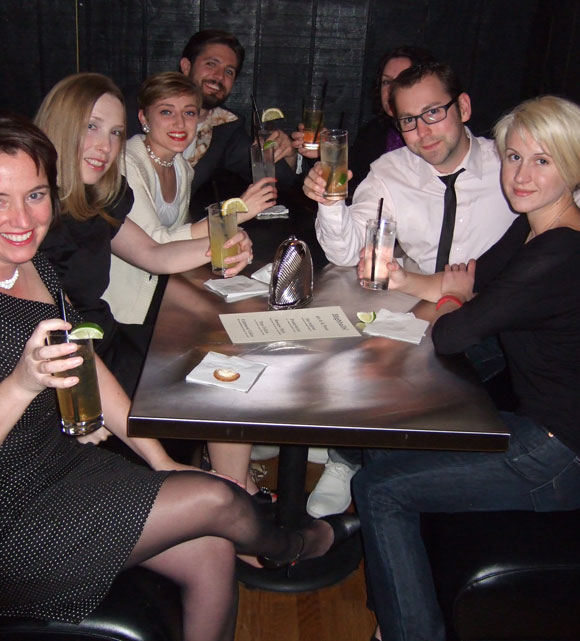
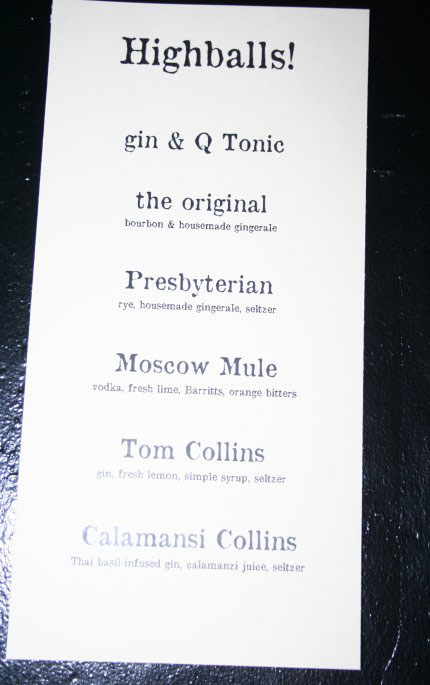
Thanks to all who came out to Trina’s Starlite Lounge for the Highballs! bash and partied like it was 1965. Highlights:
Two people thanked me for having this particular party on Mother’s Day, because their moms drank highballs.
A guy told me he wanted to drink his way through Embury and blog about it.
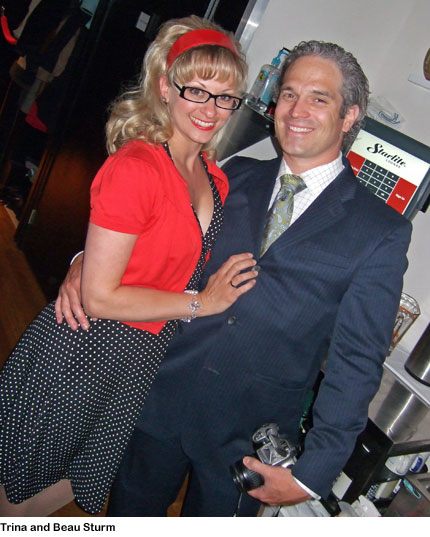
The Starlite staff and most of the guests showed off their vintage party clothes — nice.
I hobnobbed with a bunch of drinkbostonians, both new and familiar.
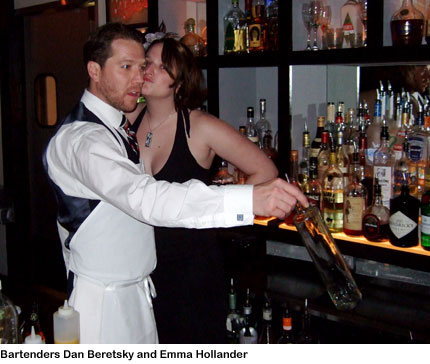
Starlite co-owner Beau Sturm made his own gingerale, and bartenders Emma Hollander and Dan Beretsky mixed it with Buffalo Trace Bourbon (for a traditional highball) and with Old Overholt Rye and seltzer (for a Presbyterian).
Chef Suzi Maitland was convinced that her giant, nut-covered port wine cheese ball would outlast the evening. We proved her wrong.
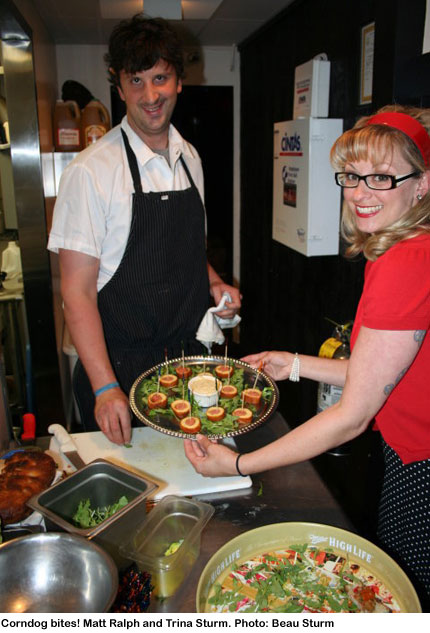
Co-owner Trina Sturm poufed her hair and greeted guests with trays of pigs in a blanket, Swedish meatballs, vegetable dip on melba toast and corndog bites.
Some old friends surprised me.
Bourbon Belle, Saucy Sureau, Gin Rickey, Pinky Gonzales, Hanky Panky and Hot Toddy of LUPEC Boston were in the house.
People danced.
Tags: highballs, Trina's Starlite Lounge
Posted in Events, Whiskey | 2 Comments »
April 9th, 2010
 Once upon a time, when adults said, “Let’s get together for drinks,” they meant highballs. Guests would bring a bottle of their preferred hooch to someone’s backyard, and the hosts would provide the tall glasses, ice and mixers — tonic, ginger ale, Squirt. Lots of smoking and guffawing would ensue before everyone drove home tipsy without seat belts.
Contemporary society goes against all that. It not only sensibly condemns the smoking and drunk driving, it sadly also dismisses the most basic form of mixed drink, the highball. We have bazillions of cocktail choices now, and, unlike the highball drinkers of yore, we talk about them endlessly (damn drinks bloggers).
In celebration of World Cocktail Week (May 6-13), let’s re-embrace that simple pleasure of the booze universe. Join drinkboston and Trina’s Starlite Lounge for Bourbon & Gingers, Presbyterians, Gin & Tonics, Moscow Mules and other members of the highball family — all with quality spirits and featuring house-made mixers — and party like it’s 1965. The details:
- Highballs! Hosted by drinkboston and Trina’s Starlite Lounge (3 Beacon St., Somerville)
- Sunday, May 9 (yes, Mother’s Day — bring mom!)
- 7:00 p.m. until last call
- $35 in advance, $40 at the door
- Highballs include bourbon & housemade gingerale, Presbyterian (rye, housemade gingerale, seltzer), gin & Q Tonic, Moscow Mule (vodka, fresh lime, housemade gingerale), Tom Collins (gin, fresh lemon, simple syrup, seltzer) and Calamansi Collins (the Starlite’s own creation with Thai basil-infused gin, calamanzi juice, simple syrup and seltzer).
- Tickets include four highballs, such retro delights as pigs in a blanket, and DJ-spun, highball-appropriate tunes.
- Call the Starlite at 617-576-0006 to purchase your ticket in advance, as there’s a good chance we’ll sell out.
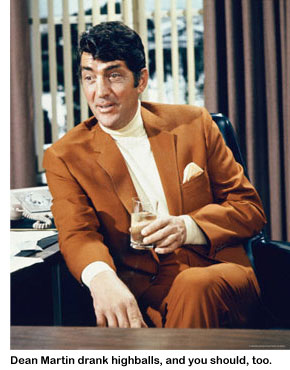
- Wear whatever you like, but anyone who shows up dressed as stylin’ as Dean Martin (or his date) will get extra credit.
Where does the term “highball” come from? Several sources trace it to the Irish expression “ball of malt,” which became Americanized in the late 1800s to “ball of whiskey” — both terms meaning a measure of whiskey. If a saloon patron wanted a longer drink with carbonated water, he asked for a “highball.” Then there’s the “highball” of railroad lingo — a signal, originally a ball hung above the tracks, indicating full speed ahead — that provides a fun double meaning.
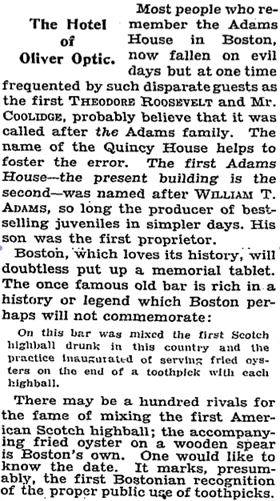 Did the scotch highball originate in Boston? This amazing article from the October 22, 1927 edition of the New York Times indicates as much. (Note the characteristic snark toward Boston.) Here’s some intel on William T. Adams, who wrote books for boys under the pen name Oliver Optic, and the Adams House hotel. It seems the NYT was lax in its fact-checking here — the Adams House was established by William T.’s father, not his son.
But wait, this DrinkBoy forum thread appears to contain a quote from a letter to the editor in the October 27, 1927 NYT by famed bartender Patrick Gavin Duffy, who makes a case for having first introduced the scotch highball in New York.
Whatever. All I know is that I’m craving a scotch and soda with a fried oyster on a toothpick. See you on May 9!
Tags: Adams House, Boston history, cocktail history, highballs, Trina's Starlite Lounge
Posted in Events, Whiskey | 7 Comments »
March 24th, 2010
My grandfather is 89 and drinks Manhattans. Upon first sip, he often utters one of his favorite expressions: “Hot damn.” He is a natural flirt — he actually gets away with addressing one of the walker-clutching ladies at his nursing home Lightnin’ — and the Manhattans he mixes in his apartment help him in that endeavor. One of his favorite stories is how a female resident approached his doorway one day as he was watching the Red Sox and drinking his favorite cocktail.
“What’re you drinking?” she said.
“Cranberry juice.”
“Don’t smell like it.”
“I’ll be right back,” he said, returning with a Manhattan for her as she settled in to watch the game.
This Christmas, my brother bought our grandfather a bottle of boutique rye whiskey — Rye 1, which, ironically enough, I have described as “not your grandfather’s whiskey” — and some sweet vermouth. I went into the kitchen to make him his drink as requested: 2 parts whiskey, 1 part vermouth, over ice. (The old man doesn’t bother with cherries or twists.) He was taken aback when he tried it, thinking I had made it too strong. Nope, 2 to 1, like you asked, I said. But then — of course! — he asked if the Rye 1 was stronger than the average whiskey. Yeah, it is, I said, remembering that my grandfather, like most of the drinking public, is used to lighter Canadian whiskies in his drinks. It’s a legacy of Prohibition and WWII that, in most places still, when you call for whiskey that’s not bourbon or scotch, you get Canadian Club or V.O. or the like.
Not that he doesn’t like the stronger, and stronger-flavored, straight rye. In fact, he seems to have developed a taste for it. I imagine the ladies will, too, soon enough.
* * *
When the 21-year-old son of a good friend told me he drank Manhattans, I was surprised. “Well … SoCo Manhattans,” he admitted, vaguely understanding the gaucheness of such a drink preference. (Hey, we’ve all been there.) Luckily, though, we were at Eastern Standard, and I was in charge. We started with a Frisco, one of my fave gateway drinks to whiskey, then moved to a Whiskey Smash.
Meanwhile, I convinced his friend and fellow classmate at Northeastern to try a Pisco Sour. “It has egg in it?” she balked. “Don’t be afraid,” I said, explaining that it would do for her drink what meringue does for lemon pie. The coup de grace was when our bartender, Hugh, handed her a teaspoon so she could scrape the fluffy, lemony, pisco-infused egg white from the bottom of the glass. It’s fun to watch young drinkers when they try a cocktail that makes them Get It. Today’s 21-year-olds don’t know how good they have it coming of age during the Cocktail Revival. I was well into adulthood before I experienced these sorts of mixtures. Then again, my grandfather, born during Prohibition, has missed them entirely. Can you imagine?
Tags: 21, grandfather, Manhattan cocktail, old drinkers, young drinkers
Posted in Cocktails, Whiskey | 16 Comments »