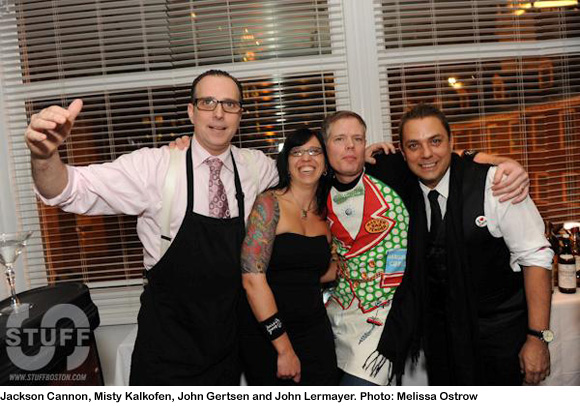
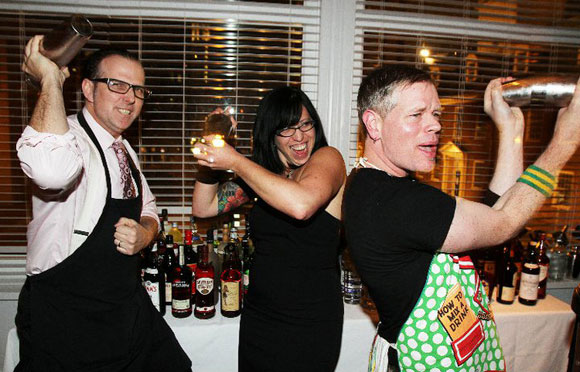
Join drinkboston and four of the Boston bar scene’s rising talents at a cocktail party at Green Street on Sunday, March 14. Boston Bartenders on the Rise will showcase some of the men and women around town who are making a name for themselves with a combination of drink-mixing prowess, hospitality and character.
Each bartender will mix a favorite cocktail and spend some time mingling with the crowd, talking cocktails, spirits, bartending and matters of similar importance. Bios and recipes below. Call Green Street today to make your reservation. Here’s the lowdown:
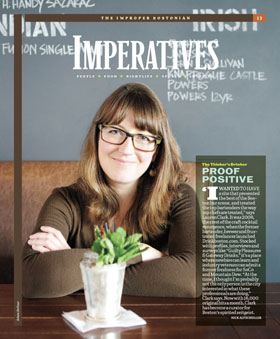
Carrie Cole of Craigie on Main started working in Boston restaurants when she moved to the Hub from Portland, Oregon, to attend Boston University. She started as a bartender, moved to cooking, became a pastry chef, then returned to the bar. After a stint at Sibling Rivalry, she was scooped up by Craigie on Main, where she is now senior bartender. Her cocktail is the Loose Translation: Scorpion Mezcal, Aperol, Mathilde XO Orange Cognac, pineapple syrup, lime juice, Allspice Dram and Angostura orange bitters. Rocks, splash of ginger.
Evan Harrison of Deep Ellum hails from Sherman, Texas. While studying literature and philosophy at UMASS, he began learning classic cocktails and craft beer as principle bartender at the Independent in Somerville. Late last year, he crossed the river to join the staff at the cocktail/beer bar Deep Ellum in Allston. His cocktail is the Peralta: Old Overholt Rye, Cynar, green Chartreuse, fresh grapefruit juice. Straight up.
Bob McCoy of Eastern Standard grew up in Middleton and started cooking in his uncle’s Malden restaurant when he was in high school. In college, he spent summers tending bar on Block Island, then moved to the Wild Horse Cafe in Beverly. After six years there, Bob was “looking for another opportunity, one that would take my profession to another level, and found it at Eastern Standard.” His cocktail is the Saving Daylight: Plymouth Gin, homemade “golden” vermouth, St. Germain Elderflower Liqueur, Cointreau and homemade bitters. Straight up.
Emily Stanley of Green Street entered the industry as soon as she turned 18 and left her hometown of Westford to study briefly at Suffolk University. She worked at Fire and Ice, Bukowski Tavern in Cambridge, Deep Ellum and Trina’s Starlite Lounge before nabbing her current position as bar manager of Green Street. Along the way, she went to school for esthetics and to be a personal trainer. Her cocktail is the William of Orange: Bols Genever, Benedictine, Punt E Mes, Aperol, orange bitters. Straight up, orange oil.
Appetizers include tuna tartare on tostones, Swedish meatballs and house-made charcuterie among other delights. This is gonna be fun. I’ll publish the full recipes after the event. Hope to see you there!
Put March 14 on your calendar, imbibers. Drinkboston and Green Street are teaming up for another event: Boston Bartenders on the Rise. The night will showcase four of the Hub’s emergent talents behind the bar, each of whom will serve a favorite cocktail:
Carrie Cole of Craigie on Main
Evan Harrison of Deep Ellum (recently of the Independent)
Bob McCoy of Eastern Standard
Emily Stanley of Green Street
While more familiar names in the Boston bar scene still command a lot of attention, the above individuals represent the up-and-coming generation of sharp personalities who know how to mix a killer drink and take good care of their guests. More details on this event in a later post.
Speaking of events, you’ll never guess what I’m doing this Sunday, February 21: judging a vodka cocktail contest. The Cocktail World Cup is put on by 42 Below Vodka and the U.S. Bartenders Guild and takes place at Bond, in the Langham Hotel, starting at 8:00 p.m. Bartenders in Boston and several other American cities are competing to go on to the national competition in New York on March 7. Three national finalists will then move on to the international competition in New Zealand, where they are expected to mix cocktails while bungee jumping and riding in speedboats. I’m not kidding. Hey, if a Boston barkeep gets to fly across the world for that kind of adventure, I’m happy to play a part.
West Coast cocktail writers Camper English and Paul Clarke have sparked a debate that I can’t resist joining, because it’s oh so familiar.
A trio of recent articles by these gentlemen, and especially the comments those articles have generated, show that there is some, ah, disagreement over bartenders’ approach to customers in the world of craft cocktails.
English got things started with a piece in the San Francisco Chronicle called “Bartenders shift from lecture to nurture.” He observes that bartenders at many successful craft cocktail bars (including Boston’s Drink) are softening their attitude toward those who haven’t converted to the Church of the Serious Cocktail and are instead winning drinkers’ hearts and minds with good, old hospitality. The article generated comments ranging from this:
[Cocktail] MENUS??? What…. like Free Range BOURBON? Geeezus gimme a break…shot o’ Jack in a dirty glass thank you very much. And yeah.. the bartender works for ME. He’ll take my order and LIKE IT. Belch.
to this:
Just about every single person who commented completely missed the mark. You don’t walk into a corner liquor store in the Tenderloin if you want fine champagne and you don’t go to the K&L Wines on 4th street if you want malt liquor. Bars like the Rickhouse pride themselves on quality drinks. If you want a Cosmo there 999 other places that will make it for you. They don’t need your business. They have plenty.
Most bartenders employ some aspect of the “Customer is always right” principle. If the ingredients are available, they will make the requested drink. But does the customer have a responsibility as well? Possibly to distinguish the types of drinks they’ll order based on the type of bar they’re visiting?
Yes, Paul. At least, the customer should have that responsibility. And it is up to mixology-minded bartenders to help the customer understand that. That means continually educating guests — most of whom don’t read cocktail blogs — about the fact that in certain places, bartending has reached a new level and that the drinks there are different. Many people, like Mr. Shot O’ Jack above, will start out thinking it’s all just a pretentious fad. But once they sample a few really well-made drinks and notice that more and more of their friends are doing the same, they’ll come around. The thing is, it always takes more time than the passionate early converts realize.
All this has happened before with food, wine and beer. It wasn’t all that long ago that lettuce was Iceberg, wine was Inglenook in a jug, and beer was Bud in a can. Anyone who clamored for more variety and better quality was considered a fussy elitist. Now, regular Joes at your average chain restaurant consume arugula, Chardonnay and India pale ale without comment.
I experienced this kind of change first-hand during my brief stint in the craft brewing industry in the late ’90s. Even though craft beer had been proliferating for over a decade at that point, people would still walk into a brewpub and order a Miller Lite. The bartender would explain that there was no Miller Lite on tap, that the establishment sold only beer that was made on the premises, and he would suggest a golden ale — milder than the pub’s other beers but still way more flavorful than mass-produced light lager. The customer would either leave or try the golden ale. If he tried it and liked it enough, he might get adventuresome later on and order an IPA or a porter. It was a process, and it didn’t happen overnight.
Did my fellow brewers and I privately snicker at those Miller Lite-ordering rubes? Yes — just as today’s craft bartenders do with the Cosmo set. But luckily for both beer nerds and cocktail geeks, the impulse to win over the unenlightened triumphs over the impulse to mock them. A little less zealotry, a little more diplomacy. Which means that, in a few years’ time, Mr. Shot O’ Jack might walk into a bar, glance at the cocktail menu without raising an eyebrow, and respectfully ask the bartender to suggest a rye for his Sazerac.
Heads up, drinkbostonians: Josey Packard, one of Boston’s best bartenders, will appear tonight on the Rachel Maddow Show on MSNBC (9:00 p.m. EST) to mix up a flaming bowl of Christmas Rum Punch. Go, Josey, go!
Regular viewers know that Maddow often closes her political talk show with a bit on cocktails — I recall Dale DeGroff mixing Irish coffees on the set earlier this year. More recently, Maddow shared with her audience an investigative coup: an actual drink menu from one of the Obamas’ regular White House cocktail parties. As you see in the short video segment above, she not only described the cocktails (the Emerson, the Stone Fence and the Frost) but explained some of their ingredients (applejack, maraschino liqueur), named and photographed the bartenders who served them (Derek Brown and Adam Bernbach), pointed out that bartending is an American invention, and signed off with this delicious nugget: “And remember, Martinis do not contain vodka.”
Packard, a friend of Maddow’s who did guest spots about cocktails on the latter’s radio show back in her Air America days, will make a punch recipe adapted from the 1949 edition of Esquire’s Handbook for Hosts, about which Paul Clarke writes humorously on Cocktail Chronicles. I got a live preview at a recent Christmas party as Josey did a (not so) dry run of the flaming punch for the assembled guests. It was very cool, what with all the spices and orange oil making sparks as they were tossed into the bowl. Even the sternest Scrooge would be uplifted by this vessel of flaming goodness.
Watch the show, congratulate Josey the next time you’re at Drink, and have a merry Christmas!
As far as I know, sherry has remained largely under the radar in Boston as both a straight drink and a cocktail ingredient. Sure, it started trickling back onto peoples’ palates a while ago with the advent of tapas restaurants like Dali, Tapeo and Toro. And several drinks writers have made a case for it recently — check out Camper “Alcademics” English’s roundup of articles about sherry, Paul Clarke’s helpful primer in Imbibe and my tribute to the Barbara West. Still, this Spanish fortified wine, with multiple styles ranging from dry and briny to mellow and nutty to raisiny and viscous, occupies only a tiny niche in this city’s drinking culture.
That may be changing. Today, two Boston bartenders, Corey Bunnewith of Coppa and Misty Kalkofen of Drink, competed in the fourth annual Vinos de Jerez (Sherry) Cocktail Competition at Clover Club in Brooklyn. Alas, neither took home the gold, but their cocktails were singled out as finalists. Take a look:
Balao Swizzle Corey Bunnewith
3 oz dry oloroso sherry (Don Nuño)
1/2 oz Meletti amaro
1/2 oz velvet falernum
1/2 oz lime
1/4 bar spoon caraway seeds
Angostura bitters
Lightly muddle caraway seeds in a collins glass to extract aromatics. Discard seeds. Add crushed ice and liquid. Swizzle until chilled. Float bar spoon of Angostura bitters over the top.
Dunaway Misty Kalkofen
2 1/4 oz fino sherry (Lustau)
1/2 oz Cynar
1/2 oz maraschino liqueur (Luxardo)
2 dashes Angostura orange bitters
Stir with ice and strain into a chilled cocktail glass. Garnish with a lemon twist.
Like its botanical-infused cousin vermouth, sherry is increasingly an ingredient that bartenders are using to make layered, sophisticated drinks that don’t singe your brain cells with hard spirits. I happened to be present at the birth of the Dunaway, whose name was my suggestion. Misty served me this drink in a vintage stemmed glass, and an image of Faye Dunaway in Chinatown, set in the 1930s, popped into my head: elegant and intriguing.
Thanks to special correspondent Aaron Butler, a colleague of the two Boston contestants at both Coppa and Drink, for the breaking contest results. And congrats to Charles Joly of the Drawing Room in Chicago for placing first and winning a trip to Spain.
Finally, last night, I met Seattle legend and internationally renowned bartender Murray Stenson. What a treat. As I’ve said here before, I’m one of many people nationwide who have encountered Murray’s hospitality from afar, by way of a surprise, complimentary drink delivered by a mutual bartending acquaintance. (I first heard about Murray from one of our city’s best bartenders, Scott Holliday, and was flattered to learn that Murray has been a drinkboston reader from early on.)
Acting as ambassador of the Murray Stenson Fan Club, New England Chapter, I presented him with a book on the history of Boston signed by several of our city’s bartenders — most of whom, like me, have only admired him from afar — plus a bottle of Chartreuse milk punch from the staff at Drink. Murray opened the punch right then and there and poured several shots for patrons at the bar. Then he mixed a few rounds of strong, elegant drinks — doling out some rare treats like the above — for me and my companions, West Coast drink writers Paul Clarke and Charles Munat. I’ll tell you more about Murray and my Seattle bar-hop in a later post.
» Save the date for drinkboston’s next event: Barstool Mountain Monday: Country Drinking Songs and Country Drinks, November 30 at the Independent in Union Square, Somerville. Think southern-style cocktails, shots of bourbon and Lone Star beer flowing to a soundtrack of classic country drinking songs spun by Brother “Taco Brim” Cleve. There’ll be well-known faves like “What’s Made Milwaukee Famous (Made a Loser Out of Me),” but also lesser-known gems like “Four on the Floor (and a Fifth Under the Seat),” and “She’s Acting Single (I’m Drinking Doubles).” More details to come soon.
» Also this month, swing by the bar at Clio between the 16th and 22nd, when bartender/mixologist Todd Maul celebrates the birthdays of David Embury and William “Cocktail” Boothby. Embury, born in 1886, is the author of the biblical Fine Art of Mixing Drinks. Boothby, born in 1862, was perhaps the best-known bartender just before Prohibition. He plied his trade most notably at the Palace Hotel in San Francisco and authored World’s Drinks And How To Mix Them and The American Bartender.
“We will be serving the Boothby Cocktail, the Casino and two creations from the Clio bartenders. For 10 bucks you get a drink and some rock shrimp,” says Todd, who provided the recipe for his homage to Embury and Boothby below.
Todd Cocktail
2 oz Rittenhouse 100 rye whiskey
1 oz Aperol
1 oz Dolin sweet vermouth
Dash Angostura bitters
Shoot, y’all. Some mighty fancy folk are making their way to ol’ Beantown to open up swanky bars in a pair of purty new hotels.
First, the W Boston in the theater district. Come October 29, its “decadent indulgences await your exploration, immersion, savoring, lingering, mingling, socializing, canoodling and celebrating.” Lingering? Mingling? OK. But canoodling? We don’t do that in Boston! Irregardless, Sasha Petraske, well known in cocktaildom for opening Milk & Honey (the bar that launched 1,000 speakeasies), Little Branch and Dutch Kills in New York and the Varnish in L.A., is reportedly in charge of the cocktail menu at the W Boston’s “destination bar.” (Update: that bar, called Descent, will not open until early 2010.)
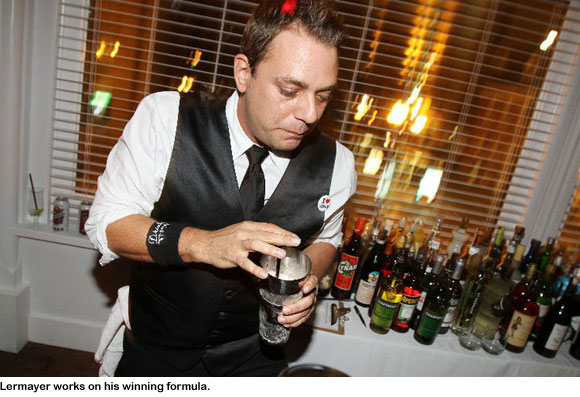
Meanwhile, John Lermayer, who leapt from head bartender at the Florida Room in Miami’s Delano Hotel to internationally acclaimed mixologist, is helming the booze program at Woodward, a “modern day tavern” in the Ames Hotel, which opens in the financial district November 19. Woodward’s PR says that Lermayer and William “English Bill” Codman (a longtime Boston bartender) are developing a “distinctive drinks menu featuring modern touches on beloved classics such as a Margarita infused with chamomile agave nectar and a Caipirinha with local apple cider and fresh rosemary.”
Neat.
OK, these are talented guys who no doubt can write an impressive cocktail menu. But, once they leave town, who (besides Codman at Woodward) will turn their recipes into drinkable drinks? That’s the million-dollar question (no exaggeration). We all know that a bad performance can turn Shakespeare into crap. Cocktail lists in certain places around town look good until you actually order from them. Take the Back Bay’s new Post 390. They serve Sazeracs! … in snifters … without a discernable trace of Peychaud’s bitters. Sigh.
But rather than be cynical, I’m going to view this as a potential bonanza for Boston bartending. So many openings for skilled practitioners all of a sudden — where will they come from? Will they be pilfered from other high-end bars like Drink, Eastern Standard, No. 9 Park and Craigie on Main? Or will ‘tenders who already man the planks at Boston’s finest hotels and steak houses gravitate to the Ames and the W to learn top-notch mixology? Should be interesting.
And think about it, aspiring bartenders: we’re still in the midst of the Great Recession, yet quality bars in Boston aren’t just booming, they’re proliferating. I mean, Legal Sea Foods is getting in on the game, for chrissake. Get yourself started as a bar back and look toward a rosy future — Boston imbibers need you!
Earlier this year, Nightclub & Bar magazine published an article I wrote on the resurgence of vintage cocktail books and the bartenders who love them called Tools of the Trade: Jiggers, Shakers and Out-of-Print Books. This was just after Mud Puddle books, the EUVS (Exposition Universelle des Vins et Spiriteux) and others became known for reissuing these obscure, old volumes, whose original editions had been selling for crazy money online. We have crossed over to a new world now — a world in which David Embury’s The Fine Art of Mixing Drinks and Harry Johnson’s Bartenders’ Manual and Guide for Hotels and Restaurants can be had for the price of a couple of cocktails, if not entirely free.
Much like I did with Boston-area bartenders a while back, I got in touch with a bunch of bartenders nationwide about their favorite old cocktail and bartending books, and whether they had ever spent big bucks on a must-have, brittle-paged tome of yore. Only tiny bits of their entertaining and thoughtful responses made it into the article. So, like any good blogger, I present here some outtakes, in no particular order, that didn’t make it into print. One thing that’s clear in both the print piece and the commentary below: everyone loves Charles Baker’s The Gentleman’s Companion, Vol. II (1939). But not for the recipes.
To be honest, my favorite cocktail books are old cookbooks. Back then they had to plan entire parties just from one book — all the way from pairing the wine with the meal, bottle service, table set-up, carving out blocks of ice for punches, and even how to take down a whole cow from the field to the table. With my background of cooking for about 10 years, it was fun to go back to these old books that I had for that, and find traces of punch recipes from [Jerry] Thomas himself. I say the Joy of Cooking, by Rombauer (1931).
Alex Day, Death + Company, New York
I should probably give you a general impression of how I feel about vintage cocktail books. I consider myself a professional bartender and am very passionate about what I do, but I’ve been eyeing the craze toward snatching up vintage cocktail books with a bit of skepticism. To me, the trend likens itself more toward the trappings of specific, hard-to-find antiques than it does to actually serving customers and expanding one’s craft.
And then there’s getting all sociological with this. American bartenders are constantly being told that our heritage and heyday lie in pre-Prohibition cocktails, and that the time between the Great Experiment and the recent classics revival has been marred by crap. We find ourselves looking back desperately to a time when the barman deserved the respect and admiration of his community and patrons, so I think there’s a real need to acquire these books to, in a way, legitimize what we’re doing with this revival.
For me, the absolute best vintage cocktail book in my collection is Charles H. Baker, Jr.’s The Gentleman’s Companion. Would I ever use a recipe from this book? No way. For me, the magic is in the writing and the story telling. What I have personally gotten from this book? A more relaxed approach to cocktails. An ethos that says: this is just cocktails. Sure, they’re damn good cocktails, but really, we’re here in this bar enjoying our lives, enjoying the people in our lives, enjoying the spirits in our glass, and enjoying the world.
Joaquin Simo, Death + Company, New York
My favorite is probably Charles H. Baker Jr.’s Gentleman’s Companion and his South American Gentleman’s Companion. While there are certainly some diamonds in the rough to be found recipe-wise, the real pleasure of reading those books lies in his inimitable prose. He drank with the best writers of his time and was surely their equal behind a typewriter as well as behind the stick.
Josey Packard, Drink, Boston
[While working for the Alembic bar in San Francisco], I looked on web sites that specialize in antiquarian books for Thomas’s How to Mix Drinks and found that at that time the first and second editions were going for around $1000. But one search — on half.com of all places — showed that among the slew of recently published ones for around $15, there was a seller listing one at $200. He mentioned some cover wear and pencil marks, and I just had a feeling about it — that he had an old one and had misunderstood how to list it properly. What came was the 1876 second edition, with some worm damage on the spine but otherwise in excellent shape. I held it and held it and held it, and ultimately sold it to Alembic for the purchase price, as my overdeveloped sense of morality told me that because I was searching on Alembic’s behalf at the time they should get it. I still feel ambivalent about it, though it is a real centerpiece of their library and is a real feather in their cap.
As pedestrian as it sounds, I keep coming back to the Savoy Cocktail Book (1930). Its completeness is unparalleled, though I almost never use the recipes as they don’t tend to be delicious as listed. The most beautiful book I own is Still Life With Bottle: Whisky According to Ralph Steadman (1997). The most useful book, being the book that taught me what I knew nothing about, is Folk Wines, Cordials, and Brandies by M. A. Jagendorf (1963). The most unusual, yet useful, cocktail history book I have is Convivial Dickens by Edward Hewett and W. F. Axton (1983), in which all of the instances in which Dickens mentions or describes drinking in his fiction are extrapolated and explained, with modern equivalents for recipe experimentation. If a person is to have one cocktail book, and only one, I’d pick Joy of Mixology (2003). The graph section is the most useful innovation I’ve yet seen in helping people understand how drinks are related.
[After Baker], the second book I pick up more than just about any other is not neccessarily vintage, but certainly rare and very much out of print. That book is called Cocktail: The Drinks Bible for the 21st Century, by Paul Harrington. This may very well be the most influential writing for me, as Harrington’s philosophies about cocktails most closely reflect my own. I know it’s only about 10 years old, but it’s quite rare and very much prized, especially among bartenders.
I haven’t spent a great amount of money on any one book — I’m too much of a bargain hunter to put up with that. I’m also a total douchebag, so I like to scour the mom-and-pop used bookstores in small towns around Oregon, picking up gems for a song while they’re none the wiser. At least I never sell them for a profit. I did get into an all-out bidding war for an early edition of The Old Waldorf-Astoria Bar Book many years ago and can’t help but think that other person is now one of my friends, Paul Clarke or something.
Marcos Tello, The Edison, The Varnish, L.A.
I actually have three favorites: Bartender’s Guide by Trader Vic (1947) — the recipes in this book are very similar to the modern breakdown of “classic” cocktails that many use today; Bottoms Up by Ted Saucier (1951) — there are a lot of great cocktails in this book, especially cocktails that originated from California; and the lesser known Home Made Beverages by Albert Hoskins (1891) — this book is a complete encyclopedia of syrups, phosphates, bitters, etc.
Kirk Estopinal, Cure, New Orleans
Charles Baker’s Gentleman’s Companion series. I know everyone loves this one, but as a read it really brings you into a high-minded, romantic setting of drinking in the days of old. Verbose as Zelda Fitzgerald and humorous as the small fraction of good stand-up comedy. The needle in the haystack of cocktail guides.
Partick Gavin Duffy’s Official Mixers Manual (1934). The intro itself is enough to make me love this book: “Bartending is an honorable trade. It is not a profession, and I have no sympathy with those who try to make it anything but what it was. The idea of calling a bartender a professor or a mixologist is nonsense.” YIKES! This guy is pissed off at someone. The recipes are fantastic, though — actually functional, unlike some other classic “guides.” Cool glassware diagrams as well as all drinks coded with their corresponding glass. I bet Wondrich likes this guy.
Esquire’s Handbook for Hosts (1949). Hundreds of recipes that mostly work. Serves as connective tissue for someone looking for the lineage of classics. The illustrations are a plus. And the overall idea that this is a guide to throw parties, down to tone of voice and what not to say in mixed company. Civility with a little sexism — a look back into the mindset of old.
I have a number of favorite cocktail books, though some of my faves have changed over time. Generally there is a specific characteristic of each beloved tome that hoists it up on my dais.
For the shear joy of recapturing a past era’s less-traveled wonder at far away places with their strange-sounding names, I think all drink nerds will point definitively at Chas. Baker. It is mixology-as-literature, just as Hemingway is literature-as-mixology. I seldom make drinks from it — it is very uneven in that regard — but as a sip inducer, it sets the mood like no other.
For inspiration courtesy of the best layout any cocktail book ever had, I go with an obscure little book named The How and the When by Hyman Gale, a bar guide first published in Chicago in 1937. Contrary to conventional wisdom, this is no wonderland of graphical grace like Harry Craddock’s Savoy Cocktail Book, or a gilt-edged beauty like Cocktail Fashions of 1936. It is printed on semi-gloss coated stock, with black ink, devoid of any decoration. What makes this book such an unduplicated joy to use are the concise two columns of recipes in simple type on each page. No hyperbole, no flourishes, just a drink’s title in one font larger, and a clear, easy to read recipe in smaller simple serif type below it. This is a book to ponder recipes in. They may have been published elsewhere first, but this is my favorite wellspring for their rediscovery.
I’ve been at the forgotten cocktail game for a long time. As such, my go-to sources for unrevived cocktails change over time. Currently, I have three. One is nearing the end of its reign at the top, one is front and center, and one has only begun to be tapped. In that order, they are: Barflies & Cocktails by Harry McElhone (where I lavish my attention on the section of drinks about town by Arthur Moss). The next is the Waldorf Bar Book by Albert Stevens Crockett. Here you get a half-book narrative of old New York, and half recipes. Of those recipes, a vast number would today be considered variations (minute variations) on the classic Martini. Gin, vermouth (or none,) bitters (or none), where the entirety of the differentiation is in proportion, brand, type and, of course, name. These recipes, frankly, make this a hard book to browse with much enthusiasm, but the great secret is that, excluding those recipes, many of the rest are strictly uncommon and startlingly good. And the newcomer in this category is… Modern American Drinks by George Kappeler. To taste the 19th century, this is where I am beginning to turn. Of the books I cite, this one, from 1895, is the oldest yet.
Yet, there is one older… my final fave. The vastly-titled New Guide for the Hotel, Bar, Restaurant, Butler & Chef by “Bacchus & Cordon Bleu” wins my quirkiest oddball drink book award. I’ll assert it is also the progenitor of that category. You see, not only does one make drinks from the recipes in this 1885 book, one makes the liqueurs — potions, really — that go into those drinks. No drink guide has ever been so arcane. So if you fancy a beverage prepared with Liqueur Excelsior, or perhaps Liqueur Criterion, this is where you must turn.
Bartender profile
There’s young Kevin Martin, looking urbane behind the bar at Eastern Standard, placing a white napkin down for your appetizer and effortlessly shaking you a gin flip. Such a gentleman. Then he hands you your drink and, while making some pleasant small talk, suddenly grins the grin of a 10-year-old who just got away with a world-class prank. That’s when you picture him wearing a grass skirt and slinging blender drinks at Cheeseburger in Paradise on Maui. Or at least now you will.
Yes, Martin spent his formative years in the business as a “blender ‘tender,” serving tourists (and a few celebs) frozen daiquiris on the beach in Hawaii, being a surf bum and generally having a blast after graduating from the Culinary Institute of America. Though trained as a cook, it didn’t take him long to realize he didn’t want to work in a “hot, muggy, windowless box.” So, he donned the grass skirt and quickly learned a thing or two about speedy drink service, which came in handy when he returned to New England and started working around the corner from Fenway Park.
Why did he leave paradise? It was time to put his education to use, he says, and to “learn the finer points of service and hospitality.” Not to mention the fact that, bless his Connecticut Yankee heart, he loves Boston. Martin has, in just a short time, put his stamp on the already talented staff at ES, and is now advancing that tradition as a manager. But what else would you expect from a guy who had the only frozen-lemonade stand in his neighborhood and who catered his first wedding at 16? Experience, confidence and genuine politeness, all wrapped in a boyish smile. It’s hard not to be in a good mood around this guy.
Hometown
Glastonbury, CT.
First drink you ever had
My dad used to give me a sip of his Manhattan, followed by letting me fish out the maraschino cherry to eat.
Most touristy bar in Boston that you like
Does Fenway count? Nothing like a warm Miller Lite on a hot day.
The difference between bar-goers in Boston and bar-goers in Hawaii
When most people head to a bar, they are either looking for fun or to get something off their chest, no matter where you are. But the difference between Hawaiian drinkers and Boston drinkers is patience. This phenomenon of waving your hand or, worse, your credit card, in Boston must stop. It’s just rude. It’s the bartender’s job to know who needs a drink. Trust us, we know you’re there, we just told you we’d be right with you, and now you’re waving at another bartender. Stop it!!!
Your guiltiest-pleasure drink
Since the LUPEC girls outed me on this drink a few months back in a Boston publication, I’ll have to admit it’s a Miami Vice: half Piña Colada, half strawberry daiquiri. As a former blender ‘tender myself, I admit it’s a pain because it take two blenders to make it, but ooohhhh soooo gooood.
Best cocktail to introduce vodka drinkers to other spirits
If I don’t think that they’re going to be able to get away from the look of a “pink martini,” it would have to be a Jack Rose, but if I can get them into a Bees Knees with Miller’s Gin, I’d be stoked.
Describe the most insane Red Sox crowd you ever experienced
There’s nothing like opening day in Kenmore Square. You are five people deep from 9:00 a.m. to midnight, serving countless oysters and plates of calamari, with an occasional omelet, to people eating standing. The music is blaring, you’re slinging gallons and gallons of Bloody Marys and wishing that Bloody Mary mix could somehow come off the soda gun. Managing what seems like a million tabs. And then, of course, there’s dealing with people that wave, but for the most part Bostonians are in good spirits on this day and just want to feel the camaraderie of the city. It’s a great time!
A bartender’s best friend is…
Wine bottles with a screw top.
A bartender’s worst enemy is…
Mint fragments in a drink that weren’t meant to be there.
Best or worst pickup line you’ve ever witnessed
“Do you think if I flex hard enough I could rip my shirt?” Response: (laughter) “Nope.”
A famous person you’ve served
Since I worked in one of those bars that everyone knows about and wants to visit when you go to a tropical location, I’ve actually waited on numerous famous people: Pauly Shore, Cameron Diaz and Justin Timberlake, Jesse James and Sandra Bullock, Pete Carroll, Ming Tsai, Jimmy Fallon, Sean Greenhalgh, Rick Lyle and, of course, Peter Wolf.
Most beloved bartending book The Craft of the Cocktail [by Dale DeGroff], also the first cocktail booked I’ve ever owned.
It’s a bit of poetic justice that Patrick Sullivan, who started the cocktail revival in Boston when he opened the B-Side Lounge in 1998, is now bringing his storied training skills to the bar staff at the biggest high-end chain of seafood restaurants in the country, Legal Sea Foods. Imagine: a properly made, balanced cocktail with fresh-squeezed juice alongside your plate of oysters or grilled bluefish. This is huge.
Sullivan was recently interviewed by Grub Street Boston (what gives, Patrick?) about his new gig as Legal’s cocktail program manager. (Like that Bostonian nickname for this local institution? Check out MC Slim JB’s commentary about making restaurant names possessive.) This excerpt from one of Sullivan’s comments is especially encouraging: “…in the past, there’s been some sweetness to the Legal Sea Foods cocktail menu. What I’m trying to do is make everyone aware of the fact that our cocktails need to be well-balanced and on the dryer side. You’ll see a lot of fresh lemon juice and bitters, which dry things out.” Wow. Adult cocktails for the masses. I’ll drink to that.