Author Archive
December 22nd, 2007
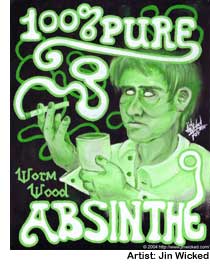 Unless you haven’t picked up a newspaper recently, you know that absinthe — the strong, licoricey liqueur with the naughty reputation — is once again legal in the U.S. after a long ban beginning in 1912.
All the articles I’ve read about the spirit and its newly legit status seemingly rummaged through the same musty steamer trunk full of anecdotes and phrases associated with the Green Fairy: the supposed hallucinogenic, madness-inducing effects; the Belle Epoque and its absinthe-drinking artists, particularly the troubled ear slicer Van Gogh; the Swiss man who sparked the ban of absinthe in Europe by murdering his family while drunk on absinthe in 1905; the word “louche,” which originally referred to the cloudiness that forms in the beverage during the ritual of dripping ice water slowly into the glass. All of the articles quote the chemist and absinthe historian Ted Breaux, who consulted on the creation of Lucid, the first absinthe on the American market. And they all employ that nonchalant tone newspapers use when reporting the latest craze over something controversial.
The story behind absinthe is indeed interesting, but, honestly, I felt like I’ve read the same article about seven times. Until I saw the one that Salon published this week: “Everything you know about absinthe is wrong.”
“Let’s clear up a few misconceptions,” says the writer, Sarah Hepola. “Absinthe does not make you hallucinate. It is not wildly addictive. It will not cause you to lop off your ear, unless (possibly, on the off-chance) you are a deeply disturbed painter racked by poverty, heartbreak and mental illness. Rather, absinthe is a good drink.” Strip away all the “lore and illegality,” she argues, and what you actually have is a damn fine, complex beverage that deserves a place in the world of legal spirits.
But the lore and the lingering whiff of illegality are, of course, precisely why people are lining up at bars to order absinthe and take part in its peculiar serving rituals, with their slotted spoons, sugar cubes and fancy ice water fountains. And they’re why the new absinthes on the market cost $60-$75 per bottle. Sure, distilling a good quality absinthe takes knowledge and skill. But that’s true of a lot of herb-based spirits — green Chartreuse comes to mind. Its strength is similar to that of absinthe, it has been rumored to have mind-altering properties, and its complex recipe requires the distiller to be meticulous. But at around $35-$40 per bottle, it seems a relative bargain.
Jared Gurfein, president of Viridian Spirits, which produces Lucid, says in the Salon article, “We’ve sold thousands more cases than expected. There is a huge interest in absinthe. Unbelievable.”
Cashing in on hype over a product, whether that product is good or bad, is nothing new. But I would say to today’s absinthe drinker: if you don’t realize that hype is what you’re paying good money for, you must be hallucinating.
Posted in Absinthe, Booze in the news, Liqueur | 5 Comments »
December 19th, 2007
 So, Scott and I are at Sav-Mor Liquors on McGrath Highway in Somerville the other day, buying what we usually buy at this seedily lit booze warehouse — a hodgepodge of 2-for-$12 wines, cheap-ass beer in cans and a good microbrew (which, this time of year, tends to be Sierra Nevada Celebration Ale) — when the indifferent sales clerk throws a little booklet into our bag of merchandise.
Now, Sav-Mor is the kind of place that sells economy-sized jugs of Mudslide Mix on the low end and Chivas holiday gift sets on the high end, so when I get home and start to flip through the booklet, called the Guide to Good Hosting 2008, I’m expecting page after page of “martini” recipes like Lingonberry Allspice Cosmos or some such Martha Stewart-y thing.
Instead, I land on page 7 to find the Whiz Bang:
1 1/2 oz Johnnie Walker Red Label
1/2 Noilly Prat dry vermouth
2 dashes grenadine
1 dash Lucid absinthe or, if not available, use Pernod or Herbsaint
2 dashes Gary Regan’s Orange Bitters No. 6
Shake ingredients with ice and strain into a chilled martini glass.
Um… WHA?! A cocktail calling for not only scotch, but dry vermouth, orange bitters and absinthe “or, if not available, use Pernod or Herbsaint”?! Wondering if this throwaway little pamphlet was written in magic ink that somehow gleaned my drinking preferences, I read on. There were recipes for a Vesper, a Gin Sling and a Honeymoon Cocktail (1 1/2 oz Laird’s Apple Jack, 1/4 oz Benedictine, 3/4 ounce Hiram Walker Orange Curacao, 1/2 oz fresh lemon juice), among other respectable drinks. And not only were many of the called-for ingredients of some quality (Luxardo Maraschino liqueur anyone?), the following tips appeared in a section called “Home bartending – become a great mixologist at home”:
“Serve your cocktails icy cold. The colder the better.”
“Use only fresh fruit whenever possible.”
“When the ingredients are clear liquids, STIR for proper mixing.”
Whoa. Any novice who comes across this booklet and actually follows its recipes and advice stands the chance of making a decent cocktail for his holiday gathering — and thus exposing his friends and family to the concept of a well-crafted drink intended for adults. The Guide to Good Hosting 2008 is a Christmas Miracle for the Cocktail Revolution.
Turns out the Guide is put out by the Beverage Media Group, the longtime publisher of liquor-industry journals whose writers include people like Dale “King Cocktail” DeGroff. DeGroff, of course, is one of the leading lights of mixology and a founder of the Museum of the American Cocktail. Even if he wasn’t directly involved in producing the Guide, his influence is all over it. Now, if only the retailers who hand these booklets out — hello, Sav-Mor — would actually sell the ingredients in the recipes … Luxardo Maraschino, Regan’s Orange Bitters … hell, rye whiskey would be a good start. I’ll have to wait ’til next year for that miracle.
Posted in Books & resources, Cocktails | 17 Comments »
December 13th, 2007
 “Last Call,” a recent Boston Globe article by Robert David Sullivan, lamented the demise of gay bars — and of their influence on urban life — in Boston. As usually happens the minute people get misty-eyed over the passing of a cultural phenomenon, a reincarnation of sorts is bubbling up right under the noses of the bereaved. Yes, the South End may have less of a gay vibe these days, but that doesn’t mean all the gay people have left Boston. They’re here, and they’re still meeting up in bars. They’re just not limiting themselves to gay bars. Some of them are waging what you might call guerrilla barfare.
Josh Gerber, an Asheville, NC, native in his late 20s, co-founded Guerrilla Queer Bar – Boston edition with his friend Daniel Heller. The idea, which started in San Francisco in 2000, is simple: a large group of gay men and women gather once a month at a “straight” bar to have a little fun by a) skewing the demographic a bit and b) doing what everyone else does when they go to bars — hanging out and ordering drinks. There are no protests or parades. Just several dozen people creating their own gay bar within a bar. As the founders of Guerrilla Queer Bar in Washington D.C. said of that group’s infiltrations, “We don’t look at it so much as a takeover as a … blending.”
Gerber, who runs Cambridge’s two 1369 Coffee Houses, intrigued me when he first told me about Guerrilla Queer Bar a few months ago. He intrigued me again when he told me that, on only its third meetup, the group attracted 120 people to the Hong Kong in Harvard Square. “I think we pretty effectively took over the bar,” he said. Clearly, GQB-Boston is onto something. I wanted details, so I arranged a Q & A with Gerber over cocktails at one of his, and my, favorite bars, Green Street.
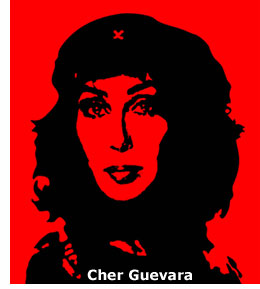
Drinkboston: Is Cher Guevara a symbol for the other Guerrilla Queer Bar groups?
Josh Gerber: No. I can’t say it’s entirely original, though. We were trying to come up with something that represented guerrilla-ness and gay-ness at the same time. We thought we had invented something really exciting. Then we Googled it and found it. So it already existed but had never been associated with the Guerrilla Queer Bar concept before us using it as our brand. It was originally, in the ’80s, a cover for a rock magazine in England. We basically stole the image, in true guerrilla form.
DB: Explain the concept of Guerrilla Queer Bar.
JG: It sounds more subversive than it’s intended. The idea is to organize a large group of gay people and bring them to bars they don’t normally go to and that don’t normally experience large groups of gay people. And, you know, we like to shake things up in a few bars and see those places maybe … slightly uncomfortable. We want people to look around and say, ‘Oh, what’s going on?’ But we don’t want people to think we’re against them or that there’s any sort of negative connotation on our part. Our entire goal is to go out and have fun with a bunch of fellow gays in a straight bar.
DB: Are you trying to make a statement, but a somewhat cheeky, innocuous statement?
JG: Yeah, we’re trying to make a statement, but more than anything, we’re just trying to have fun. We want to meet in bars that are pretty stereotypically hetero, or that aren’t accustomed to a gay crowd — like Match, for instance [a “burger and martini bar” in the Back Bay].
DB: How did that go?
JG: It didn’t go as well as our first event [at the People’s Republic in Cambridge], but we had a similar turnout, between 50 and 60 people. It was really, really crowded, and the bar was understaffed. It took 20 minutes to get drinks. Plus, the bar’s terrible. We kind of want to go to terrible bars sometimes, but god. It’s an interesting thing for us, trying to figure out which bars to go to. We want to be in a place where we’re able to have an impact. If we’re 60 people in a bar that seats 600, then so what, who cares? But when there are 60 people in the People’s Republic, it’s like, ‘Oh my god, what’s going on?’ That was our first one, which was very fitting, given that they have a poster of Che over the door. It’s the whole Commie theme. It was funny, though, because it was a Red Sox night, and most of the straight people in the bar were completely oblivious because they were staring at the game.
DB: Is the demographic of the group mostly guys in their 20s and 30s?
JG: It’s 20s-30s coed. This is actually something I’m really excited about, that we’re about 50-50 gay and lesbian. In the gay bar scene, and in the bar scene in general, gays and lesbians don’t mix. Gays and lesbians at the same time have everything in common and absolutely nothing in common. The bar scene tends to focus on the “nothing in common.” It’s been really cool to mix them in this event. The other thing that I’ve found that has been really exciting is the fact that everyone’s part of something that nobody else in the bar is a part of. The “otherness” of it all makes everyone want to talk to each other and hang out. Which is different from going to any traditional bar unless you’re the ultra-outgoing type.
 DB: I’ve heard that gay men are doing this because 1) they’re tired of the “ghettoized” gay bar scene and 2) they can socialize in Querrilla Queer Bar groups in ways that are not possible at gay bars, where the vibe can be hyper-sexualized. Can you comment on that?
JG: I’m not a huge fan of the gay bar scene in Boston or even gay bars in general, primarily because they tend to be gay first and bars second. So, what you often wind up with is mediocre bars — with mediocre service and mediocre drinks — that are really busy because they’re gay. I don’t identify as gay first. I identify as, you know, outdoorsy, and I identify as interested in local foods and community … I have a lot of interests. And gay is somewhere on that list, and it’s relatively high, but if someone were to approach me and say, “Who are you?” “Gay” would not be my first word. And I feel like, if you approach those bars and say “Who are you?” “Gay” is the first word. That’s not where I want to hang out. That’s not to say that gay bars don’t have their place or shouldn’t be there. I think they’re a great thing in that they enable gay men to be in a place that’s comfortable. But as for me, I want to both be comfortable and be in a bar that I like and not feel like I’m gay first.
DB: Given what you just said — and it seems there are other people, especially in the younger generation, who feel the way you do about the gay bar scene — do you think gay bars will even exist in 20 years? Or will gay bars at least change the way they operate?
JG: I think gay bars will absolutely exist in 20 years. Being a gay person, meeting other gay people is not easy unless you’re involved in a gay scene, and the way for a gay scene to exist is through … bars. Every other bar besides a gay bar — and this is part of the reason we’re doing this — is hetero-normative. There’s an assumption made that everyone in there is straight. While I wish that assumption wasn’t there, of course it’s there. The vast majority of people are straight. So, it’s a reasonable assumption. But it sucks to be gay in a hetero-normative place, so you have to create alternative spaces in which that assumption doesn’t exist or where people can make the [assumption that gay people are also in the mix].
If it’s the case that 10 percent of the population is gay, we can stand for a lot more than four gay bars in Boston. Ten percent of the bars aren’t gay. If that were the case, there’d be some competition. There’d be what has happened in the rest of the bar world, which is that it’s important for any establishment to make themselves stand out. Right now, the problem with gay bars is that they don’t have to stand out. Just by being gay, they’re able to attract a crowd, and they don’t have to try that hard. Why bother caring about drinks? Why bother making it a really nice space? Why bother investing in the place when you can just be gay, and that’ll do it?
DB: What if more straight people went to gay bars? I mean, my boyfriend and I have been to gay bars where we’ve felt totally comfortable, and we’ve been to gay bars where we’ve felt we shouldn’t be there.
JG: I would love it. If I owned a gay bar, I wouldn’t want it to, out of my control, suddenly become a “straight” bar. But I would love it if straight people came to the bar. I mean, the more that there’s mixture, and the more that there’s mutual embracing of each other’s scenes, the less weird it’ll be. The thing that’s interesting about Guerrilla Queer Bar is that bars generally love it. I mean, 60 people showing up is like, it’s great business — especially if the people are drinking. So, it’s a simple concept, but I’m really excited about it. Do you have any suggestions for the next bar?
Posted in Boston bars | 4 Comments »
December 9th, 2007
 I tend to be skeptical of trendy new drink menus, especially those at trendy new restaurants that are obviously cashing in on a popular concept. In this case, I’m talking about the drink menu at Mooo, which joins KO Prime as Boston’s latest postmodern steak house. These aren’t your grandfather’s steak houses, with their dark, gentleman’s club decor. These are steak houses for today’s stylish man or woman susceptible to sleek, wink-wink design, like blurred photos of calves on the wall above your meat-laden table, and ornate chandeliers ‘clothed’ in cylinders of parchment. Mooo, which replaced the Federalist in the XV Beacon Hotel, is the latest ultra-high-end offering from celebrity chef Jamie Mammano of Mistral and Sorellina.
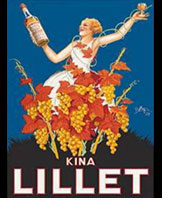
Luckily, there is a drink at Mooo that hits the right note of wit and taste without trying too hard, and that is the Lady’s Martini: Lillet Blanc, fresh lemon juice and hibiscus syrup, chilled and served straight up with a champagne chaser. I don’t know why it’s called the Lady’s Martini — maybe because it’s pink and relatively low in alcohol. It also happens to be gorgeous and delicious. Mooo serves the “martini” in a delicate, vintage-looking cocktail glass and the champagne chaser in a stemless flute, an aesthetic combination that makes you feel sophisticated just by sitting in front of it. But that’s not what we’re about, is it? We’re about flavor. And this cocktail has a layered, sweet-tartness that would satisfy even without the champagne. But when you put the bubbles on top of this little flavor lozenge, you suddenly feel like you’re wearing white gloves and smart hat.
All you men out there who appreciate a good cocktail: I urge you to be secure enough in your masculinity to give the Lady’s Martini ($13) a try. Or at least have your date order it, and taste hers.
Posted in Champagne, Cocktails, Vermouth | No Comments »
December 5th, 2007
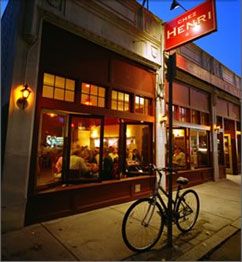
Established: 1994
Specialty: Wine, cocktails
Prices: Moderate to high
Atmosphere: Warmly lit Cambridge nook with noted French-Cuban cuisine, stellar wines by the glass and a short but sweet cocktail menu, all doled out by a single hardworking, competent bartender.
See Best Boston bars for address and contact info.
This is what happens whenever I get near Chez Henri: the cheery red window frames catch my eye, and I peer inside to gauge the seating prospects at the narrow, cozy bar filled with contented Cantabrigians eating Cuban sandwiches. Even if there’s a crowd, I can’t help myself — I go in and wait patiently for a barstool.
Chez Henri has two distinct clienteles: the one that fills the dining room to feast on Chef Paul O’Connell’s nationally recognized French-Cuban cuisine, and the one that flocks to the bar that introduced Mojitos and Cuban sandwiches to greater Boston. O’Connell himself notes that there is a clear demarcation between the “bar people and the dining room people.” He once thought about expanding the bar area but decided, probably correctly, that its small size had a lot to do with its charm. Plus, the architecture of the previous occupant wasn’t to be messed with. A restaurant called Chez Jean operated here for 35 years prior to Chez Henri. “I felt like a caretaker when I took over the space,” explains O’Connell, who kept the “Chez” and added the “Henri,” for his son.
One thing about O’Connell, he knows how to pick his bartenders. Some of Boston’s best — Joe McGuirk, Dylan Black, Scott Holliday — have put in time here and helped coin the standard summation of what it’s like to run the show on this cute, cozy little stage: ‘This bar will break you.’ Between pounding mint leaves into battalions of Mojito glasses, serving two different menus (restaurant and bar), recommending wines and tending to additional customers at the back bar and at a handful of tables, it takes hustle to succeed here. The latest team, Ari Barbanel and Rob Kraemer, takes turns holding down the fort, with Kraemer carrying on an unofficial tradition of classic cocktail-inspired mixology. From day one, O’Connell has eschewed “flavored vodka drinks” for rum-based classics like the Periodista (dark rum, fresh lime, apricot liqueur and dash of orange liqueur) and bartender creations like Kraemer’s Shiver. And at $7 each, these cocktails are some of the cheapest in Cambridge.
Did I mention it gets crowded in here? And that sometimes the crowd skews a bit much toward gray-ponytailed professor types? Don’t worry, such annoyances melt away as soon as you secure a seat at the bar.
Posted in Boston bars | No Comments »