Archive for the ‘Rum’ Category
May 15th, 2011
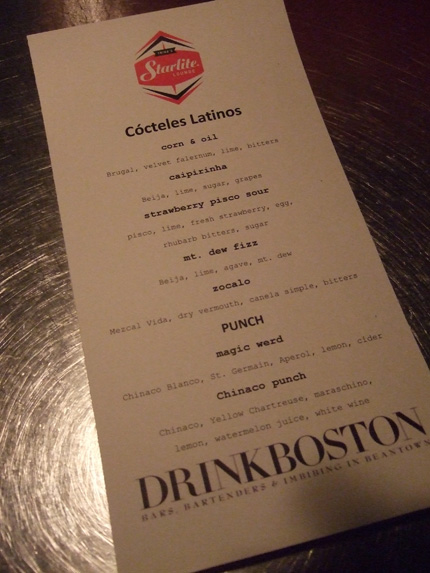
Muchas gracias to everyone who turned up at last Sunday’s Cócteles Latinos! party at Trina’s Starlite Lounge. The drinks, the food, the music and the vibe were all tops. It’s not every day that you can sip on a Mountain Dew Fizz (made with Beija Cachaca) while nibbling on Peruvian potato salad and pulled-pork tortillas, listening to X and the Reverend Horton Heat (thanks, DJ Dave Cagle), and basking in a complete takeover of the Starlite’s main bar. Thanks to Beau and Trina Sturm for hosting this shindig with drinkboston, and to guest bartenders Ben Sandrof and Misty Kalkofen for their dream-team antics. Below, enjoy the party photos and the recipes — just in time for your summer drinking needs — that Beau, Ben and Misty dreamed up for the occasion. Salud!
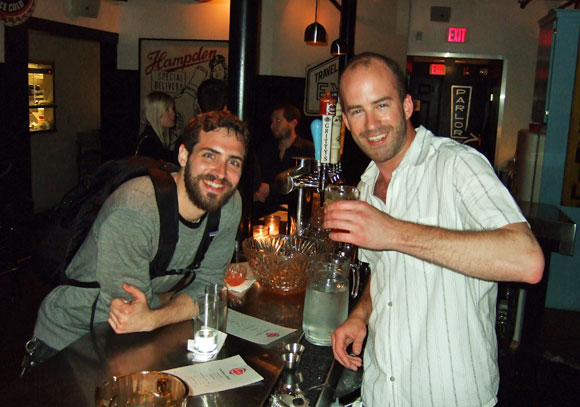
Green Street bartender George Theodore Jenich and Ben Sandrof
Chinaco Punch
2 oz Chinaco Plata tequila
3/4 oz Yellow Chartreuse
1/4 oz Luxardo Maraschino
1/2 oz lemon juice
1 1/2 oz watermelon juice
1 oz vinho verde
Combine all ingredients and serve in a rocks glass over a large ice cube or two. Scale up for a big punch bowl with a big chunk of ice in the middle.
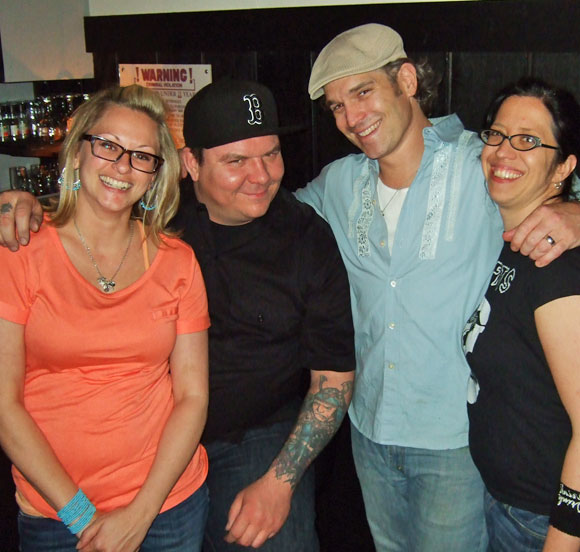
Trina Sturm, Dave Cagle, Beau Sturm and Misty Kalkofen
Corn & Oil
1 1/2 oz. Brugal Anejo rum
3/4 oz Velvet Falernum
1/2 oz lime juice
Shake ingredients briefly over ice, then strain into glass with crushed ice. Top with several dashes Angostura bitters.
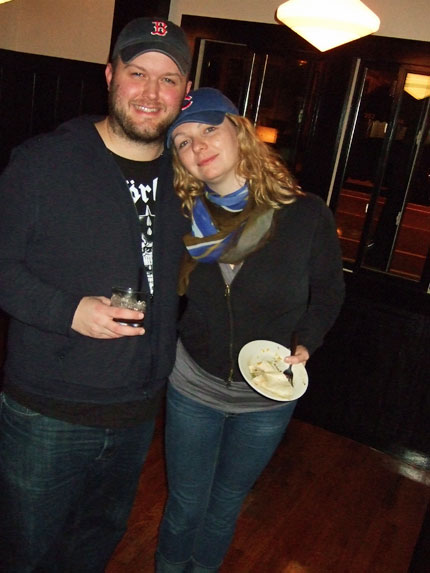
Phillip Naslund of Local 149 and friend Sarah
Magic Word
2 oz Chinaco Plata tequila
3/4 oz St Germain Elderflower Liqueur
1/2 oz Aperol
1/2 oz lemon juice
1 1/2 oz hard cider
Combine all ingredients and serve in a rocks glass over a large ice cube or two. Scale up for a big punch bowl with a big chunk of ice in the middle.

Lillian Milagros Carrasquillo, Jonathan O'Toole, Kim Boutwell and Sean Frederick
Mountain Dew Fizz
2 oz Beija Cachaca
1 1/2 oz Mountain Dew
1/2 oz lime juice
1/4 oz agave syrup
1 egg white
Dry shake all ingredients except Mountain Dew. Add ice and Mountain Dew and shake very well until egg white froths. Strain into highball glass.
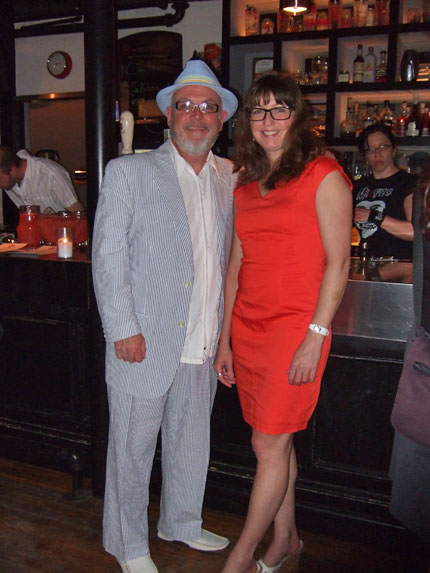
Brother Cleve with Lauren Clark of drinkboston
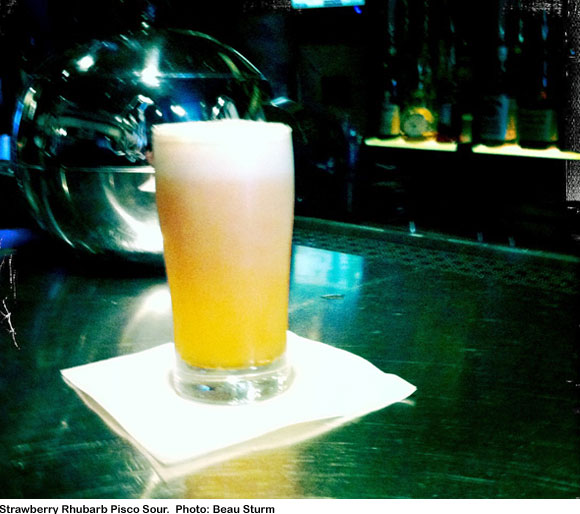
Strawberry Rhubarb Pisco Sour
2 oz Macchu Pisco
1 egg white
1 oz fresh strawberry syrup*
1/2 oz simple syrup
1/2 oz lime juice
Rhubarb bitters
Dry shake all ingredients except rhubarb bitters. Add ice and shake very well until egg white froths. Strain into highball glass and top with rhubarb bitters. *Strawberry syrup: puree fresh strawberries and pass through a chinois. Mix liquid 1:1 with white sugar until sugar dissolves.

Los cocteleros: Noah and Elizabeth
Zocalo
2 oz Del Maguey Vida mezcal
1/2 oz dry vermouth
1/2 oz canela (cinnamon) simple syrup
2 dashes Angostura orange bitters
Lemon oil garnish
Combine first four ingredients in mixing glass filled with ice and stir very well. Strain into chilled martini or rocks glass and twist lemon peel over the top.
Tags: cachaca, mezcal, summer cocktails, Trina's Starlite Lounge
Posted in Cocktails, Events, Pisco, Punch, Rum, Tequila | No Comments »
April 30th, 2011
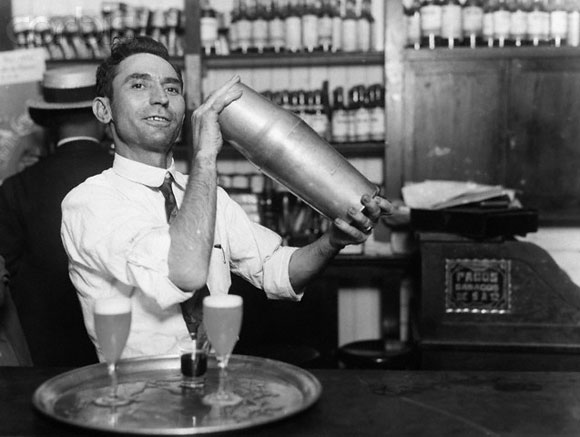
On May 8, drinkboston and Trina’s Starlite Lounge are throwing a party, Cócteles Latinos!, featuring cocktails (see below) made with Latin American spirits: rum, tequila, mezcal, cachaca, pisco and perhaps the odd Mayan liqueur. Salud!
Besides Mother’s Day and the beginning of World Cocktail Week, we’re celebrating drinkboston’s 5th birthday. Boston’s First Couple of bartending, Beau and Trina Sturm, will be our hosts, and special guests Ben Sandrof and Misty Kalkofen will get behind the stick. Deep Ellum’s Dave Cagle will spin party tunes, and Starlite chef Suzi Maitland and her crew will put out the Latin American treats.
Cocktail menu will feature both old-school and new-school libations, TBD. Thanks a million to our sponsors: Brugal rum, Chinaco tequila, Del Maguey Vida mezcal and Macchu Pisco.
- Cócteles Latinos! Hosted by drinkboston and Trina’s Starlite Lounge (3 Beacon St., Somerville)
- Sunday, May 8 (yes, Mother’s Day — bring mom!)
- 7:00 p.m. until last call
- Tickets are $40 and include three cocktails and Latin American snax.
- Call the Starlite at 617-576-0006 to purchase your ticket in advance, as there’s a good chance we’ll sell out quickly.
Put on your best Old Havana nightclub threads and come on by. See you there!
THE COCKTAILS
(Exact recipes will be published after the event.)
Zocalo
Del Maguey Vida Mezcal
Dry vermouth
Canela simple syrup
Angostura bitters
Lemon oil
Chinaco Punch
Chinaco Plata Tequila
Yellow Chartreuse
Luxardo Maraschino
Lemon juice
Watermelon juice
Vino verde
Magic Word
Chinaco Plata Tequila
St Germain
Aperol
Lemon juice
Hard cider
Corn & Oil
Brugal Anejo Rum
Velvet Falernum
Lime juice
Angostura bitters
Strawberry Rhubarb Pisco Sour
Macchu Pisco
Egg white
Lime juice
Fresh strawberry syrup
Rhubarb bitters
Mountain Dew Fizz
Cachaca
Mountain Dew
Lime juice
Agave syrup
Egg white
PLUS: Classic Mojitos & Green Grape Caipirinhas
Posted in Cocktails, Events, Pisco, Rum, Tequila | No Comments »
August 27th, 2010
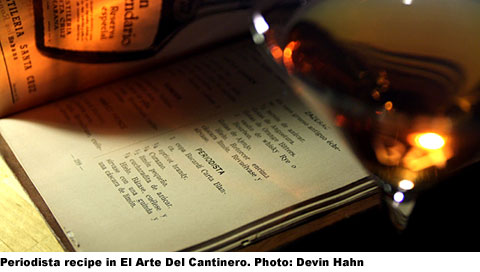
Watch out when making off-hand remarks around Devin Hahn, author of the blog Periodista Tales. He will record everything you say. Then publish it. The thing is, you’ll be (mostly) thankful he did.
Hahn began writing the engaging, real-time narrative of his quest to find the origins of the Periodista — a drink found on multiple cocktail menus in Boston but apparently unknown in other cities — a mere few months ago. And already, the description of the Periodista on the menu at Eastern Standard pays homage to him. Already, cocktail historians around the country know about him.
In his most recent installment, he describes a sit-down we had at the Franklin Cafe to talk about this apparently Cuban cocktail (of which he now knows more than probably anyone alive) and other matters of the Boston drink scene.
If you dig cocktail history and haven’t checked out Hahn’s blog yet, I suggest you start from the beginning.
Tags: Cuba, Devin Hahn, Periodista
Posted in Books & resources, Cocktails, drinkboston in the news, Rum | No Comments »
August 12th, 2010
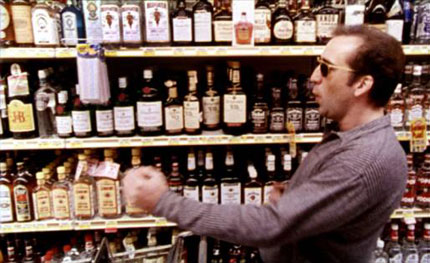
A friendly reminder that this coming tax-free weekend doesn’t just apply to TVs, leather armchairs and solid-wood shellcases for your iPad. It also applies to booze. Have your eye on a bottle of green Chartreuse VEP ($130)? Strathisla 1967 Speyside scotch whisky ($175)? Remy Martin Cognac Louis XIII Grande ($1700)? Well, grab your shopping cart and boogie down the aisle of one of these fine establishments.
» Boston wins. Damned if Boston didn’t hit it out of the park during Tales of the Cocktail in July. First of all, more Boston bar industry folk represented our city at New Orleans’ annual drinks convention than ever before. Second of all, Drink won the Grand Marnier-sponsored Barroom Brawl, besting five other top-notch cocktail bars from around the U.S. and earning the title Best Bar in America. Third of all, Drink’s Misty Kalkofen won the Pisco Sour Pentathalon and will in the near future enjoy her prize: a trip to Peru to see how desert-grown grapes turn into white brandy. Congrats to all! Liza Weisstuch offers a vivid snapshot of the competition and, more generally, the Boston slant on Tales in today’s Phoenix. Good stuff.
» Remixology. Speaking of contests, there’s a new bar celeb in town: John Mayer of Cambridge’s Craigie on Main. A relatively new member of the staff there, he wowed everyone at the Appleton Estate Rum Remixology contest earlier this week with his mixing skills, sense of humor and ability to explain how a favorite song inspired a new cocktail. His presentation involved Frankie Valli’s “Sherry Baby,” a powder-blue brocade blazer, three mixing glasses spinning on a turntable, a small disco ball, a history lesson on Jamaica’s first prime minister — Alexander Bustamante — and the year 1962. He will compete in the national finals of the competition in NYC on August 30. Go, John! Here are recipes for the Bustamante and the other semi-finalists’ tasty drinks.
» Literature. Geoff “Psycho-Gourmet” Nicholson’s fantastic essay, Drink What You Know, appeared in the New York Times’ Book Review recently. He starts by comparing the advice writers dispense about drinking to the way they depict drinking in their literature, and arrives at his thesis:
“When you think about it, rules for drinking are not so different from rules for writing. Many of these are so familiar they’ve become truisms: Write what you know. Write every day. Never use a strange, fancy word when a simple one will do. Always finish the day’s writing when you could still do more. With a little adaptation these rules apply just as well for drinking. Drink what you know, drink regularly rather than in binges, avoid needlessly exotic booze, and leave the table while you can still stand.”
Read it. And then check out the response over at Jezebel: the Reader’s Drinking Game.
» History. I was putting off going to Plymouth to learn about Pilgrims until my retirement years, but now I have a reason to go earlier. Pilgrim Hall Museum (“America’s museum of Pilgrim possessions”) is running an exhibition called “Plymouth History in a Glass: The Artifacts and Culture of Beverages and Drinking” until December 31. Silver tankards. Ceramic punch bowls. Glass tumblers. Ooh, I’m getting hot flashes. Not only that, there are two related lectures: one on historic Plymouth-area taverns on August 25 and one on September 29 called “The Design of Drinking: from the Jazz Age to the Space Age.” Far out.
» Name that bar. What would you call a bar frequented by venture capitalists, entrepreneurs and hardworking graduate students from all over the world who converge on the high-tech cluster that is Kendall Square, Cambridge? The people behind the in-the-works “Venture Cafe” are seeking a more clever name than the working title for their “place-based social networking” project. They have partnered with restaurateur Gary Strack from Central Kitchen and the Enormous Room and are scouting Kendall Square locations for a 2011 opening. With any luck the place will liven up the woefully nightlife-less neighborhood. Got a suggestion for what to call the place? Chime in on their Facebook page.
Tags: Bustamante, Craigie on Main, Drink, history, John Mayer, Kendall Square, literature, Plymouth, Tales of the Cocktail, tax-free weekend
Posted in Bartenders, Booze in the news, Cocktails, New Orleans, Nips, Pisco, Rum | 1 Comment »
July 14th, 2010
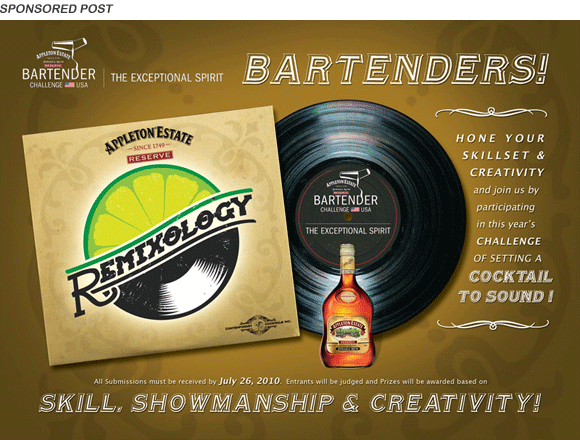
Boston bar professionals, think of a song that really grabs you — one that makes you want to jump up on a table and sing into an empty beer bottle, or slow-ride in a convertible down Mass Ave., or grab a dark-haired stranger in a Buenos Aires cafe and do the tango. Translate that song into a cocktail with Appleton Estate Reserve Jamaica Rum. Submit your recipe and the tale of its musical inspiration by July 26. Why? You could win a trip to Jamaica — and global renown.
There are cocktail contests that are about chops and style, and there are cocktail contests that are about mixology and heritage. Then there’s Remixology. The brainchild of former Boston bartender Willy Shine and his consulting company, Contemporary Cocktails, Remixology mashes both traditions together — to the tune of your favorite song and featuring a quality rum. Here’s how it goes:
- Once all submissions are entered by July 26, 15 contestants will be chosen and featured on the Appleton Reserve Mixology Challenge and Contemporary Cocktails websites and in press materials.
- Five of the 15 will be selected to compete in August at Drink. This will involve “performing” your cocktail to the tune that inspired it, as well as mixing a second cocktail that is locally inspired (“No Charles River ice,” warns Willy.) Yes, you can sing and dance — but you don’t have to. Get creative. We’re not talking Tom Cruise or Coyote Ugly — you’re cooler than that.
- The top Boston finisher moves on to the finals in Manhattan August 30-31 to show bartenders from the other competing cities — NYC, Miami and San Francisco — who’s boss.
- The winner of the finals wins a red-carpet, all-expenses-paid trip to Jamaica in October to participate in the Global Showcase with bartenders from nine other countries.
How cool is that? Get all the details here. Represent for Beantown!
Tags: Appleton Estate Reserve Rum, bartending contest, cocktail contest, Contemporary Cocktails, music, Remixology
Posted in Bartenders, Cocktails, Rum | 3 Comments »