Here we come a wassailing
Among the leaves so green,
Here we come a wandering
So fair to be seen.
— Traditional Christmas carol
* * *
We serve hard drinks in here for men who want to get drunk fast, and we don’t need any characters hanging around to give the joint “atmosphere.”
— Nick the bartender, It’s a Wonderful Life
» Clarence the Angel, the character who prompted that famous remark from Nick the bartender by ordering mulled wine, would be pleased with the offerings this Thursday, December 10 at the Franklin Southie (152 Dorchester Ave., South Boston). Drinkboston joins with Kate Palmer (aka Saucy Sureau) of St. Germain Elderflower Liqueur and Franklin bev manager/bartender Joy Richard for St. Germain Industry Night. Like the inaugural industry night that featured Fernet cocktails last month, this informal gathering is an enticement for bar and restaurant workers but welcomes non-industry folk alike with signature cocktails, swag and whatever shenanigans ensue. The menu of $6 St. Germain cocktails launches at 8:00, the $1 Island Creek oysters at 9:00. The festivities last ’til closing time at 2:00. Don your reindeer sweater and come on by!
» Patrick Maguire, a regular commenter on drinkboston and a frequenter of Boston restaurants, is on a mission to drum up respect for people in the service industry. He recently launched his own blog, Server Not Servant, and was interviewed in Sunday’s Globe about his mission and its related book project. If you happen to run into him while you’re out on the town, be sure to shake his hand and say hello. Especially if you’re in the service industry — he’s got a questionnaire for you.
» Given that I touched on the topic recently, I was really excited to see an article on Massachusetts’ liquor licensing racket in the latest Boston Magazine. That’s because there isn’t a lot of thoughtful explanation out there on the matter, which looms large over Boston’s drinking culture. “The Drinks Are on Them,” by Jason Schwarz, is about how the law firm of McDermott, Quilty & Miller dominates the city’s liquor licensing. With their success in winning over state and city politicians, the liquor licensing board and persnickety neighborhood associations, “these lawyers are the arbiters of where, and how, we eat in this town,” argues Schwarz. It’s an interesting read, but, in typical Boston Mag fashion, it doesn’t delve nearly deep enough into an issue that deserves a good investigative report. For instance, the article offers up this tidbit: “That’s why a lot of [restaurateurs] boycott the city,” says Charlie Perkins, who brokers restaurant (and liquor license) sales as the head of the Boston Restaurant Group. “You have to pay $200,000 just to serve a drink. A lot of people go to the suburbs.”
Hey, how about an anecdote or two about those restaurateurs who forsook Boston for the ‘burbs? There’s nothing like a sharp-clawed exposé of Boston liquor law to put me in the holiday spirit!
I got to thinking about Massachusetts’ peculiar “cordial license” recently after sitting down with Courtney Bissonnette to get a sneak peak at her cocktail menu for Coppa. The latest venture by prolific chef Ken Oringer is set to open in the South End any minute now and amp up the Italian enoteca concept the way Toro has done with Spanish tapas. Bissonnette will helm the bar program at both establishments, in which her husband, chef Jamie Bissonnette, is a partner.
Unlike Toro, which has a full liquor license, Coppa has a beer and wine license with a permit to serve cordials and liqueurs. So Bissonnette, collaborating with head bartender Corey Bunnewith (recently of Drink), devised a list of cocktails based on, yes, liqueurs like St. Germain and Cherry Heering, but also vermouths and other aromatized wines, Italian bitters like Aperol and Campari, and a splash of Plymouth Sloe Gin and Pimms No. 1. It includes an Aperol Spritz (Aperol, prosecco, soda) and a Lenny e Joan (Plymouth Sloe Gin, dry vermouth, Cynar, lime, orange zest, sugar rim). Creative, tasty-looking stuff, and, as Boston magazine recently pointed out, Coppa isn’t the only place making cocktails within the confines of a cordial license.
Which brings us to the question: just what are the confines of such a license? Well … no one really knows. “It was never spelled out in writing,” said a long-time member of Boston’s liquor wholesale industry who wishes to remain anonymous. This source — I’ll call him Stan — says that the license came about because of Italian-American drinking customs. Specifically, North End restaurateurs, who typically had beer and wine licenses, were miffed about getting busted periodically for offering their clientele a customary after-dinner shot of Sambuca or Strega. So, in 1994, the cordials and liqueurs permit was born. Stan connects this development to the growing clout of Italian politicians around that time. While I haven’t done the research to verify that claim, it is intriguing that 1994 marked the beginning of both the cordial license and Tom Menino’s long (and, since Tuesday, getting longer) tenure in the mayor’s office.
Anyway, the thing about the cordial license is that “cordial” and “liqueur” have been liberally defined. Most people — including liquor industry folk, says Stan — first assumed that the license referred only to sugary spirits flavored with various fruits and botanicals. But over the years, outliers snuck in. Grappa? Pisco? Check. Applejack? Check. Flavored vodka? Check. So … if you’re a grape-based spirit, and you want to be served under a cordial license, say you’re from anywhere but France. If you’re applejack, don’t worry; only about three people in the city know what you really are (70% grain neutral spirit — woo hoo!). And if you’re vodka, just infuse yourself with kiwi or something to make yourself seem cute and harmless as a bunny, even though you’re sugarless and 80 proof.
It all adds up to one very grey area, where some spirits attract scrutiny and others don’t. Grappa is an example of the former, and therefore is typically served on the sly, according to Stan. It is actually up to the wholesale companies to decide what they are and aren’t allowed to sell to establishments with cordial licenses. And they all do so individually, says Stan, so there tends to be some variation in product listings. A restaurateur might be able to get, say, applejack through one wholesaler but not another.
While a full liquor license is almost always going to be the most desirable type of license, mixologists can get pretty creative with a cordial license. And, presumably, these licenses are cheaper and easier to get than full licenses, which are strictly capped and therefore so coveted that corruption regularly ensues. Liquor laws are weird in a sometimes cool way. I love that a special provision created to accommodate the customs of an influential ethnic group has spawned creative bars that are mixing interesting drinks with unusual ingredients. And it’s nice knowing that if I go to a place like Coppa and I’m not in the mood for a mixed drink, I can get a nice, civilized, 110-proof shot of green Chartreuse.
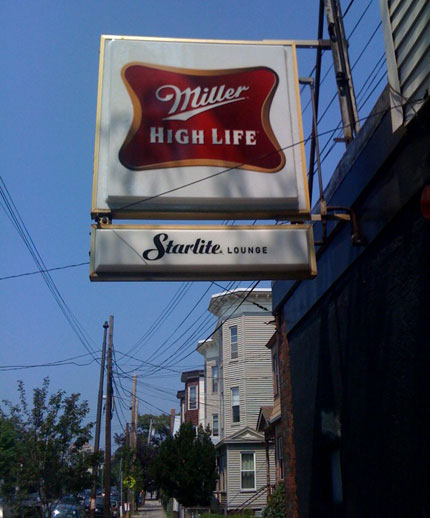
» The biggest news for this installment of Nips is the opening of a fun, new neighborhood bar: Trina’s Starlite Lounge in Inman Square, Cambridge (in the former home of the Abbey Lounge — R.I.P.). If the Starlite were a film, its opening weekend would make it a blockbuster. My preliminary review: energetic, funky vibe; a bar and management staff full of heavy hitters who balance skills with a good-time attitude; a somewhat spare-despite-its-retro-decor look; a very wallet-friendly menu of American picnic ‘n’ patio fare; a list of classic- and culinary-inspired cocktails that’s decent but doesn’t knock my socks off (although a rye Manhattan with Carpano Antica did); and a puzzlingly suburban beer list (Coors Light? Blue Moon? However, Reading Lager in cans and a bucket of High Life ponies are a nice touch).
» Two very different booze promotions rolled through town recently. One was for Grand Marnier, at Drink. The other was for The Macallan, at the Cyclorama.
Jeff Grdinich, New Hampshire barman and consultant with aka wine geek (which represents GrandMa), enlisted bartenders/mixologists around Boston to create cocktails featuring the sweet, cognac-based orange liqueur. Basically, GrandMa’s like, ‘Hey, all the cocktail geeks are mixing with Cointreau — we want a piece of the action, too.’ It’s true that a lot of vintage cocktail recipes call for the less syrupy Cointreau for orange flavor. But the mixologists stepped up, and the drinks at this party were for the most part tasty and balanced. I’m partial to one that I’ve written about before: Grdinich’s Root of All Evil. Also check out Cocktail Virgin Slut’s assessment of not only their own Lioness (of Brittany) but also Scott Holliday’s Alicante, Matt Schrage’s Hugo Ball and John Gertsen’s Mission of Burma. Interesting stuff.
Where the GrandMa event was a mingle-friendly, French-themed cocktail fête (co-organized by the saucy broads of LUPEC Boston), the Macallan event was a slick presentation, complete with pulsing club music and moody, black-and-white images of a nude model posing among barrels of aging scotch. Not what I expected, to say the least. Brand ambassador Graeme Russell, whose red tartan pants accented the bizarro atmosphere, told the 150 or so guests about the distillery’s history and methods, including its unusually small copper pot stills and predominant use of sherry barrels (as opposed to bourbon barrels). He talked us through tastes of the 12-, 15-, 17- and 18-year-olds, with the latter two being the most impressive (they retail for about $120 and $150, respectively). The 18-year, aged entirely in sherry barrels, was an ethereal balance of honey, flower and orchard fruit notes with just enough smoke to let you know you were drinking scotch. The 17 was earthier, with an acidic, phenolic character coming from a portion of whiskey that had been aged in bourbon barrels, which are more charred than sherry barrels and produce bolder flavors. Great scotch, weird presentation.
» And now for some literature… Finally, a useful dictionary. Drunk: The Definitive Drinker’s Dictionary just came out, with a record 2,964 terms for, ya know, blotto, plastered and Dean Martoonied. There’s a companion website, too. Once you’ve purchased the tome online, check out Wayne Curtis’ astute, witty profile in Downeast magazine of a Portland, ME, bartender who badly needed profiling: John Myers. We see Myers’ “Wild Bill Hickok” demeanor around Boston now and again, but not enough. Finally, you’re well aware that a brewer for Guinness perfected a statistical method called “small sample theory” in the early 1900s, thus ushering in the modern capability of brewers and other manufacturers to produce tons of product and produce it consistently, right? Oh, you’re not? Well, read this Salon post about how the human thirst for alcohol can lead to great scientific advances.
I followed up my how2heroes video on Boston’s Ward Eight cocktail with this one on the Red Rot Cocktail. You may recall that Misty Kalkofen and I created this confection for a party at the Boston Athenaeum. It’s inspired by the “red rot cocktail” that book restorers use to bring musty, old, red leather-bound books back to life. Never thought you’d see footage of rotting book covers in a cocktail video, did you?
The great thing about the video is that we actually got to shoot it in the historic, Beacon Street building that houses the Athenaeum. If you’ve never been there, you should pop in someday and check out the first floor and gallery areas. Better yet, become a member and get access to the whole place. You can check out books, attend lectures (I’ve been to some really good ones) and other events, and bring your laptop and work in a spacious, art-and-antique-filled room overlooking the Granary Burying Ground. Contrary to any preconceptions you may have, you don’t have to be a blue-blooded retiree to join. All you need is a credit card and a couple of references.
As for the cocktail (recipe here): it’s pretty, it’s tasty, it’s balanced, and it’s accessible. Serve it to your vodka-swilling friends, and they will be converted to the ways of gin.
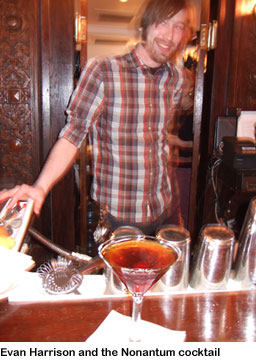
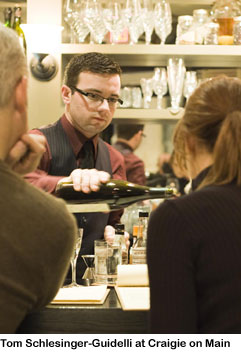
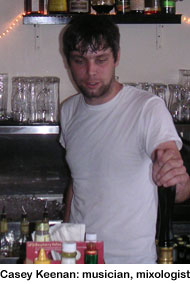
Something about the Boston bar scene really hit home for me recently: there’s a bunch of cute, young guys in this town creating spectacular drinks. Evan Harrison’s Nonantum, Tom Schlesinger-Guidelli’s Northern Lights and Casey Keenan’s Bohannon, to name a few. I’m besotted.
Take Harrison of the Independent — only a year or two out of college, and already he’s figured out how to use the herbal, day-glo-yellow Italian liqueur Strega (a.k.a. “witch”) in a cocktail. Check this out:
Nonantum
2 parts Old Overholt rye
1 part Punt e Mes
1 part Strega
1 dash each Angostura bitters and Regan’s orange bitters
Stir over ice until very cold and strain into a chilled cocktail glass.
“It’s a pretty clear take off of the Green Point cocktail, just substituting Strega and bitters for the Yellow Chartreuse,” Harrison says.
“I came up with this in an attempt to find something to do with Strega apart from dust the bottle and answer questions about it. Strega is a cool little spirit with a cool history, but it’s too sweet to shoot or even sip on its own, and I’ve never seen it called for in any recipe. Surprisingly, it draws out the bitter orange flavors in the Punt e Mes while letting the rye do its work. And also to Strega’s credit, it gives the drink a cool, thick viscosity that kind of lingers in your mouth.”
Yeah, that pretty much sums it up. The upshot is that this drink is worthy of distinction among its many rye-liqueur-vermouth brethren, including Drink’s Fort Point.
OK, but the Nonantum? “The name comes from that village in Newton, where I was once stranded after a bizarre Catholic festival. I mistook the name for being Latin and thought it had something to do with their odd form of civic organization. I was wrong, but I still like the name.” As Harrison later learned, Nonantum is in fact a Native American word meaning, appropriately, “rejoicing.”
Schlesinger-Guidelli has barely cracked the quarter-century mark, but he already has some stellar cocktails to his name, notably the Jaguar and the new Northern Lights. The NL is one of those drinks where each layer of flavor shines on its own but contributes to a greater whole, like dance sequences in a great MGM musical.
The story behind the drink? “I took a week off between starting at Craigie and ending at Eastern Standard. I went down to Westport, MA, to work on the upcoming venture. One night of mixing with some of my best friends, this drink just came together. The late-night mixing and watching the stars, in cold New England … it reminded me of the vibrant Northern Lights.”
Shake very well over ice, strain into a cocktail glass, and garnish with a lemon twist. Notes: Find demerara sugar (or sugar in the raw) at specialty stores like Christina’s in Inman Square. Also, S-G is pretty insistent on the brand of scotch: “I think the honeyed nature of Grant & Sons is really beautiful here.”
I admit I have yet to try Casey Keenan’s Bohannon, but it came to my attention via a trusted source. When he’s not playing drums for the Major Stars, Pants Yell! and other outfits, Keenan can be found at Deep Ellum. Recently, he took the Swedish Punsch that Ellum bar czar Max Toste made and created a cocktail with it that enamored Imbibe magazine enough to appear in the January/February issue. If you know Keenan and his love for 1960s and ’70s music, you’ll be amused but not surprised by the fact that he named the drink after disco producer Hamilton Bohannon.
Bohannon
2 oz gin
½ oz Green Chartreuse
½ oz Swedish Punsch
Pinch of fresh black pepper
Shake very well over cracked ice and strain into a chilled cocktail glass. Garnish with black pepper.
"Lauren Clark takes readers on a supremely sudsy tour of New England ales, lagers, pilsners, and porters. This is the New England the Puritans warned everybody about, but few have chronicled."
– Wayne Curtis, And a Bottle of Rum: A History of the New World in 10 Cocktails