Good god, y’all, I know it’s been a while. This broad’s been working like a dog at the old day job. Work is the curse of the drinking classes, as Oscar Wilde said. Actually, like a lot of famous quotes, this one’s provenance is not verifiable. The quote does not appear in any of Wilde’s writings; rather, it was attributed to him by his friend and biographer Frank Harris in Oscar Wilde: His Life and Confessions. It was allegedly uttered in the context of Wilde’s snarky comment about the acting profession over dinner at the Savoy in the 1890s:
It seemed to him a great pity that actors should be taught to read and write: they should learn their pieces from the lips of the poet. “Just as work is the curse of the drinking classes of this country,” he said laughing, “so education is the curse of the acting classes.”
» Project Savoy. Speaking of the Savoy, I recently got word from fellow blogger Erik Ellestad that he is but 50 recipes away from mixing all 750 cocktails in the Savoy Cocktail Book, published by the hotel in 1930. I reported on the beginning of this quest back in ’07. What fun to go back and read that post, as it records when I first became aware of Josey Packard, one of Boston’s best bartenders. (Fun fact: my shout-out in that post to Josey, who lived in San Francisco at the time, resulted in an email from her very shortly thereafter. A year later, she was working at Drink in Boston.) Erik, I do hope you’re planning a wrap party when you finally hit the finish line!
» Boston barkeeps on TV. OK, leave it to a Bostonian to put books before TV, but here’s some big news: not just one, but two Boston bartenders are, right this moment, in Los Angeles taping the third season of On the Rocks: The Search for America’s Top Bartender. Trina Sturm of Trina’s Starlite Lounge and Bill Codman of Woodward Tavern are competing against six other bartenders from around the country for the “top bartender” title and a grand prize of $100,000. Yowza! OK, so it’s a bit of a cheesy reality show sponsored by Absolut Vodka, but how can you not root for our hometown talent?
I spoke to Trina before she boarded a plane for the West Coast to see how she felt about the whole thing. She was both nervous and confident. “I’m sure of my bartending abilities, but what about when cameras are on me? The caliber of the bartenders is good this year. I don’t know how I’ll stack up against them. I know there are people better in certain aspects [of bartending], but the whole package? That’s me.” Episode 1 airs October 30 after Saturday Night Live … but not in Boston, unfortunately. So, fans of Trina and Bill will have to gather ’round the computer monitor and watch it on the web. Here’s a big, Beantown best-of-luck to both!
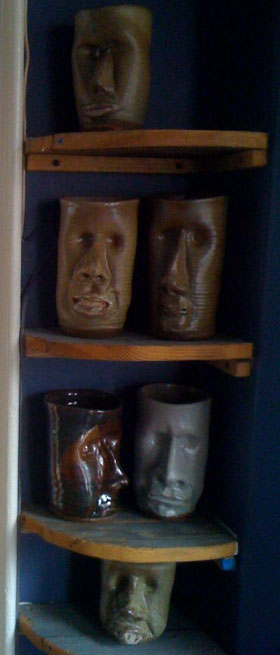
»”Tiki” sculpture. Hey, are you looking for a really, really special gift for the tiki enthusiast in your life or for someone who appreciates useful sculpture? Then check out these expressive, one-of-a-kind, glazed-clay vessels that are kind of a cross between tiki mugs and “grotesques” carved into medieval cathedrals. The artist is Jim McDonough of North Carolina, who, perhaps not surprisingly, is a plastic surgeon who has performed many facial-reconstruction surgeries. He also happens to be the father of Boston poet and sometime Russell House bartender Jill McDonough. The sculptures/mugs are for sale at the Boston Shaker.
Well, I’m off for a little vacation in France. Stay tuned for a post on Chartreuse and other Gallic liquid delights.
Give a man a drink, and he’ll drink for a day. Give a man some quality hooch and cocktail tools, and he’ll drink for a lifetime. I think that’s an ancient Chinese proverb.
In time for the holidays, I have (finally) added to drinkboston a Supplies page listing liquor stores and other retailers who stock the kind of ingredients that today’s classically minded cocktailian demands. Merry Christmas!
Many of us prefer going out to Boston’s best bars for good cocktails, but I know that, especially in this crappy economy, some imbibers are doing more mixing at home. In fact, they are the good people who have helped compile this list of places that stock often hard-to-find ingredients, such as rye whiskies, amari, Haus Alpenz liqueurs, various types of bitters, falernum, Old Tom gin, rum agricole, shrub and good vermouth — plus, all the equipment and instruction you need to set up your home bar (hello, Boston Shaker). And since we in Massachusetts suffer the curse of being banned from ordering liquor through the mail, these sources are especially helpful.
Just for fun, you may want to revisit some of the posts that inspired the Supplies page:
If there are any Boston-area stores with a good selection of classic-cocktail ingredients and mixing equipment that you think deserve to be included, make your case at drinkboston at comcast dot net.
Here’s a to a pleasantly lubricated holiday season!
Wow, has it really been two years since I wrote the original Operation 1919 post urging Boston imbibers to demand pre-Prohibition and other rare cocktail ingredients from their local liquor purveyors? Well, some positive developments since then indicate that our voices have been heard.
Several stores have beefed up — and in some cases continued to stock — their selection of classic cocktail spirits, including BRIX Wines in Boston (South End and Broad St.), Downtown Wine & Spirits and the Wine & Cheese Cask in Somerville, the Wine Gallery in Brookline and Boston (Kenmore Square), Gordon’s in Newton, Liquor Land in Roxbury, Mall Discount Liquors in Cambridge (Fresh Pond), and Julio’s in Westborough.
The Boston Shaker at Grand in Somerville opened this past year and has become a Mecca for those seeking bitters (could you imagine buying celery, cherry or whiskey barrel-aged bitters two years ago? Ha!) and non-alcoholic ingredients like Luxardo maraschino cherries, fruit shrubs, real grenadine, orgeat and falernum, not to mention cocktail tools and books. Many people have chimed in here and elsewhere about specialty-food and international stores that carry stuff like orange flower water, passionfruit juice and pomegranate juice. These include Christina’s spice shop in Cambridge, Super 88 grocery stores, and assorted Brazilian, Caribbean and Asian stores in a neighborhood near you. (Also check liquor stores in these ‘hoods for stuff like cachaca, pisco and funky eaux de vie.) Then there’s Cirace in the North End for hard-to-find aperitivos, amaros and digestivos (Cynar, Averna, Fernet, etc).
Just for fun, here’s a wish list of items culled from comments on that first 1919 post, as well as from myself and various other cocktailians since then. I divided the list up into rough categories of availability. I say “rough,” because a lot of this stuff is still only available at a handful of places, and is often unpredictably stocked. So please don’t take my word for it — call ahead. And I know a few people out there who have more comprehensive knowledge of Boston-area liquor store inventories than I do, so please let me know of a) any hot new finds or b) unavailable items to start a new wish list.
More or less available at some/most of the places above (Starred items available at the Boston Shaker)
Batavia Arrack
Bitters (other than Angostura and Fee’s orange)*
Bluecoat Gin
Creme de Violette
Falernum (Fee Bros.)*
Genever (Bols, Anchor)
Herbsaint
Luxardo Maraschino cherries*
Luxardo Maraschino liqueur
Old Tom Gin (Hayman’s)
Orgeat*
Pimento Dram (St. Elizabeth Allspice Liqueur)
Rye whiskey
Shrub (fruit syrups preserved with a little vinegar)*
Sloe Gin (Plymouth)
Vermouth (Vya, Dolin)
Sighted locally but generally hard to find
Amer Picon/Torani Amer
Bonded Applejack
Carpano Antica
Kummel
Marie Brizard liqueur (particularly Apry, or apricot)
Velvet Falernum
Unavailable or should be easier to find
Bitters (clones of Abbott’s or Boker’s — some bars are making their own)
Byrrh wine
Kola tonic
Raspberry syrup
Swedish punsch
One “hard to find” item that was mentioned more than once by commenters on that first post? St. Germain Elderflower Liqueur. Hard to imagine, since its ubiquity now has earned it the nickname “bartender’s ketchup.” Also, is Cherry Heering really that hard to find, or is it just me?
To conclude, I think we’re getting there. But one-stop shopping for much of the above still seems far away. Is a huge, unfussy liquor warehouse that features Rittenhouse 100, Herbsaint, Luxardo cherries, grapefruit bitters and Creme de Violette, along with the usual 97 flavors of vodka and econo-sized Mudslides, too much of a pipe dream?
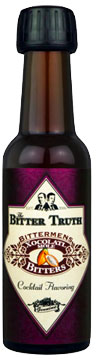
It’s the moment cocktailians have been waiting for. Bittermens bitters are finally going to be available in stores and more widely in bars. After years — yes, years — of battling various authorities to make and sell their bitters, all the while providing their products to select bars in Boston and elsewhere on a “pre-release” basis, Avery and Janet Glasser have finally and happily entered a partnership with the German bitters producer the Bitter Truth.
The first Bittermens products being released under the partnership are Grapefruit Bitters and Xocolatl (Chocolate) Mole Bitters. Hopefully the Glassers’ other artisanal flavors, like ‘Elemakule Tiki Bitters, won’t be far behind. The goods won’t be available for purchase stateside for another few months; for now you have to buy them through the Bitter Truth website (and pay dearly for overseas shipping, I’m afraid). The price of an individual bottle is listed at 10.90 euros, which is about 15 bucks.
The Boston Shaker already sells several varieties of Bitter Truth bitters (Celery, Jerry Thomas’ Decanter, etc.) and hopes to begin offering Bittermens bitters as soon as they are available.
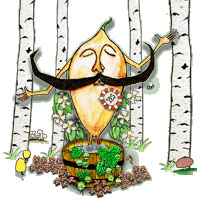
I have happily been following Dann Paquette’s brewing career since about the mid-’90s, when he was at the Northeast Brewing Co. in Allston. Numerous brewing stints later, including a recent couple of years in Yorkshire, England, Dann started his latest venture: Pretty Things Beer and Ale Project. Look for Pretty Things beers in your local bar or packie, and drink them. They are really good. I’m partial to the American-style saison, Jack d’Or (left). It’s distinctive and delicious, yet versatile enough for everyday use.
Downtown Wine & Spirits in Davis Square, Somerville, has fairly recently expanded the “spirits” part of its name with hard-to-find bourbons, liqueurs, rums, etc. It also has the best combination website/blog of any liquor store in greater Boston. And they have regular tastings.
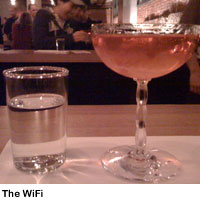
Scott opened the June Esquire, featuring the annual Best American Bars list, and asked me, “Which Boston bar do you think they picked?” “Drink,” I said. No brainer. (There’s also an RIP sidebar that bids farewell to the B-Side.) Speaking of Drink, on a recent visit I tried Josey Packard‘s homage to the Marconi Wireless, the WiFi: Bonded Laird’s Applejack, Lillet Blanc, Drambuie. Strong, complex, stunning.
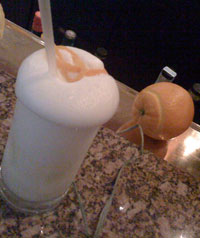
Todd Maul has rather quietly been insinuating craft cocktails into the Boston fine-dining scene. He recently moved from Rialto in Cambridge to Clio in Boston, where he has livened up a cocktail menu based largely on vodka and sake infusions with classically inspired mixtures using gin, tequila, whiskey and rum. As you can see from the pic, he also makes a helluva Ramos Gin Fizz. Go check this guy out.
Finally, an observation and a question: remember when people who patronized bars and restaurants were called “customers?” In the last few years, in some establishments anyway, they have become “guests.” What’s the origin of the switch? I suppose it’s nicer to be considered a guest than merely one end of a cash deal, even though being someone’s guest has traditionally implied that you enjoy their hospitality without having to pay for it.
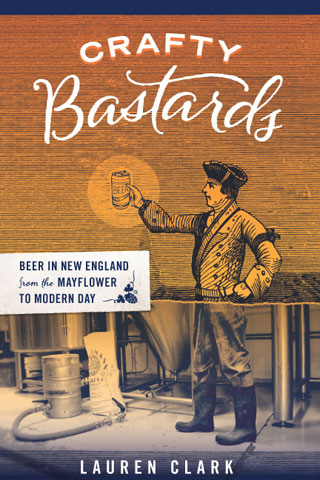
"Lauren Clark takes readers on a supremely sudsy tour of New England ales, lagers, pilsners, and porters. This is the New England the Puritans warned everybody about, but few have chronicled."
– Wayne Curtis, And a Bottle of Rum: A History of the New World in 10 Cocktails
1/2 oz brandy
1/4 oz Jamaica rum
4 oz Madeira
4 oz shaved ice
1 egg yolk
3/4 tsp powdered sugar
1 cup milk
Beat egg and sugar together. Add remaining ingredients except milk; shake, and strain into a large bar glass. Top with milk, stir, and dust with nutmeg.
 I spoke to Trina before she boarded a plane for the West Coast to see how she felt about the whole thing. She was both nervous and confident. “I’m sure of my bartending abilities, but what about when cameras are on me? The caliber of the bartenders is good this year. I don’t know how I’ll stack up against them. I know there are people better in certain aspects [of bartending], but the whole package? That’s me.” Episode 1 airs October 30 after Saturday Night Live … but not in Boston, unfortunately. So, fans of Trina and Bill will have to gather ’round the computer monitor and watch it on the web. Here’s a big, Beantown best-of-luck to both!
 It’s the moment cocktailians have been waiting for. Bittermens bitters are
  I have happily been following Dann Paquette’s brewing career since about the mid-’90s, when he was at the Northeast Brewing Co. in Allston. Numerous brewing stints later, including a recent couple of years in Yorkshire, England, Dann started his latest venture:
  Scott opened the June Esquire, featuring the annual
  Todd Maul has rather quietly been insinuating craft cocktails into the Boston fine-dining scene. He