Archive for February, 2008
February 29th, 2008
“Shake well with ice.”
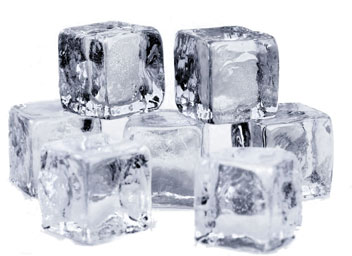
The vast majority of recipes for straight-up cocktails instruct you to do this, but what does shaking (or stirring) “well” really mean? I occasionally give advice to home bartenders, and the main thing I find myself repeating is, “Shake/stir your cocktail until it’s really, really cold. You can leave a cocktail on ice longer than you think.” People are always surprised to hear this, because they heard somewhere once that bartenders are shiftless characters who will carelessly “water down” your drink unless you keep them on their toes. It’s not until these misguided drinkers have tasted a cocktail that’s been properly watered down, by a skilled bartender who knows his/her way around a shaker, that they realize what they’ve been missing during all those years of drinking tepid, poorly mixed booze.
But I find myself at a loss when the person I’m advising asks, “OK, but for how long do I shake the drink?” Well … it depends on the cocktail, the ice, the vigorousness of the shaking … In short, there’s not really a standard response. So I’m offering here the next best thing: expert advice. I posed these questions to several of Boston’s best bartenders: “How do you gauge when a cocktail’s cold enough — when your hand aches from holding the icy shaker? Do you count the number of shakes/stirs? For the home bartender’s sake, can you estimate the number of seconds (or even minutes) a typical cocktail should take to chill perfectly?” Their responses are below. Read them, and you’ll be able to wow the guests of your next cocktail party by demonstrating a “dry integration shake.”
NOTE: I didn’t really get into the whole matter of different types of ice, which some bartenders obsess over in their quest for the perfectly chilled drink. (That’ll be the subject for another day — this post’s long enough). That said, if you don’t have a Lewis Bag in your house, make sure you read to the end.
Rob Kraemer, Chez Henri
I go ’til my hand sticks to the shaker, probably under 20 seconds if shaking hard. Too long dilutes the drink fast, but I’m interested to see what other responses you get, as I don’t even think about it.
Ben Sandrof, No. 9 Park
As far as shaking a drink, I usually give egg drinks about a minute of shaking, unless of course it’s a fizz, in which case it’s a bit longer. If it’s a stirred cocktail, about 20 seconds does the trick. The key is that we are looking for approximately 20 to 30 percent ice melt in the cocktail, as well as the appropriate amount of chill. I could be a real nerd and tell you that there is a thermometer on hand to make sure the drinks are, as finished products, between 28 and 30 degrees, but let’s not go there yet…
Brother Cleve, freelance mixologist and cocktail historian
“When your hand aches from holding the icy shaker.” That’s really when I put it down. I recall going to the Blackbird in NYC when Dale DeGroff and Audrey Saunders were the bartenders, back in the late ’90s. I was really impressed with Dale’s shaking technique (over the shoulder, very fluid movements, and for a long time). I asked him about the length of time he would shake for, and he explained that he felt that the longer shaking time added, and mixed, the additional water the drink required to be balanced, especially since they used pretty large ice cubes. Generally, frost on the metal shaker indicates that it’s ready. I guess it works out to be a minute or two. I’ll shake longer if there’s dairy or eggs involved.
If I’m shaking with crushed ice, I do it for less time, as it adds more water at a more rapid rate. Same thing with blender drinks. Most tropicals should be done at high speed for five to 10 seconds, max.
Tom Schlesinger-Guidelli, Eastern Standard
In all honesty, I would say that both shaking and stirring are, at this point, second nature. It is really about feel, tasting a drink … is it balanced? Does it need more water to balance it out? Shaking or stirring are, at their most basic, about waterizing. I would say, in most scenarios, it is not necessarily about getting “appropriately cold” (though that is a wonderful secondary side effect). Instead, I think about properly waterizing that drink first, and how that usually offers you the proper temperature.
There are a number of different of types of shakes as well, each depending on what it is you are actually shaking. Many of Boston’s bartenders use a “dry shake” [a shake without ice, usually followed by a shake with ice] on egg drinks, arguing that it creates better texture in a drink. Some of us don’t necessarily buy into that philosophy. Then there is the “integration shake,” basically a quick two or three shakes, used to make the different liquids come together better. It’s one we use a lot, both for drinks like the Whiskey Smash, which ends up being strained over crushed ice, and for a lot of sparkling cocktails, like the Belle du Jour or even a French 75. In the Whiskey Smash example, you even use one further breakdown, a dry integration shake. It is for this reason that I think it is really hard to give an answer to “how long?” With a sort of mainstream everyday cocktail it is probably in the range of 30 or so shakes, maybe somewhere around 20 seconds.
In terms of stirring, I usually teach new bartenders to stir their cocktails until the shaker frosts over. That, to me, is kind of an easier distinction, particularly if you are stirring out of a [metal] shaker rather than a glass.
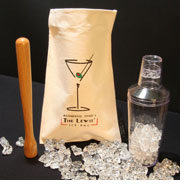 Now, a piece of advice from little old me: Before you make a cocktail at home, crack your ice. The cubes from your standard freezer tray are nice and hard and dense — much better in quality than most “quick-melt” bar ice, I’ve heard bartenders say — but, with their smooth surfaces, they’re a little too slow to melt in your shaker. So empty a tray of cubes into your Lewis Bag, and give the bag a few hard wacks with the accompanying wooden mallet. Cracked ice + ample shaking/stirring time = great cocktails.
Tags: coldness, ice, shaking, stirring, temperature, water
Posted in Bartenders, Cocktails, Drinking supplies | 5 Comments »
February 28th, 2008
 Just in case you didn’t read to the end of the last post, I thought I’d point to the latest installment of my Ale Street News column, Ms. Mug. In The Pink Elephant in the Room, I call beer writers (and by extension all drinks writers) out for avoiding ever mentioning the fact that they drink for the buzz as much as the taste.
“…We’ve been policed, and have policed ourselves, into a sometimes comically polite way of talking about beer.”
And I admit I’m among the guilty. Not that everyone wants to hear the details of what a contented, appealing genius I become over the course of an evening at the bar (I’ll leave that kind of writing to commenters on Yelp.com). But to give the impression that all that gin and whiskey I knock back spends quality time with my taste buds would be dishonest. Kind of like when someone says he subscribes to Playboy for the articles.
Tags: beer writers, drunkenness
Posted in Beer | 3 Comments »
February 26th, 2008
No, it’s not a tool for measuring how much Budweiser you drink, it’s a way to find out what kind of wines your taste buds prefer. Check out the Taste Budometer. “The Taste Budometer will ask you simple questions about salt, coffee and mixed drinks that are proven in many studies to align with taste sensitivities,” says the web site. Once you complete the survey, you’ll be assigned a classification based on your taste preferences.
According to the Budometer, I’m what’s known as a Tolerant Taster. “We demand intensity, plenty of oak and power. BIG is better! High alcohol wines often taste rich and delicious.” My supposed favorite white wines? “Reserve-style Chardonnays from around the world. Rhone-style whites. Frankly I’d just rather have red wine.” And my favorite reds? “Cabernet Sauvignon and blends. Rhone and Rhone-style blends. Old-vine Zinfandels. Brunellos, Super Tuscan, Barolo, and Amarone from Italy. Intensely flavored reds from France, Spain and South Africa.”
Based on my relatively limited experience with wine — my income allows me only a passing familiarity with a lot of the fancy stuff named above — those results are pretty accurate. But they’re limited. I like a much wider variety of whites, for example, as well as some lighter reds. Granted, the Budometer is still in its beta stage. As the web site explains, it currently takes into account only the “sensory discrimination” aspect of your wine preference, not its “aspiration value.” Huh?
“The founders of the Taste BUDOMETER postulate that people’s preferences in food, music, wine and all things ‘sensory’ can be best understood in two primary dimensions: Sensory Discrimination and Aspiration Value. While people are distributed all across these two dimensions, the deep genetic and cultural influences at work mean, in reality, that people are highly clustered into groups within the Flavor-Aspiration Matrix.”
Apparently, the prime-time version of the Budometer will feature a way to measure that “aspiration value,” the better to find out where you fall in the Flavor-Aspiration Matrix. Finally, a personality test for winos.
Thanks to Stan Hieronymus, author of Brew Like a Monk, for the Budometer tip. It happened to be part of a post on his Appellation Beer blog that mentioned my latest Ms. Mug column for Ale Street News, The Pink Elephant in the Room.
Tags: taste buds, Wine
Posted in Books & resources, Wine | No Comments »
February 22nd, 2008
 I’ve been drafted to represent Tales of the Cocktail 2008 at the Boston Globe Travel Show this Friday and Saturday (February 22-23). TOTC Founder Ann Tuennerman is busy promoting her event elsewhere around the country, so I, along with Misty Kalkofen of Green Street, signed on for the job. Since Misty and I (and several of our fellow Boston cocktailians) are attending TOTC again this year, you’ll be hearing more about this be-there-or-be-square cocktail party as its time (July 16-20) nears. And, of course, there’ll be posts about the event during and after the fact, just like last year.
Misty’s and my presentation will involve a few cocktail demos, of course. Two of the featured drinks celebrate New Orleans and its cocktail history; the third gives Travel Show attendees a taste of what’s happening in today’s Boston scene. Try them out yourself while you plan your trip to New Orleans this summer. FYI, we used Hendrick’s gin (a TOTC sponsor) in the recipes below.
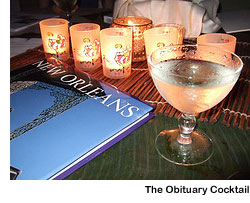
Obituary Cocktail
2 oz gin
1/4 oz dry vermouth
1/4 oz absinthe (or Herbsaint)
Stir all ingredients well over ice and strain into a cocktail glass. This cocktail was created at Jean Lafitte’s Blacksmith Shop on Bourbon St., one of New Orleans’ oldest saloons.
French 75
1 1/2 oz gin
3/4 oz fresh lemon juice
1/2 oz simple syrup
Champagne
Shake gin, lemon juice and simple syrup over ice. Pour into champagne flute or saucer and top with Champagne. The bar at the famous New Orleans restaurant, Arnaud’s, is named for this drink. The drink is, as you know, named for the rapid-firing cannon the French used in World War I.
Flapper Jane
1 3/4 oz gin
1/2 oz fresh lemon juice
3/4 oz Wu Wei tea-infused simple syrup*
dash of Peychaud’s bitters
Shake all ingredients over ice and strain into a cocktail glass. The Flapper Jane was created for the LUPEC Boston Tea Party.
*Wu Wei tea-infused simple syrup: heat 1 cup sugar, 1 cup water and 1 Tbsp Wu Wei tea in a saucepan until all the sugar dissolves. Pour into a container and let cool. Store in fridge.
Tags: Gin, New Orleans, Tales of the Cocktail
Posted in Cocktails, Events, Gin, New Orleans | 6 Comments »
February 20th, 2008
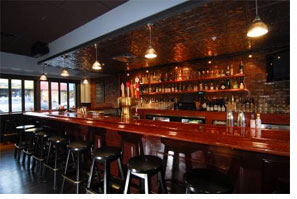 You would think, from the buzz that began the day it opened for business, that Highland Kitchen was the very first restaurant to open in Somerville. It seems everywhere I go, someone is asking someone else, “So, have you been to Highland Kitchen yet?” I’ve lived in Somerville for a long time, I’ve seen some good restaurants come and go, but I’ve never seen anything like this level of excitement.
Is it warranted? Pretty much. What we Somervillians essentially have with Highland Kitchen is our first neighborhood restaurant owned by a noted chef who is offering consistently well made, but not too fancy, food and drink in the perfect price range. (Entrees under $20, surprisingly large cocktails $7-$8). Highland Kitchen is to the ‘ville what the Franklin Cafe is to the South End or Green Street is to Central Square in Cambridge. Which makes sense, because the chef-owner, Mark Romano, used to be the chef at Green Street and its former incarnation, the Green Street Grill, drawing legions of fans with his Caribbean-influenced dishes. He’s slipping some of that cuisine in here and there, but basically this is a menu of the comfort variety, with steak frites, bluefish cakes, a “Cuban Reuben,” gumbo, burgers, etc.
Part of the enthusiasm over Highland Kitchen stems from its location in a spot, outside of the city’s main squares, that has never had a destination restaurant. People who live in neighborhoods north of Highland Ave. no longer have to trek to Davis or Union squares to get a nice dinner. And Highland Kitchen is staffed with pros, so it hasn’t seemed to suffer the dreaded kinks that need to be worked out in the first few months of business. Romano’s wife and partner, Marci Joy, was (according to the Globe), a manager at East Coast Grill. The servers and bartenders have logged many hours at other respected establishments around greater Boston, including No. 9 Park, Upstairs on the Square, the Independent and Gaslight. I wasn’t surprised at all when I found Joe McGuirk working behind the bar during my most recent visit.
Michael, the bar manager, is a gracious guy who has put together a short but decent cocktail list with a few things — like the Bourbon Smash, the Brandy Flip and the Periodista — that appeal to vintage cocktail enthusiasts like me. There are daily blackboard specials, too. Aware of McGuirk’s knowledge of vintage recipes, I embarked on an off-menu expedition by asking for a Frisco. Alas, there was no Benedictine (only B&B). Then Michael suggested a Red Hook. Uh — yes please! Good food, good service, good prices and Red Hooks? Highland Kitchen’s not the first restaurant to open in Somerville, but I’m going to go ahead and say it’s already among the best.
Tags: somerville
Posted in Boston bars, Cocktails | 3 Comments »