Good god, y’all, I know it’s been a while. This broad’s been working like a dog at the old day job. Work is the curse of the drinking classes, as Oscar Wilde said. Actually, like a lot of famous quotes, this one’s provenance is not verifiable. The quote does not appear in any of Wilde’s writings; rather, it was attributed to him by his friend and biographer Frank Harris in Oscar Wilde: His Life and Confessions. It was allegedly uttered in the context of Wilde’s snarky comment about the acting profession over dinner at the Savoy in the 1890s:
It seemed to him a great pity that actors should be taught to read and write: they should learn their pieces from the lips of the poet. “Just as work is the curse of the drinking classes of this country,” he said laughing, “so education is the curse of the acting classes.”
» Project Savoy. Speaking of the Savoy, I recently got word from fellow blogger Erik Ellestad that he is but 50 recipes away from mixing all 750 cocktails in the Savoy Cocktail Book, published by the hotel in 1930. I reported on the beginning of this quest back in ’07. What fun to go back and read that post, as it records when I first became aware of Josey Packard, one of Boston’s best bartenders. (Fun fact: my shout-out in that post to Josey, who lived in San Francisco at the time, resulted in an email from her very shortly thereafter. A year later, she was working at Drink in Boston.) Erik, I do hope you’re planning a wrap party when you finally hit the finish line!
» Boston barkeeps on TV. OK, leave it to a Bostonian to put books before TV, but here’s some big news: not just one, but two Boston bartenders are, right this moment, in Los Angeles taping the third season of On the Rocks: The Search for America’s Top Bartender. Trina Sturm of Trina’s Starlite Lounge and Bill Codman of Woodward Tavern are competing against six other bartenders from around the country for the “top bartender” title and a grand prize of $100,000. Yowza! OK, so it’s a bit of a cheesy reality show sponsored by Absolut Vodka, but how can you not root for our hometown talent?
I spoke to Trina before she boarded a plane for the West Coast to see how she felt about the whole thing. She was both nervous and confident. “I’m sure of my bartending abilities, but what about when cameras are on me? The caliber of the bartenders is good this year. I don’t know how I’ll stack up against them. I know there are people better in certain aspects [of bartending], but the whole package? That’s me.” Episode 1 airs October 30 after Saturday Night Live … but not in Boston, unfortunately. So, fans of Trina and Bill will have to gather ’round the computer monitor and watch it on the web. Here’s a big, Beantown best-of-luck to both!
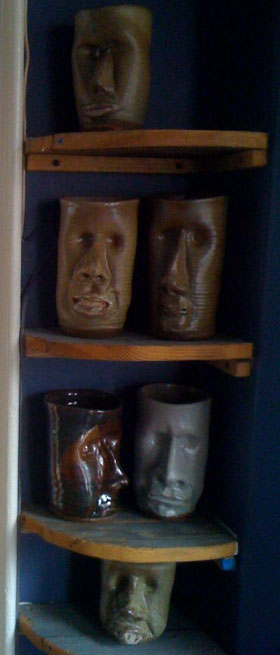
»”Tiki” sculpture. Hey, are you looking for a really, really special gift for the tiki enthusiast in your life or for someone who appreciates useful sculpture? Then check out these expressive, one-of-a-kind, glazed-clay vessels that are kind of a cross between tiki mugs and “grotesques” carved into medieval cathedrals. The artist is Jim McDonough of North Carolina, who, perhaps not surprisingly, is a plastic surgeon who has performed many facial-reconstruction surgeries. He also happens to be the father of Boston poet and sometime Russell House bartender Jill McDonough. The sculptures/mugs are for sale at the Boston Shaker.
Well, I’m off for a little vacation in France. Stay tuned for a post on Chartreuse and other Gallic liquid delights.
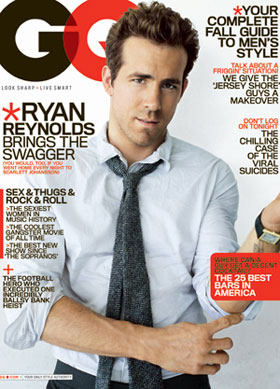
It’s a pretty good list. That is, GQ magazine’s first attempt at choosing, in ranked order, The 25 Best Cocktail Bars in America. Let’s get out of the way the fact that, like any “best of” list, this one has provoked some gripes. No Teardrop Lounge (Portland), no Vessel (Seattle), no Milk & Honey (New York)?
And don’t get Bostonians started. Ranking “evolved music venue” the Whistler in Chicago above our city’s Drink, an actual cocktail bar? And what’s with back-handed compliments like, in the Drink writeup: “Don’t cringe when the bartenders … ask for your ‘flavor profile.’ They mean no harm” (this notion that Drink’s bartenders behave like New Age therapists has got to die); and referring to Eastern Standard as “(perhaps unintentionally) the most elegant sports bar in the country”? Ouch.
But wait. Maybe Eastern Standard really is the most elegant sports bar in the country. That’s part of what makes it great. And GQ chose the ZigZag Cafe in Seattle as the number-one cocktail bar in the land. Is anyone going to quibble with that? Let’s congratulate both Drink and Eastern Standard for making the list and also raise a glass to GQ for promoting to a mass audience the idea that “every city in this country deserves a bar that cares deeply about the craft of the cocktail.”
» Bartenders on the move… We applaud and lament the departure of Superman Sam Treadway from the 21st-best cocktail bar in America (see above). The poor thing left Drink for a job offer to open three new hotel bars in Hawaii… Tom Schlesinger-Guidelli, who left Craigie on Main early this year, will soon open the Island Creek Oyster Bar as general manager in the Kenmore Square space that used to house Great Bay… Meanwhile, a few doors down, the talented Bob McCoy is wrapping up his tenure at Eastern Standard to join ICOB as principal bartender. The new restaurant won’t be cocktail-centric, although something tells me you’ll be able to order a top-notch drinky there… Speaking of top-notch drinkies, the talented bar staff at Craigie on Main offers best wishes to their colleague Paul Manzelli, who is leaving to pour libations at the new restaurant Bergamot. This development, along with Greg Rossi’s presence behind the now-full-liquor-licensed bar at Dali, makes the intersection of Beacon and Washington streets in Somerville an unlikely spot for dueling fine-dining barmen… Finally, two of Boston bartending’s big guns, Todd Maul of Clio and journeyman Ben Sandrof, will appear for one night only tomorrow (9/26) at Woodward at AMES ongoing Cocktail Wars.
» Freaky Tiki Fridays II. You might remember that July’s Nips column mentioned a fun new thing called Freaky Tiki Fridays at Think Tank in Kendall Square. Well, the day after the inaugural happy hour, Cambridge experienced the Great Flash Flood of 2010. Think Tank’s sub-basement space was nearly destroyed. Now the joint has re-emerged from the deluge, and Boston’s Emperor of Exotica, Brother Cleve, reports that the weekly after-work shindig with Polynesian-styled cocktails and app specials and “an array retro/futuristic sounds of nu/old school lounge, tiki/exotica, surf, soul and other titty shakers” is back on.
» Bittermens Bitters. Finally, finally, finally, Boston has its own bitters producer. The saga of Bittermens Bitters, which Avery and Janet Glasser started in 2007, has included a long and drawn-out licensing application, an ill-fated partnership with the Bitter Truth, and, finally, today’s status as a legal producer and seller of “non-potable” elixirs — like Xocolatl Mole Bitters, Grapefruit Bitters and Boston Bittahs — beloved by craft cocktail bartenders nationwide. Congrats and best of luck to this local concern. Here’s how to buy Bittermens Bitters.
A friendly reminder that this coming tax-free weekend doesn’t just apply to TVs, leather armchairs and solid-wood shellcases for your iPad. It also applies to booze. Have your eye on a bottle of green Chartreuse VEP ($130)? Strathisla 1967 Speyside scotch whisky ($175)? Remy Martin Cognac Louis XIII Grande ($1700)? Well, grab your shopping cart and boogie down the aisle of one of these fine establishments.
» Boston wins. Damned if Boston didn’t hit it out of the park during Tales of the Cocktail in July. First of all, more Boston bar industry folk represented our city at New Orleans’ annual drinks convention than ever before. Second of all, Drink won the Grand Marnier-sponsored Barroom Brawl, besting five other top-notch cocktail bars from around the U.S. and earning the title Best Bar in America. Third of all, Drink’s Misty Kalkofen won the Pisco Sour Pentathalon and will in the near future enjoy her prize: a trip to Peru to see how desert-grown grapes turn into white brandy. Congrats to all! Liza Weisstuch offers a vivid snapshot of the competition and, more generally, the Boston slant on Tales in today’s Phoenix. Good stuff.
» Remixology. Speaking of contests, there’s a new bar celeb in town: John Mayer of Cambridge’s Craigie on Main. A relatively new member of the staff there, he wowed everyone at the Appleton Estate Rum Remixology contest earlier this week with his mixing skills, sense of humor and ability to explain how a favorite song inspired a new cocktail. His presentation involved Frankie Valli’s “Sherry Baby,” a powder-blue brocade blazer, three mixing glasses spinning on a turntable, a small disco ball, a history lesson on Jamaica’s first prime minister — Alexander Bustamante — and the year 1962. He will compete in the national finals of the competition in NYC on August 30. Go, John! Here are recipes for the Bustamante and the other semi-finalists’ tasty drinks.
» Literature. Geoff “Psycho-Gourmet” Nicholson’s fantastic essay, Drink What You Know, appeared in the New York Times’ Book Review recently. He starts by comparing the advice writers dispense about drinking to the way they depict drinking in their literature, and arrives at his thesis:
“When you think about it, rules for drinking are not so different from rules for writing. Many of these are so familiar they’ve become truisms: Write what you know. Write every day. Never use a strange, fancy word when a simple one will do. Always finish the day’s writing when you could still do more. With a little adaptation these rules apply just as well for drinking. Drink what you know, drink regularly rather than in binges, avoid needlessly exotic booze, and leave the table while you can still stand.”
» History. I was putting off going to Plymouth to learn about Pilgrims until my retirement years, but now I have a reason to go earlier. Pilgrim Hall Museum (“America’s museum of Pilgrim possessions”) is running an exhibition called “Plymouth History in a Glass: The Artifacts and Culture of Beverages and Drinking” until December 31. Silver tankards. Ceramic punch bowls. Glass tumblers. Ooh, I’m getting hot flashes. Not only that, there are two related lectures: one on historic Plymouth-area taverns on August 25 and one on September 29 called “The Design of Drinking: from the Jazz Age to the Space Age.” Far out.
» Name that bar. What would you call a bar frequented by venture capitalists, entrepreneurs and hardworking graduate students from all over the world who converge on the high-tech cluster that is Kendall Square, Cambridge? The people behind the in-the-works “Venture Cafe” are seeking a more clever name than the working title for their “place-based social networking” project. They have partnered with restaurateur Gary Strack from Central Kitchen and the Enormous Room and are scouting Kendall Square locations for a 2011 opening. With any luck the place will liven up the woefully nightlife-less neighborhood. Got a suggestion for what to call the place? Chime in on their Facebook page.
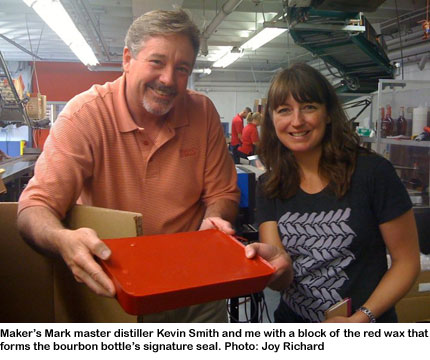
When Maker’s Mark president Bill Samuels Jr. and his master distiller, Kevin Smith, decided to make their company’s first new bourbon in over 50 years, they could have gone the well-traveled route: an extra-aged, high-proof whiskey with “reserve” in the name (and a price tag well over $50). But their whole philosophy goes against the whopping spice, caramel, smoke and tannic flavors that can come from extended time in charred oak barrels. They’re all about toasty, mellow, vanilla — a flavor profile they get by blending whiskey from barrels that rotate through three-story rickhouses (barrel-aging warehouses) for a “mere” six to eight years, compared to 12-20+ for some boutique bourbons. So, they decided to simply take their regular Maker’s Mark bourbon and amp it up it somehow. But how? Enter the wood chef.
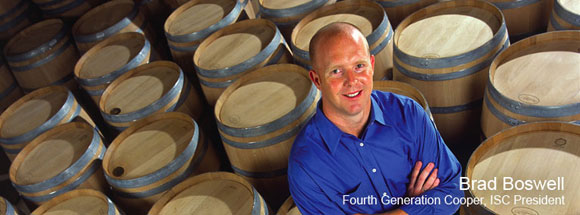
I admit I laughed when I heard that term, too. (Disclosure: Maker’s Mark flew me down to Kentucky to check out the distillery.) But I realized it wasn’t a stretch when I talked to the chef himself, Brad Boswell of the Independent Stave Company. Boswell’s family has been making oak barrels for aging spirits and wine for 98 years. And lately, they have brought a healthy dose of science to their medieval craft. They begin with a thorough understanding of the chemical composition of different species of oak, and of the appropriate length of seasoning (aging oak staves in the open air) for the intended beverage. Then they cook the staves or finished barrels according to a library of recipes that “pinpoint layers of flavor” between toasted and charred, says Boswell. Basically, he can make you a barrel that imparts to its contents the exact characteristics you’re looking for.
In Maker’s Mark’s case, those characteristics were “sweet toasty oak, not smoky. Forward on the palate. Long finish. No sour or bitter aftertaste. A little spicy,” say my notes from a conversation with Smith. But the distiller knew that that particular combo of spicy notes and long finish typically go hand in hand with at least a bit of smokiness, sourness and bitterness. “We were asking for the impossible,” says Smith. In fact, they were asking for something that couldn’t be achieved with any sort of aging regime in the charred barrels that are standard to the bourbon industry. (The wood on the inside of the barrel is literally blackened with fire.)
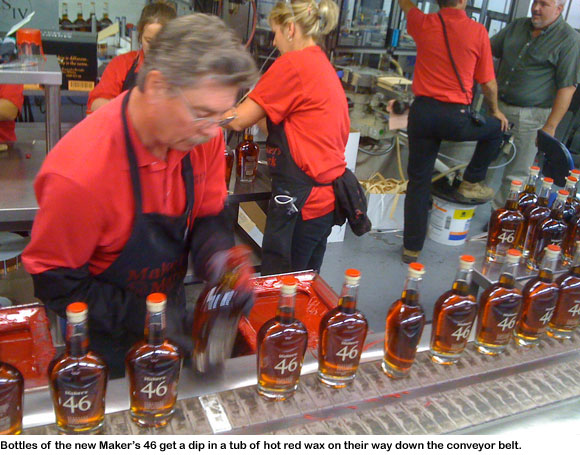
It took 125 experiments — many of which “sucked,” says Smith — to hit upon the right wood recipe, one that was entirely new in bourbon making. It begins with French, rather than the standard American, oak staves. Those staves are seasoned for a long 18 months, which lowers the wood’s tannins and intensifies its vanillins. Boswell then tried a new cooking technique: he seared the staves on both sides, like a steak, to just short of charred. Boswell catalogued this recipe as Profile No. 46.
Smith arrayed 10 of the staves in an empty Maker’s barrel, then poured the fully matured bourbon back in to rest for about nine weeks. The combination of the seasoned French oak and Boswell’s searing method gave just the sweet toastiness and spicy notes — think cinnamon instead of rye bread — that Maker’s wanted. Samuels and Smith had their new product, and they decided to name it Maker’s 46, after Boswell’s special wood recipe.
This may all sound pretty esoteric, but the result is a bourbon quite different from Maker’s Mark. The 46 has a dry spiciness, a rich texture and a higher proof (94 compared to 90 for the flagship) that are sure to appeal to the bourbon, and even rye, adventurer, without alienating the devoted Maker’s Mark drinker. And it’s reasonably priced at about $10 more than traditional Maker’s, which is usually $23 to $25. Maker’s 46 will be available in Boston sometime next month.
The 70-year-old Samuels, a seventh-generation distiller who is nearing retirement, seems pleased by the new whiskey. He admits that it arose partly out of market demand for something new and exciting from Maker’s, which largely created the premium bourbon category that is now exploding. But he also wanted to be remembered for something other than faithfully reproducing his father’s bourbon recipe from the 1950s. Now his nightmares of a tombstone that says, simply, “He didn’t screw it up,” are over.
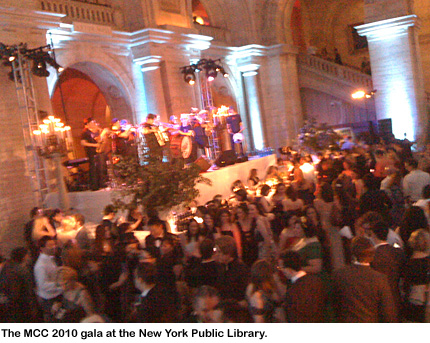
It started with a festive gala amid the marble-and-granite splendor of the New York Public Library and ended (for me, at least) with a wee-hours dinner at the 1930s-Eurasian-exotica-inspired Macao Trading Co. In between, I …
Ate an exquisite smorgasbord at Aquavit with Karlsson’s vodka reps (that’s right, I said vodka) and a bunch of sassy bartenders from L.A. and San Francisco.
Heard Fritz Maytag of Anchor Brewing and Distilling chronicle his 15-year adventure in craft distilling and sampled his 100-percent-rye Old Potrero whiskies.*
Enjoyed Laird’s apple brandy cocktails at the “official bar of the Manhattan Cocktail Classic” and met the 230-year-old distillery’s vice president, Lisa Laird Dunn.
Entered a phone booth at Crif Dog from which I slipped into PDT (Please Don’t Tell) for a Romeo y Julieta, a rich, woody concoction involving Ron Zacapa Centenario rum and tobacco essence.
Sipped a Mai Tai accompanied by exotica music and the squawking of live parrots at the exclusive (because it’s in somebody’s apartment) Rhum Rhum Room.
Heard the engaging story of how cocktails migrated from America to Europe circa 1870-1940 (thanks, David Wondrich and Fernando Castellon).
Checked out a special tasting of new and unusual rums, whiskies, aperitif wines and syrups at wd-50.
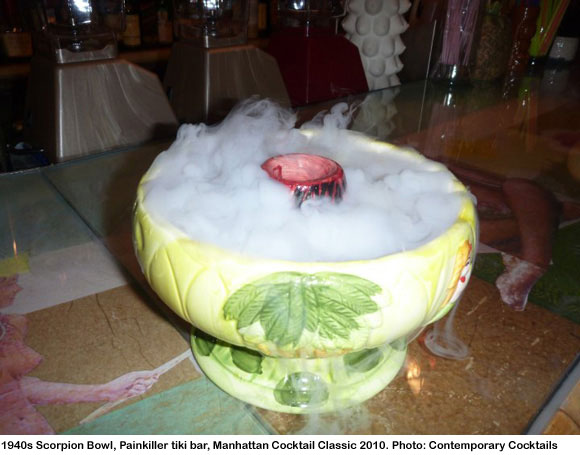
Drank a 1940s-era Scorpion Bowl out of a two-foot-long straw at an Appleton Estate Rum party at the brand-new Painkiller urban tiki bar.
Clinked vintage cocktail glasses with my writer girlfriends at the new, Victorian-parlor-inspired Raines Law Room.
Arrived too late to get a cocktail at the Tanqueray 10 party at the Kingswood and was grateful to be handed a glass of Haus Alpenz’ newest import, the aperitivo Cocchi Americano, instead.
So, as you can see, the opportunities for learning, schmoozing, tasting and debauchery at the first official Manhattan Cocktail Classic were slim.
But seriously … this four-day intoxinalia is clearly meant to rival Tales of the Cocktail in New Orleans as a confab for professionals and enthusiasts alike to get acquainted with the latest products, recipes and industry knowledge and to hobnob with the illuminati of the cocktail and spirits world.
One of the advantages the MCC has over Tales is that there are many more serious cocktail bars in New York than in New Orleans, and those bars hold their own seminars in addition to the events taking place in the Astor Center — and in addition to being open during regular business hours. Also, every event featured real glassware, and the vast majority of the cocktails were well made despite being cranked out for thousands of people. The hospitality infrastructure in New York quite simply gets the job done.
The disadvantages of the MCC vs. Tales have to do with all those things about New York that get under people’s skin: the frenetic pace and social jockeying involved in a typical night out, the difficulty of getting into exclusive speakeasy-style bars and, of course, the expense. Tickets to MCC events start at $50 (the gala was $100). Add lodging, cabs and dining out and … whoa. Still, it was a blast.
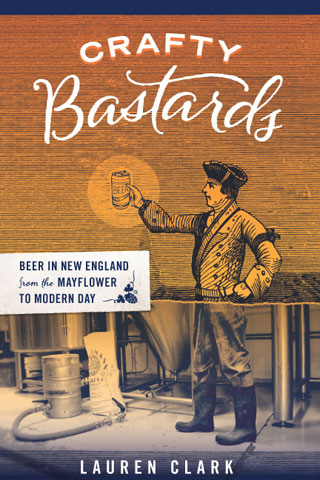
"Lauren Clark takes readers on a supremely sudsy tour of New England ales, lagers, pilsners, and porters. This is the New England the Puritans warned everybody about, but few have chronicled."
– Wayne Curtis, And a Bottle of Rum: A History of the New World in 10 Cocktails
5 sour cherries
1 oz yellow Chartreuse
1/4 oz fresh grapefruit juice
1 dash Angostura bitters
Sparkling wine
Muddle the sour cherries in a mixing glass. Add the Chartreuse, grapefruit juice and bitters. Shake with ice and strain into a champagne flute. Top with sparkling wine.
 I spoke to Trina before she boarded a plane for the West Coast to see how she felt about the whole thing. She was both nervous and confident. “I’m sure of my bartending abilities, but what about when cameras are on me? The caliber of the bartenders is good this year. I don’t know how I’ll stack up against them. I know there are people better in certain aspects [of bartending], but the whole package? That’s me.” Episode 1 airs October 30 after Saturday Night Live … but not in Boston, unfortunately. So, fans of Trina and Bill will have to gather ’round the computer monitor and watch it on the web. Here’s a big, Beantown best-of-luck to both!