Archive for the ‘Cocktails’ Category
November 23rd, 2010
As my friend Senator John aptly tweeted during the grand finale of the year-long Cocktail Wars at Woodward Tavern in the Ames Hotel, “If you dropped a bomb on the Ames Hotel, we’d be drinking light beer and screwdrivers for months.”
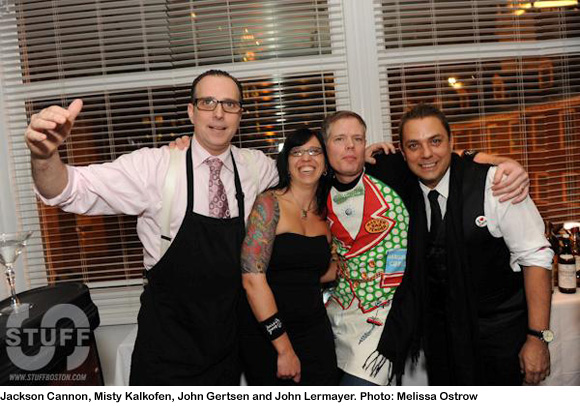
Arguably Boston’s three best bartenders — Jackson Cannon of Eastern Standard and John Gertsen and Misty Kalkofen of Drink — competed against each other and Miami’s finest, John Lermayer, in a showdown that capped a series of drink-mixing battles between Boston bartenders (and sometimes their colleagues from other cities). And there to cheer the competitors on was seemingly every other bartender of note who wasn’t on the stick that night. Thankfully, no bombs were dropped. Except for this one: the guy from Miami won.
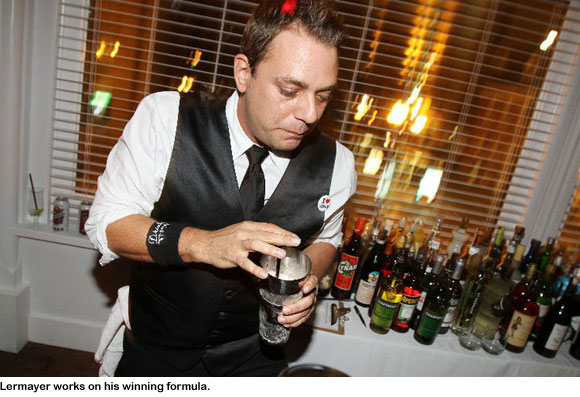
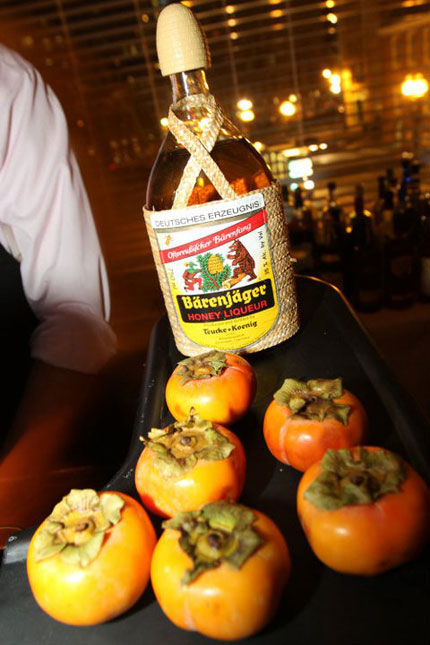
That’s right, John Lermayer, who tends bar at the Florida Room and consults for hotel bars around the world, bested his Beantown colleagues fair and square. I should know, because I was one of the judges. His winning cocktail, the Misty Morning Sour (see below), hit all the criteria admirably: quality, creativity, presentation and use of surprise ingredients — persimmon and Barenjager honey liqueur. Misty Kalkofen took second place for her mezcal-based Per Simon. In the quality department, all the cocktails got high marks on my ledger — particularly considering they were each created in an astonishing 20 minutes.
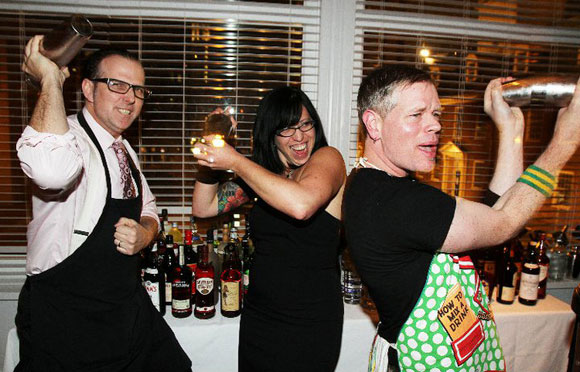
Here are some pics from the bash, plus the recipes that each of the four competitors came up with. What a pleasure it was to literally drink in their talents.
Misty Morning Sour
John Lermayer
Persimmon (a couple slices)
Strawberry (one or two)
1 1/2 oz Plymouth gin
3/4 oz Aperol
3/4 oz Barenjager
3/4 oz lemon juice
1/4 oz simple syrup
2 drops orange blossom water
Egg white
Muddle persimmon and strawberry in a mixing glass. Add remaining ingredients and dry-shake. Shake all again well over ice. Strain into cocktail glass with sliced strawberry and persimmon garnish. The name: inspired by how John imagined his fellow contestant, Misty, would feel the next morning.
Per Simon
Misty Kalkofen
Half a persimmon
2 oz Del Maguey Mezcal Vida
1/2 oz Plymouth sloe gin
1/2 oz Barenjager
1/2 oz lemon juice
1/2 oz agave nectar
1/2 oz Amontillado sherry
6 drops Bittermens grapefruit bitters
Nutmeg garnish
Muddle persimmon in a mixing glass. Add all other ingredients except nutmeg and shake well over ice. Strain into a cocktail glass and garnish with fresh grated nutmeg. The name: a play on one of the surprise ingredients and on the name of one of the judges, Simon Ford, international ambassador for Plymouth gin.

Once in a Blue Persim-moon
Jackson Cannon
Persimmon (couple slices)
1 1/2 oz Barenjager
1 oz Plymouth gin
1/2 oz lemon juice
1 egg white
Dash Peychaud’s bitters
Sparkling wine
Dry-shake first four ingredients and strain through a tea strainer. Dry-shake strained ingredients with egg white. Shake all again with ice. Strain into a champagne flute, top with Peychaud’s and sparkling wine. The name: inspired by the blue moon in the sky that evening.
Wasp Bite
John Gertsen
2 oz persimmon infused* Plymouth gin
1/2 oz lemon juice
1/2 oz Barenjager
1 tsp black pepper
Barenjager soaked persimmon skin “twist”
Muddle pepper in mixing glass. Add all ingredients except twist. Add ice, shake and double strain into a chilled coupe. Garnish with the twist. The name: a play on Drink’s peppery Bee Sting, which is itself a play on the classic Bee’s Knees.
*The Plymouth Gin was infused using a quick infusion technique known as nitrogen cavitation. Gertsen used a 1 liter iSi profi whip canister, added 375 ml of Plymouth Gin and the pulp from 4 medium-sized persimmons, and charged the canister twice with nitrogen.
Except for top photo, all photos by Mark Andrew Deley of Crammed Media.
Tags: Ames Hotel, Barenjager, cocktail contest, Jackson Cannon, john gertsen, John Lermayer, Misty Kalkofen, persimmon, Woodward Tavern
Posted in Bartenders, Cocktails, Events, Liqueur | No Comments »
September 16th, 2010
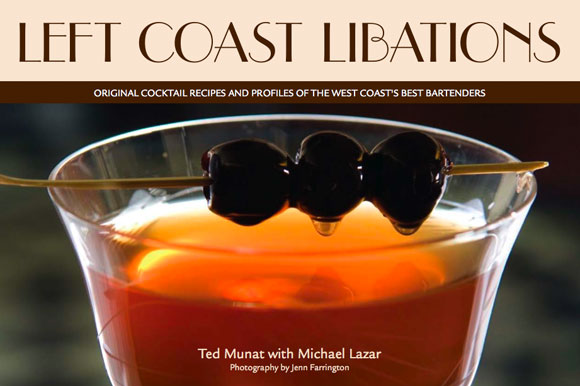
Ted Munat blogged this recently: “I love the cocktail industry. It is brimming with creativity and with beautiful and amazing people. The affection people have for what they do, and for the others that do it, is unmatched in any other community on earth I have ever encountered.”
You might view that as mushy hyperbole from a happy drunk if Ted didn’t just publish a book, Left Coast Libations, that makes a solid case for the above statement over 160 pages of bartender profiles, city descriptions and recipes/photos of the splendid mixology that’s happening on the other side of the country. Left Coast Libations is an intelligent, cheeky, utterly heartfelt love letter to “the art of West Coast bartending.”
The book grew out of a pamphlet that Ted and his brother Charles put together and introduced, as I remember it anyway, at Tales of the Cocktail in 2008. “One copy fell into the hands of Scott Bodarky, a Bay Area book publisher,” writes Ted on the LCL website, and soon thereafter work on a “real life big boy book” began in partnership with recipe guru Michael Lazar and photographer Jenn Farrington. Here’s a brief excerpt and recipe from the Portland, Oregon section’s writeup of Evan Zimmerman of Laurelhurst Market (which I highly recommend):
“Evan’s a tornado behind the bar. And creative, wild, borderline insane shit flies in every direction from where he stands. For the love of God, the man’s drink in this book calls for smoked ice. Do you have any idea how far gone from reality a person has to be to conceive of smoking ice? I was a teenager once, and I tried smoking just about everything… but never ice.”
Smoke Signals
1 1/2 oz Tennessee whiskey
1 oz manzanilla sherry
3/4 oz Pecan Syrup
1/2 lemon juice
1 dash The Bitter Truth Jerry Thomas’ Own Decanter bitters
Smoked ice
Combine all the ingredients except smoked ice in a shaker with (not smoked) ice. Shake hard. Double-strain over a 2″ by 2″ block of the smoked ice in an Old Fashioned glass.
If you want to know how to make smoked ice and pecan syrup — and you like fun cocktail writing and tasty recipes — you have to buy the book. (Don’t worry, not every recipe in LCL calls for such complicated ingredients).
I don’t know if there will ever be an East Coast Cocktails-or-something-or-other to rival LCL, but, Ted & Co., you have officially fired the first shot. Cheers and congrats to you all.
Tags: California, Left Coast Libations, Oregon, Ted Munat, Washington, West Coast
Posted in Books & resources, Cocktails | 6 Comments »
August 27th, 2010
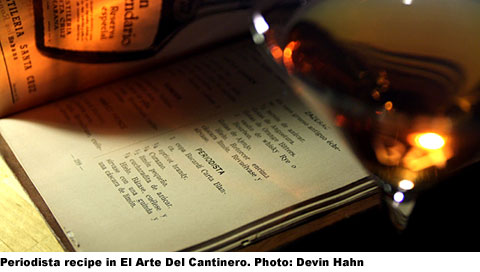
Watch out when making off-hand remarks around Devin Hahn, author of the blog Periodista Tales. He will record everything you say. Then publish it. The thing is, you’ll be (mostly) thankful he did.
Hahn began writing the engaging, real-time narrative of his quest to find the origins of the Periodista — a drink found on multiple cocktail menus in Boston but apparently unknown in other cities — a mere few months ago. And already, the description of the Periodista on the menu at Eastern Standard pays homage to him. Already, cocktail historians around the country know about him.
In his most recent installment, he describes a sit-down we had at the Franklin Cafe to talk about this apparently Cuban cocktail (of which he now knows more than probably anyone alive) and other matters of the Boston drink scene.
If you dig cocktail history and haven’t checked out Hahn’s blog yet, I suggest you start from the beginning.
Tags: Cuba, Devin Hahn, Periodista
Posted in Books & resources, Cocktails, drinkboston in the news, Rum | No Comments »
August 19th, 2010
I’ve hit a wall — a wall of cocktails. No, I haven’t had too much to drink (the night is young). Rather, I can’t decide what to drink in the first place. There are too many cocktails out there. This is a fabulous problem.
Talented bartenders around the city are in a spasm of creativity. When they’re not creating new cocktails for their oft-rotating menus or to satisfy their individual customers’ nightly whims, they’re whipping up new recipes for liquor brand-sponsored contests and promotions. (And as we know, more and more bartenders are going further, moonlighting as mixologists for spirits companies.) At the same time, they’re continually digging old cocktails out of obscurity as re-printings of vintage bartending manuals proliferate.
Hence, I can always order something I’ve never had before at a half-dozen or more bars around town. What I end up with is usually pretty satisfying. But is it memorable? This is where I hit that proverbial wall. Either I don’t give enough cocktails a chance to cast a spell over my senses, or not enough cocktails are that magical in the first place.
I’m not going to get all Bernard DeVoto and say that there are only two cocktails, a slug of whiskey and a Martini (although those are on my desert island list). I’m saying that, like writing or filmmaking, cocktailing — both production and consumption — needs a little editing. Or sometimes a lot of editing.
And different kinds of editing, too. Think of a bar as a publishing house. There are the acquisitions editors, who curate the recipes according to the house philosophy and the season. There are the content editors, who pick apart a recipe, try different proportions, add a barspoon of this or a twist of that, and form it into a workable draft. There are the copyeditors, who refine things further by suggesting perhaps a different brand of gin or a flamed peel. And there are the proofreaders, who notice mistakes like a lipstick-stained glass or wilted mint.
The wrinkle, of course, is that the bartender has to fill most if not all these roles. The customer generally works in the proofreading department but sometimes takes on some copy and content editing, depending on his knowledge of cocktails and rapport with the bartender.
Customers have to be their own editors, too. If you, like me, have hit a cocktail wall, maybe you need to pare down a bit. Stick with, say, 10 different cocktails and get to know them over the course of a year. Choose depth over variety. After that period, you might have acquired enough wisdom, palate-wise, to quote Samuel Johnson to an up-and-comer behind the bar who just served you his fourth new creation of the evening: “Read your own compositions, and when you meet a passage which you think is particularly fine, strike it out.”
Tags: editing, mixology, technique
Posted in Cocktails | 8 Comments »
August 12th, 2010
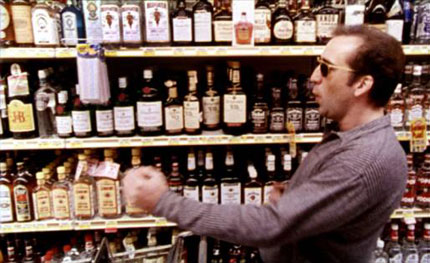
A friendly reminder that this coming tax-free weekend doesn’t just apply to TVs, leather armchairs and solid-wood shellcases for your iPad. It also applies to booze. Have your eye on a bottle of green Chartreuse VEP ($130)? Strathisla 1967 Speyside scotch whisky ($175)? Remy Martin Cognac Louis XIII Grande ($1700)? Well, grab your shopping cart and boogie down the aisle of one of these fine establishments.
» Boston wins. Damned if Boston didn’t hit it out of the park during Tales of the Cocktail in July. First of all, more Boston bar industry folk represented our city at New Orleans’ annual drinks convention than ever before. Second of all, Drink won the Grand Marnier-sponsored Barroom Brawl, besting five other top-notch cocktail bars from around the U.S. and earning the title Best Bar in America. Third of all, Drink’s Misty Kalkofen won the Pisco Sour Pentathalon and will in the near future enjoy her prize: a trip to Peru to see how desert-grown grapes turn into white brandy. Congrats to all! Liza Weisstuch offers a vivid snapshot of the competition and, more generally, the Boston slant on Tales in today’s Phoenix. Good stuff.
» Remixology. Speaking of contests, there’s a new bar celeb in town: John Mayer of Cambridge’s Craigie on Main. A relatively new member of the staff there, he wowed everyone at the Appleton Estate Rum Remixology contest earlier this week with his mixing skills, sense of humor and ability to explain how a favorite song inspired a new cocktail. His presentation involved Frankie Valli’s “Sherry Baby,” a powder-blue brocade blazer, three mixing glasses spinning on a turntable, a small disco ball, a history lesson on Jamaica’s first prime minister — Alexander Bustamante — and the year 1962. He will compete in the national finals of the competition in NYC on August 30. Go, John! Here are recipes for the Bustamante and the other semi-finalists’ tasty drinks.
» Literature. Geoff “Psycho-Gourmet” Nicholson’s fantastic essay, Drink What You Know, appeared in the New York Times’ Book Review recently. He starts by comparing the advice writers dispense about drinking to the way they depict drinking in their literature, and arrives at his thesis:
“When you think about it, rules for drinking are not so different from rules for writing. Many of these are so familiar they’ve become truisms: Write what you know. Write every day. Never use a strange, fancy word when a simple one will do. Always finish the day’s writing when you could still do more. With a little adaptation these rules apply just as well for drinking. Drink what you know, drink regularly rather than in binges, avoid needlessly exotic booze, and leave the table while you can still stand.”
Read it. And then check out the response over at Jezebel: the Reader’s Drinking Game.
» History. I was putting off going to Plymouth to learn about Pilgrims until my retirement years, but now I have a reason to go earlier. Pilgrim Hall Museum (“America’s museum of Pilgrim possessions”) is running an exhibition called “Plymouth History in a Glass: The Artifacts and Culture of Beverages and Drinking” until December 31. Silver tankards. Ceramic punch bowls. Glass tumblers. Ooh, I’m getting hot flashes. Not only that, there are two related lectures: one on historic Plymouth-area taverns on August 25 and one on September 29 called “The Design of Drinking: from the Jazz Age to the Space Age.” Far out.
» Name that bar. What would you call a bar frequented by venture capitalists, entrepreneurs and hardworking graduate students from all over the world who converge on the high-tech cluster that is Kendall Square, Cambridge? The people behind the in-the-works “Venture Cafe” are seeking a more clever name than the working title for their “place-based social networking” project. They have partnered with restaurateur Gary Strack from Central Kitchen and the Enormous Room and are scouting Kendall Square locations for a 2011 opening. With any luck the place will liven up the woefully nightlife-less neighborhood. Got a suggestion for what to call the place? Chime in on their Facebook page.
Tags: Bustamante, Craigie on Main, Drink, history, John Mayer, Kendall Square, literature, Plymouth, Tales of the Cocktail, tax-free weekend
Posted in Bartenders, Booze in the news, Cocktails, New Orleans, Nips, Pisco, Rum | 1 Comment »