Archive for September, 2007
September 30th, 2007
I want to like the bar/lounge that is part of the nouveau steak house KO Prime and used to be part of the restaurant Spire, in the posh Nine Zero Hotel (90 Tremont St.). KO Prime is in a great, history-saturated part of Boston — near the Common, the State House, the Athenaeum, the Parker House, Locke-Ober and the Old Granary Burying Ground, where Paul Revere and Samuel Adams are buried. Not bad company. My first visit was promising. I ordered the rum-based Tea Party Cocktail, which was smartly served in a plain white chilled teacup. The rum, spice and citrus flavors evoked a really good colonial-style rum punch. I also sampled the One Hot Minute, a mixture of tequila, agave nectar, lime juice and Lillet Blanc with a few drops of jalapeno Tabasco sauce, served on the rocks in a short glass. Sounds odd, but all the ingredients balanced one another out and constituted a nicely layered, zesty drink.
Unfortunately, the sleek, characterless look of the bar isn’t much changed from the Spire days — though the cowhide covering the low lounge chairs is a colorfully kitschy new touch. In the restaurant itself, the recessed ovals in the ceiling display — inexplicably, but what the hell — details of Grant Wood’s famous painting American Gothic.
Admittedly, KO Prime is about the food. We’re talking about Mr. KO, or Ken Oringer, of Clio fame, and rising young chef Jamie Bissonette, formerly of Eastern Standard. But … the bar happens to come with the place. Some time and effort were obviously put into the list of newly created cocktails. I revisited the Tea Party Cocktail and the One Hot Minute on my second pass through KO Prime. They weren’t as good as previously. The rum came through too bluntly in the Tea Party, and the One Hot Minute was served in a bigger glass. This helped throw the balance of ingredients off so that the drink tasted a little too tequila-y and a little too sweet. I mentioned to the bartender that the drink had been served in a rocks glass previously, and he said he put it in a highball glass because, basically, ‘more is better.’ With a gin and tonic, maybe, but not with a more complicated mixture.
I’m guessing Oringer and Bissonette wouldn’t be so cavalier about changing the proportion of ingredients in one of their dishes. Is it being too nitpicky to ask for consistency in the quality of the cocktails? This would make the bar at KO Prime worthy of its owner’s culinary reputation and its location’s luster.
Posted in Boston bars, Cocktails | No Comments »
September 26th, 2007
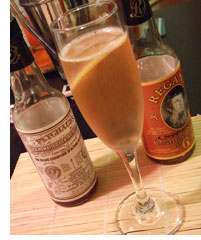 A friend of mine recently asked me to create a cocktail for her wedding. I was honored. I immediately began imagining cognac and champagne mixtures with fresh citrus and exotic liqueurs. Then my friend forwarded me the contract from the bartenders she had hired for the occasion. That brought me back to reality. How do you create a festive, wedding-worthy cocktail out of the raw materials found in the standard Marital-Industrial Complex bar setup (a phenomenon that persists no matter how fancy or distinctive the wedding)? You break out the bitters, that’s how.
You know the kinds of booze I’m talking about: Canadian Club, Seagram’s VO, a couple types of vodka, and liqueurs that were big in the ’80s, i.e. Peachtree Schnapps. No bourbon, no cognac and, obviously, no fresh citrus juice. There’d be gin and champagne, though, so I decided to work around those. My friend loves French 75s, after all.
I realized that the cocktail would have to be very simple, given that I would need to batch up the spirits beforehand and transport them to the wedding myself in my Executair 101; there was no prayer that the speed-pouring M.I.C. bartenders would follow a recipe, even if I supplied the called-for ingredients. I could only rely on them to chill the spirit mixture and top it with champagne. Since I love the combination of bitters that make another champagne cocktail, the Seelbach, so distinctive, I thought I’d use two kinds of bitters to bring my gin-champagne mixture to life. After a few experiments, I settled on a 2:1 proportion of Regan’s orange bitters and Peychaud’s bitters.
The bride-to-be sampled my creation and proclaimed it worthy of toasting her union with a man named Jones. I think it’s pretty tasty. See for yourself:
The Mrs. Jones Cocktail
makes 2 drinks
1 oz gin
1 tsp simple syrup
4 dashes Regan’s orange bitters
2 dashes Peychaud’s bitters
Champagne
Shake first four ingredients in a mixing glass with ice and strain into 2 champagne flutes. Top with enough champagne or sparkling wine to make the cocktail light pink. Drop a very thin slice of lemon into each glass.
Endnote: I went to cocktaildb.com, and the only other drink I could find that combines orange and Peychaud’s bitters is:
The Metropole Cocktail
1 1/4 oz cognac
1 1/4 oz dry vermouth
1 dash Peychaud’s bitters
1 dash orange bitters
Add cherry
Stir in mixing glass with ice and strain into a cocktail glass.
Posted in Bitters, Champagne, Cocktails, Gin | 1 Comment »
September 24th, 2007
If you just can’t wait for the LUPEC Boston Tea Party (scroll down), and you’re dying for a tasty vintage cocktail that’ll help Boston-area women, you have until the end of September to visit some of the restaurants participating in LUPEC Boston’s “This One’s for the Ladies” drink promotion. Be sure to ask for the cocktails those establishments chose to raise money for Jane Doe Inc. (the Massachusetts Coalition Against Sexual Assault and Domestic Violence). Examples: the Pegu Cocktail at the Independent, the Hanky Panky at Eastern Standard and the Barbara West at Green Street.
I have to admit I’m partial to the latter, because … well, every LUPEC (Ladies United for the Preservation of Endangered Cocktails) member has a cocktail alias, and Barbara West happens to be mine. Not only is this dry, appetite-whetting drink delicious, it reminds me of those two great “forebroads” I knew as my grandmothers: one was named Barbara, and the other (Marion) drank sherry. Here’s the recipe for the BW, from Ted Haigh’s Vintage Spirits & Forgotten Cocktails:
Barbara West Cocktail
2 oz. gin
1 oz. sherry (preferably amontillado)
1/2 oz. fresh lemon juice
1 sm. dash Angostura bitters
Shake in an iced cocktail shaker and strain into a cocktail glass. Garnish with a lemon twist.
Posted in Cocktails, Gin | 2 Comments »
September 24th, 2007
 As a member of the Boston drinking community who’s making every effort to repopularize vintage cocktails, it’s only natural that I fell in with a group proclaiming its dedication to “breeding, raising, and releasing nearly extinct drinks into the wild.” The group is the Boston chapter of LUPEC, or Ladies United for the Preservation of Endangered Cocktails. A group of boozin’ broads (yes, “broad” is how LUPEC members refer to one another) in Pittsburgh founded LUPEC in 2001, and there are now chapters in Denver, New York, Philadelphia and Phoenix, in addition to Boston.
The history of cocktails and the stories of our forebroads who sipped them are only part of the LUPEC Boston mission. The other part is raising funds for organizations that benefit Boston-area women. The LUPEC Boston Tea Party, a coed, 1920s speakeasy-inspired event, will benefit Jane Doe Inc. in recognition of Domestic Violence Awareness Month (October). The October 7th party takes place on the Boston Sailing Center’s permanently docked Louisiana riverboat at Lewis Wharf in the North End from 7-11 p.m. For your $50 ticket, you’ll get cocktails (served in teacups — shhh, don’t tell the cops), hors d’oeuvres from top Boston-area restaurants, live music, dancing, entry to raffles and a chance to wear those vintage cocktail party clothes you bought at the Garment District. The LUPEC Boston Tea Party only has room for 100 guys and dolls, so purchase your tickets now (in person, in cash — hey, it’s a speakeasy) at either Green Street in Cambridge (280 Green St.) or Toro in the South End (1704 Washington St.).
Posted in Events | No Comments »
September 20th, 2007
I present to you something that’ll make imbibing in Beantown a little easier: a Google map of best Boston bars. Happy wandering.
Anyone out there good at map mashups? I’d love to put best Boston bars and the MBTA on the same map. If you can make that happen, I will personally buy you a drink at the Boston-area bar of your choice.
Posted in Books & resources, Boston bars | 7 Comments »