Archive for the ‘Pisco’ Category
May 15th, 2011
Muchas gracias to everyone who turned up at last Sunday’s Cócteles Latinos! party at Trina’s Starlite Lounge. The drinks, the food, the music and the vibe were all tops. It’s not every day that you can sip on a Mountain Dew Fizz (made with Beija Cachaca) while nibbling on Peruvian potato salad and pulled-pork tortillas, listening to X and the Reverend Horton Heat (thanks, DJ Dave Cagle), and basking in a complete takeover of the Starlite’s main bar. Thanks to Beau and Trina Sturm for hosting this shindig with drinkboston, and to guest bartenders Ben Sandrof and Misty Kalkofen for their dream-team antics. Below, enjoy the party photos and the recipes — just in time for your summer drinking needs — that Beau, Ben and Misty dreamed up for the occasion. Salud!
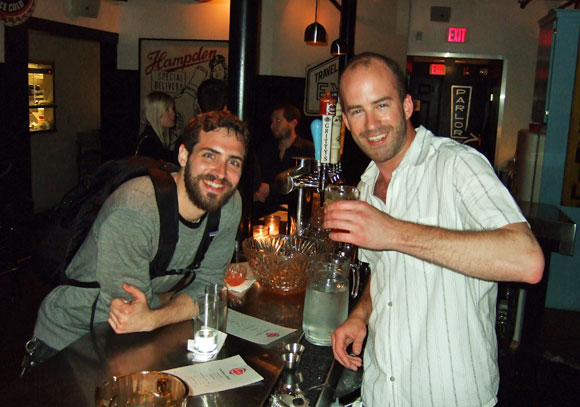
Green Street bartender George Theodore Jenich and Ben Sandrof
Chinaco Punch
2 oz Chinaco Plata tequila
3/4 oz Yellow Chartreuse
1/4 oz Luxardo Maraschino
1/2 oz lemon juice
1 1/2 oz watermelon juice
1 oz vinho verde
Combine all ingredients and serve in a rocks glass over a large ice cube or two. Scale up for a big punch bowl with a big chunk of ice in the middle.
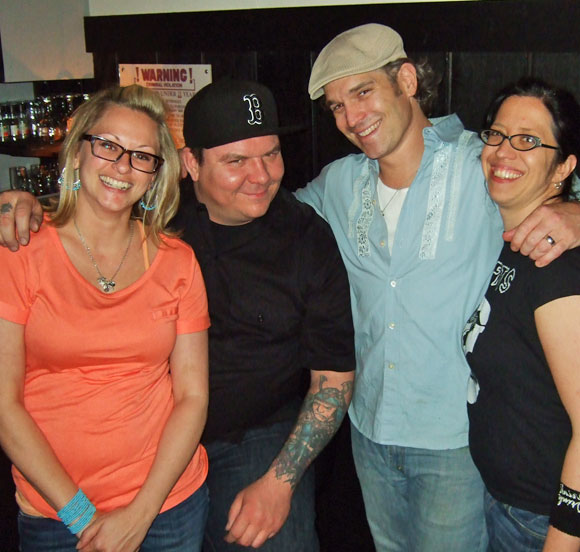
Trina Sturm, Dave Cagle, Beau Sturm and Misty Kalkofen
Corn & Oil
1 1/2 oz. Brugal Anejo rum
3/4 oz Velvet Falernum
1/2 oz lime juice
Shake ingredients briefly over ice, then strain into glass with crushed ice. Top with several dashes Angostura bitters.
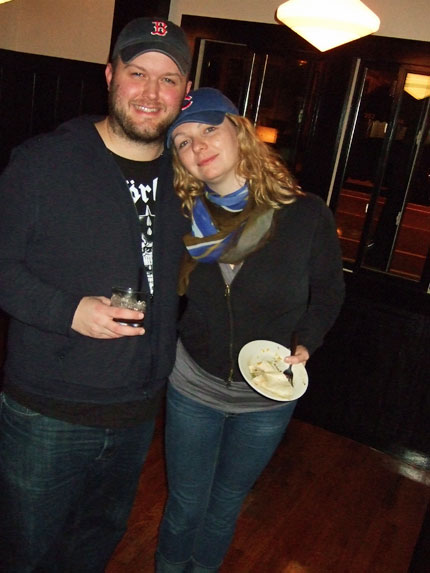
Phillip Naslund of Local 149 and friend Sarah
Magic Word
2 oz Chinaco Plata tequila
3/4 oz St Germain Elderflower Liqueur
1/2 oz Aperol
1/2 oz lemon juice
1 1/2 oz hard cider
Combine all ingredients and serve in a rocks glass over a large ice cube or two. Scale up for a big punch bowl with a big chunk of ice in the middle.

Lillian Milagros Carrasquillo, Jonathan O'Toole, Kim Boutwell and Sean Frederick
Mountain Dew Fizz
2 oz Beija Cachaca
1 1/2 oz Mountain Dew
1/2 oz lime juice
1/4 oz agave syrup
1 egg white
Dry shake all ingredients except Mountain Dew. Add ice and Mountain Dew and shake very well until egg white froths. Strain into highball glass.
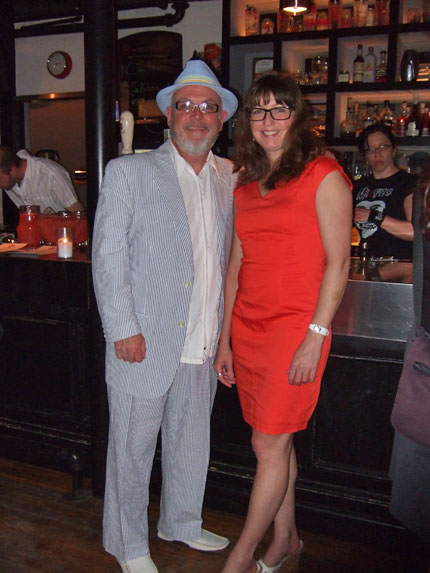
Brother Cleve with Lauren Clark of drinkboston
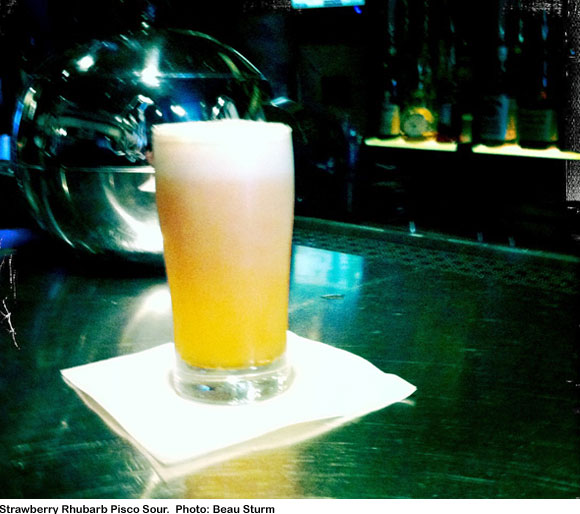
Strawberry Rhubarb Pisco Sour
2 oz Macchu Pisco
1 egg white
1 oz fresh strawberry syrup*
1/2 oz simple syrup
1/2 oz lime juice
Rhubarb bitters
Dry shake all ingredients except rhubarb bitters. Add ice and shake very well until egg white froths. Strain into highball glass and top with rhubarb bitters. *Strawberry syrup: puree fresh strawberries and pass through a chinois. Mix liquid 1:1 with white sugar until sugar dissolves.

Los cocteleros: Noah and Elizabeth
Zocalo
2 oz Del Maguey Vida mezcal
1/2 oz dry vermouth
1/2 oz canela (cinnamon) simple syrup
2 dashes Angostura orange bitters
Lemon oil garnish
Combine first four ingredients in mixing glass filled with ice and stir very well. Strain into chilled martini or rocks glass and twist lemon peel over the top.
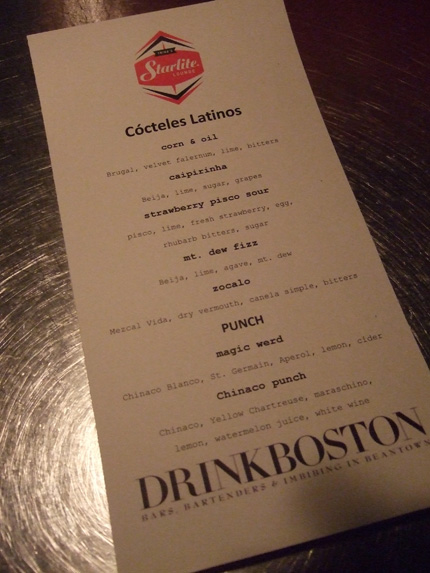
Tags: cachaca, mezcal, summer cocktails, Trina's Starlite Lounge
Posted in Cocktails, Events, Pisco, Punch, Rum, Tequila | No Comments »
April 30th, 2011
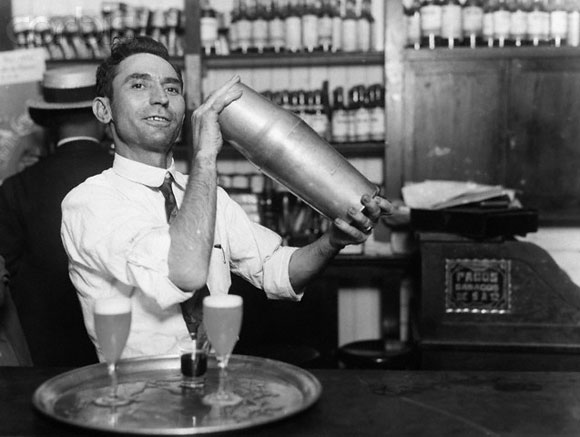
On May 8, drinkboston and Trina’s Starlite Lounge are throwing a party, Cócteles Latinos!, featuring cocktails (see below) made with Latin American spirits: rum, tequila, mezcal, cachaca, pisco and perhaps the odd Mayan liqueur. Salud!
Besides Mother’s Day and the beginning of World Cocktail Week, we’re celebrating drinkboston’s 5th birthday. Boston’s First Couple of bartending, Beau and Trina Sturm, will be our hosts, and special guests Ben Sandrof and Misty Kalkofen will get behind the stick. Deep Ellum’s Dave Cagle will spin party tunes, and Starlite chef Suzi Maitland and her crew will put out the Latin American treats.
Cocktail menu will feature both old-school and new-school libations, TBD. Thanks a million to our sponsors: Brugal rum, Chinaco tequila, Del Maguey Vida mezcal and Macchu Pisco.
- Cócteles Latinos! Hosted by drinkboston and Trina’s Starlite Lounge (3 Beacon St., Somerville)
- Sunday, May 8 (yes, Mother’s Day — bring mom!)
- 7:00 p.m. until last call
- Tickets are $40 and include three cocktails and Latin American snax.
- Call the Starlite at 617-576-0006 to purchase your ticket in advance, as there’s a good chance we’ll sell out quickly.
Put on your best Old Havana nightclub threads and come on by. See you there!
THE COCKTAILS
(Exact recipes will be published after the event.)
Zocalo
Del Maguey Vida Mezcal
Dry vermouth
Canela simple syrup
Angostura bitters
Lemon oil
Chinaco Punch
Chinaco Plata Tequila
Yellow Chartreuse
Luxardo Maraschino
Lemon juice
Watermelon juice
Vino verde
Magic Word
Chinaco Plata Tequila
St Germain
Aperol
Lemon juice
Hard cider
Corn & Oil
Brugal Anejo Rum
Velvet Falernum
Lime juice
Angostura bitters
Strawberry Rhubarb Pisco Sour
Macchu Pisco
Egg white
Lime juice
Fresh strawberry syrup
Rhubarb bitters
Mountain Dew Fizz
Cachaca
Mountain Dew
Lime juice
Agave syrup
Egg white
PLUS: Classic Mojitos & Green Grape Caipirinhas
Posted in Cocktails, Events, Pisco, Rum, Tequila | No Comments »
August 12th, 2010
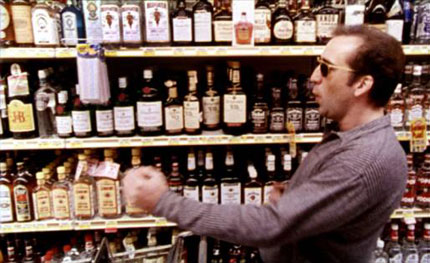
A friendly reminder that this coming tax-free weekend doesn’t just apply to TVs, leather armchairs and solid-wood shellcases for your iPad. It also applies to booze. Have your eye on a bottle of green Chartreuse VEP ($130)? Strathisla 1967 Speyside scotch whisky ($175)? Remy Martin Cognac Louis XIII Grande ($1700)? Well, grab your shopping cart and boogie down the aisle of one of these fine establishments.
» Boston wins. Damned if Boston didn’t hit it out of the park during Tales of the Cocktail in July. First of all, more Boston bar industry folk represented our city at New Orleans’ annual drinks convention than ever before. Second of all, Drink won the Grand Marnier-sponsored Barroom Brawl, besting five other top-notch cocktail bars from around the U.S. and earning the title Best Bar in America. Third of all, Drink’s Misty Kalkofen won the Pisco Sour Pentathalon and will in the near future enjoy her prize: a trip to Peru to see how desert-grown grapes turn into white brandy. Congrats to all! Liza Weisstuch offers a vivid snapshot of the competition and, more generally, the Boston slant on Tales in today’s Phoenix. Good stuff.
» Remixology. Speaking of contests, there’s a new bar celeb in town: John Mayer of Cambridge’s Craigie on Main. A relatively new member of the staff there, he wowed everyone at the Appleton Estate Rum Remixology contest earlier this week with his mixing skills, sense of humor and ability to explain how a favorite song inspired a new cocktail. His presentation involved Frankie Valli’s “Sherry Baby,” a powder-blue brocade blazer, three mixing glasses spinning on a turntable, a small disco ball, a history lesson on Jamaica’s first prime minister — Alexander Bustamante — and the year 1962. He will compete in the national finals of the competition in NYC on August 30. Go, John! Here are recipes for the Bustamante and the other semi-finalists’ tasty drinks.
» Literature. Geoff “Psycho-Gourmet” Nicholson’s fantastic essay, Drink What You Know, appeared in the New York Times’ Book Review recently. He starts by comparing the advice writers dispense about drinking to the way they depict drinking in their literature, and arrives at his thesis:
“When you think about it, rules for drinking are not so different from rules for writing. Many of these are so familiar they’ve become truisms: Write what you know. Write every day. Never use a strange, fancy word when a simple one will do. Always finish the day’s writing when you could still do more. With a little adaptation these rules apply just as well for drinking. Drink what you know, drink regularly rather than in binges, avoid needlessly exotic booze, and leave the table while you can still stand.”
Read it. And then check out the response over at Jezebel: the Reader’s Drinking Game.
» History. I was putting off going to Plymouth to learn about Pilgrims until my retirement years, but now I have a reason to go earlier. Pilgrim Hall Museum (“America’s museum of Pilgrim possessions”) is running an exhibition called “Plymouth History in a Glass: The Artifacts and Culture of Beverages and Drinking” until December 31. Silver tankards. Ceramic punch bowls. Glass tumblers. Ooh, I’m getting hot flashes. Not only that, there are two related lectures: one on historic Plymouth-area taverns on August 25 and one on September 29 called “The Design of Drinking: from the Jazz Age to the Space Age.” Far out.
» Name that bar. What would you call a bar frequented by venture capitalists, entrepreneurs and hardworking graduate students from all over the world who converge on the high-tech cluster that is Kendall Square, Cambridge? The people behind the in-the-works “Venture Cafe” are seeking a more clever name than the working title for their “place-based social networking” project. They have partnered with restaurateur Gary Strack from Central Kitchen and the Enormous Room and are scouting Kendall Square locations for a 2011 opening. With any luck the place will liven up the woefully nightlife-less neighborhood. Got a suggestion for what to call the place? Chime in on their Facebook page.
Tags: Bustamante, Craigie on Main, Drink, history, John Mayer, Kendall Square, literature, Plymouth, Tales of the Cocktail, tax-free weekend
Posted in Bartenders, Booze in the news, Cocktails, New Orleans, Nips, Pisco, Rum | 1 Comment »
November 5th, 2009
I got to thinking about Massachusetts’ peculiar “cordial license” recently after sitting down with Courtney Bissonnette to get a sneak peak at her cocktail menu for Coppa. The latest venture by prolific chef Ken Oringer is set to open in the South End any minute now and amp up the Italian enoteca concept the way Toro has done with Spanish tapas. Bissonnette will helm the bar program at both establishments, in which her husband, chef Jamie Bissonnette, is a partner.
Unlike Toro, which has a full liquor license, Coppa has a beer and wine license with a permit to serve cordials and liqueurs. So Bissonnette, collaborating with head bartender Corey Bunnewith (recently of Drink), devised a list of cocktails based on, yes, liqueurs like St. Germain and Cherry Heering, but also vermouths and other aromatized wines, Italian bitters like Aperol and Campari, and a splash of Plymouth Sloe Gin and Pimms No. 1. It includes an Aperol Spritz (Aperol, prosecco, soda) and a Lenny e Joan (Plymouth Sloe Gin, dry vermouth, Cynar, lime, orange zest, sugar rim). Creative, tasty-looking stuff, and, as Boston magazine recently pointed out, Coppa isn’t the only place making cocktails within the confines of a cordial license.
Which brings us to the question: just what are the confines of such a license? Well … no one really knows. “It was never spelled out in writing,” said a long-time member of Boston’s liquor wholesale industry who wishes to remain anonymous. This source — I’ll call him Stan — says that the license came about because of Italian-American drinking customs. Specifically, North End restaurateurs, who typically had beer and wine licenses, were miffed about getting busted periodically for offering their clientele a customary after-dinner shot of Sambuca or Strega. So, in 1994, the cordials and liqueurs permit was born. Stan connects this development to the growing clout of Italian politicians around that time. While I haven’t done the research to verify that claim, it is intriguing that 1994 marked the beginning of both the cordial license and Tom Menino’s long (and, since Tuesday, getting longer) tenure in the mayor’s office.
Anyway, the thing about the cordial license is that “cordial” and “liqueur” have been liberally defined. Most people — including liquor industry folk, says Stan — first assumed that the license referred only to sugary spirits flavored with various fruits and botanicals. But over the years, outliers snuck in. Grappa? Pisco? Check. Applejack? Check. Flavored vodka? Check. So … if you’re a grape-based spirit, and you want to be served under a cordial license, say you’re from anywhere but France. If you’re applejack, don’t worry; only about three people in the city know what you really are (70% grain neutral spirit — woo hoo!). And if you’re vodka, just infuse yourself with kiwi or something to make yourself seem cute and harmless as a bunny, even though you’re sugarless and 80 proof.
It all adds up to one very grey area, where some spirits attract scrutiny and others don’t. Grappa is an example of the former, and therefore is typically served on the sly, according to Stan. It is actually up to the wholesale companies to decide what they are and aren’t allowed to sell to establishments with cordial licenses. And they all do so individually, says Stan, so there tends to be some variation in product listings. A restaurateur might be able to get, say, applejack through one wholesaler but not another.
While a full liquor license is almost always going to be the most desirable type of license, mixologists can get pretty creative with a cordial license. And, presumably, these licenses are cheaper and easier to get than full licenses, which are strictly capped and therefore so coveted that corruption regularly ensues. Liquor laws are weird in a sometimes cool way. I love that a special provision created to accommodate the customs of an influential ethnic group has spawned creative bars that are mixing interesting drinks with unusual ingredients. And it’s nice knowing that if I go to a place like Coppa and I’m not in the mood for a mixed drink, I can get a nice, civilized, 110-proof shot of green Chartreuse.
Tags: Coppa, cordials, liquor license, Massachusetts liquor laws
Posted in Applejack, Liqueur, Pisco, Vermouth | 6 Comments »
May 16th, 2008
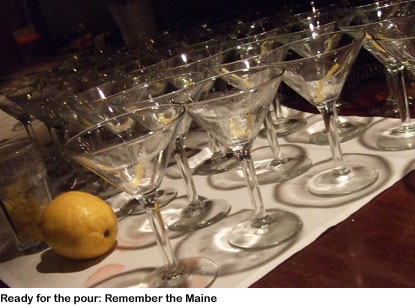
If you couldn’t get into the sold-out World Cocktail Day party at Green Street on Tuesday, I’m sorry to tell you that it was a ton o’ fun. In fact, it was an evening I was downright thankful for. It marked the end of World Cocktail Week, whose frivolity contrasted unavoidably with a coinciding spate of tragedies: the cyclone in Myanmar, the earthquake in China, tornadoes in the U.S. (not to mention the continuing grimness in Iraq, Afghanistan, etc, etc, etc). I’m not trying to bring anyone down here. I’m just saying there were times during the evening when I paused, soaked up the good vibe among the crowd and thanked my lucky stars.
Our guest bartenders, four knowledgable and talented New England gentlemen, each mixed a vintage cocktail of their choice, then went from table to table recounting that libation’s origins and moment in history. They time-traveled from 1870s San Francisco to an 1880s bartender’s manual to the Spanish-American War (1898) to an early 20th-century obsession with songs about maidens. The cocktails (below) were accompanied by flatbread pizza, beef tongue tacos and other tasty treats from the Green Street kitchen. We started with an innocent-seeming Maiden’s Prayer and ended with a brassy Remember the Maine, at which point the joke was whether anyone would remember the Maine.
Maiden’s Prayer
by Tom Schlesinger-Guidelli of Eastern Standard
3/4 oz Plymouth Gin
3/4 oz white rum
3/4 oz lemon juice
1/2 oz Cointreau
1 dash orange bitters
Shake well over ice, strain into a cocktail glass, and garnish with a flower. Based on a variation (circa 1930) of the original (circa 1907), which may have been inspired by a hit piano tune of the late 1800s.
Nicol’s Secret Pisco Punch (without cocaine)
by John Gertsen of No. 9 Park
6 parts BarSol pisco
3 parts lemon juice
2 parts pineapple syrup
1 part water
Shake, strain into a cocktail glass, and garnish with pineapple. The recipe originated with Duncan Nicol, the proprietor of San Francisco’s Bank Exchange saloon from the late 1870s until Prohibition. The secret’s out: a wee bit of gum arabic (which comes in a white powder — get it?) makes this a silky sweet punch.
Bijou
by Brother Cleve, cocktail historian and mixologist
1/3 Plymouth Gin
1/3 sweet vermouth
1/3 green Chartreuse
1 dash orange bitters
Stir well over ice and strain into a chilled cocktail glass. Garnish with a cherry or a lemon twist. A Golden Age cocktail dating back to Harry Johnson’s Bartender’s Manual in 1882.
Remember the Maine
by John Myers, Portland, Maine-based bartender and cocktail historian
1 1/2 oz good rye whiskey or bourbon (i.e. Maker’s Mark)
3/4 oz sweet vermouth
1-2 tsp of cherry brandy
1/2 tsp absinthe or Pernod veritas
Stir well over ice and strain into a chilled cocktail glass with a lemon twist. Named for the rallying cry of the Spanish-American war, the cocktail is described in Charles H. Baker Jr.’s The Gentleman’s Companion (1939). Myers’ note: “Any absinthe substitute will work, but the ‘cherry brandy’ is up for some interpretation. Different drinks occur — but still work, so little is deployed — if Cherry Heering or maraschino are used.”
World Cocktail Day at Green Street benefited the Museum of the American Cocktail, which launched World Cocktail Week. Plymouth Gin, Maker’s Mark bourbon and BarSol Pisco were the evening’s sponsors. Many thanks to Green Street bar manager Misty Kalkofen, owner Dylan Black and everyone else in the kitchen, behind the bar and out on the floor for totally kicking ass.
Posted in Cocktails, Events, Gin, Pisco, Whiskey | 8 Comments »