Heads up, drinkbostonians: Josey Packard, one of Boston’s best bartenders, will appear tonight on the Rachel Maddow Show on MSNBC (9:00 p.m. EST) to mix up a flaming bowl of Christmas Rum Punch. Go, Josey, go!
Regular viewers know that Maddow often closes her political talk show with a bit on cocktails — I recall Dale DeGroff mixing Irish coffees on the set earlier this year. More recently, Maddow shared with her audience an investigative coup: an actual drink menu from one of the Obamas’ regular White House cocktail parties. As you see in the short video segment above, she not only described the cocktails (the Emerson, the Stone Fence and the Frost) but explained some of their ingredients (applejack, maraschino liqueur), named and photographed the bartenders who served them (Derek Brown and Adam Bernbach), pointed out that bartending is an American invention, and signed off with this delicious nugget: “And remember, Martinis do not contain vodka.”
Packard, a friend of Maddow’s who did guest spots about cocktails on the latter’s radio show back in her Air America days, will make a punch recipe adapted from the 1949 edition of Esquire’s Handbook for Hosts, about which Paul Clarke writes humorously on Cocktail Chronicles. I got a live preview at a recent Christmas party as Josey did a (not so) dry run of the flaming punch for the assembled guests. It was very cool, what with all the spices and orange oil making sparks as they were tossed into the bowl. Even the sternest Scrooge would be uplifted by this vessel of flaming goodness.
Watch the show, congratulate Josey the next time you’re at Drink, and have a merry Christmas!
I got to thinking about Massachusetts’ peculiar “cordial license” recently after sitting down with Courtney Bissonnette to get a sneak peak at her cocktail menu for Coppa. The latest venture by prolific chef Ken Oringer is set to open in the South End any minute now and amp up the Italian enoteca concept the way Toro has done with Spanish tapas. Bissonnette will helm the bar program at both establishments, in which her husband, chef Jamie Bissonnette, is a partner.
Unlike Toro, which has a full liquor license, Coppa has a beer and wine license with a permit to serve cordials and liqueurs. So Bissonnette, collaborating with head bartender Corey Bunnewith (recently of Drink), devised a list of cocktails based on, yes, liqueurs like St. Germain and Cherry Heering, but also vermouths and other aromatized wines, Italian bitters like Aperol and Campari, and a splash of Plymouth Sloe Gin and Pimms No. 1. It includes an Aperol Spritz (Aperol, prosecco, soda) and a Lenny e Joan (Plymouth Sloe Gin, dry vermouth, Cynar, lime, orange zest, sugar rim). Creative, tasty-looking stuff, and, as Boston magazine recently pointed out, Coppa isn’t the only place making cocktails within the confines of a cordial license.
Which brings us to the question: just what are the confines of such a license? Well … no one really knows. “It was never spelled out in writing,” said a long-time member of Boston’s liquor wholesale industry who wishes to remain anonymous. This source — I’ll call him Stan — says that the license came about because of Italian-American drinking customs. Specifically, North End restaurateurs, who typically had beer and wine licenses, were miffed about getting busted periodically for offering their clientele a customary after-dinner shot of Sambuca or Strega. So, in 1994, the cordials and liqueurs permit was born. Stan connects this development to the growing clout of Italian politicians around that time. While I haven’t done the research to verify that claim, it is intriguing that 1994 marked the beginning of both the cordial license and Tom Menino’s long (and, since Tuesday, getting longer) tenure in the mayor’s office.
Anyway, the thing about the cordial license is that “cordial” and “liqueur” have been liberally defined. Most people — including liquor industry folk, says Stan — first assumed that the license referred only to sugary spirits flavored with various fruits and botanicals. But over the years, outliers snuck in. Grappa? Pisco? Check. Applejack? Check. Flavored vodka? Check. So … if you’re a grape-based spirit, and you want to be served under a cordial license, say you’re from anywhere but France. If you’re applejack, don’t worry; only about three people in the city know what you really are (70% grain neutral spirit — woo hoo!). And if you’re vodka, just infuse yourself with kiwi or something to make yourself seem cute and harmless as a bunny, even though you’re sugarless and 80 proof.
It all adds up to one very grey area, where some spirits attract scrutiny and others don’t. Grappa is an example of the former, and therefore is typically served on the sly, according to Stan. It is actually up to the wholesale companies to decide what they are and aren’t allowed to sell to establishments with cordial licenses. And they all do so individually, says Stan, so there tends to be some variation in product listings. A restaurateur might be able to get, say, applejack through one wholesaler but not another.
While a full liquor license is almost always going to be the most desirable type of license, mixologists can get pretty creative with a cordial license. And, presumably, these licenses are cheaper and easier to get than full licenses, which are strictly capped and therefore so coveted that corruption regularly ensues. Liquor laws are weird in a sometimes cool way. I love that a special provision created to accommodate the customs of an influential ethnic group has spawned creative bars that are mixing interesting drinks with unusual ingredients. And it’s nice knowing that if I go to a place like Coppa and I’m not in the mood for a mixed drink, I can get a nice, civilized, 110-proof shot of green Chartreuse.
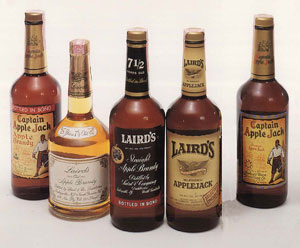
Drinkboston.com reader Adam Machanic emailed me recently with the results of some exhaustive mixological studies of apple-based spirits from Laird’s & Co., the oldest producer of America’s oldest native distilled spirit, applejack. In addition to applejack (a blend of 35 percent apple brandy and 65 percent grain neutral spirits that puts the “jack” in a Jack Rose), Laird’s produces Old Apple Brandy, aged in oak for 7 1/2 years, and 100-proof, bottled-in-bond apple brandy that’s also 7 1/2 years old. It takes about 20 pounds of apples to make just one of these bottles of pure apple spirits. Wow. Adam’s findings made me think, ‘Man, I’ve gotta get my hands on some of this stuff!’ and I wanted to share them:
“I ended up ‘experimenting’ my way through an entire bottle of the 7 1/2 year old brandy over the past several weeks, and I have to say, if science class experiments had been that fun I might have studied a bit more often. Seriously, though, it’s great stuff. Compared with the ‘smooth blend’ version, it hits you quite hard in the nose with apple essence the moment you remove the cap. Straight, it has a bit of sweetness, and is exceptionally drinkable neat or with an ice cube or two. Color-wise, it’s light, golden and exceptionally clear. Excellent in a Marconi Wireless with some good vermouth — but much better with Vya than with Punt e Mes; the latter overpowers it. I also thought it was wasted in a Jack Rose — the drink tasted no different to me than with the normal applejack. I really enjoyed it as an Old Fashioned, with 1/3 tsp of sugar, two dashes of Regan’s orange bitters, and a dash of Angostura.
“I enjoyed my experiments so much that I placed a follow-up order and got my hands on some of the 100 proof, bonded stuff. This is an entirely different beast — the liquid in the bottle has an almost rusty tone, and is slightly hazy compared with the brandy. And as an added bonus, there are a few floating specks of something in each bottle, visible if you shake it up a bit. Who knows what’s in there. The apple sensation is huge and overpowering both on the nose and the tongue, but thanks to the increased proof there is also quite a bit of heat — I don’t like this one neat at all. On the flip side, it stands up to the Punt e Mes just fine in a Marconi Wireless, and can even be a bit overpowering. I haven’t had a chance to do a Jack Rose yet, but that’s next on the list — I have high hopes for its success there.”
Many thanks to Adam for putting his liver to the test for the sake of experimentation. Unfortunately, he had to order the specialty Laird’s items online; I don’t know of any liquor stores in the Boston area that carry anything other than the blended applejack. Please, correct me if I’m mistaken.
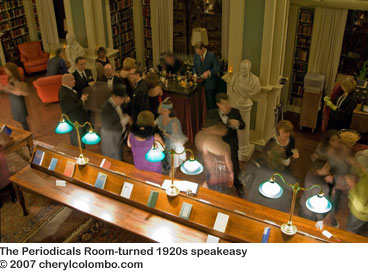
Last night, the Boston Athenaeum, one of America’s oldest private libraries, threw a Roaring Twenties party for some of its members with the help of drinkboston. There was a password to get in (“Gatsby sent me”), a secret entrance to the Periodicals Room where the festivities were held, a jazz band, cucumber sandwiches and, naturally, vintage cocktails (see below). Also, every attendee was handed an antique playing card; the game was to find the other partygoer with the same card and write something down about that person in the guest book. In the end, a man in a smoking jacket tried to bribe the fuzz who raided the speakeasy, but nothing doing — they sent us off to where we belonged: the 21st Amendment.
The party was thrown for the Athenaeum’s “associate members” (aka members 41 and under), some of whom, like me, helped plan the shindig. Not surprisingly, I was in charge of making sure we had quality hooch. Enter some of Boston’s best bartenders — John Gertsen, Misty Kalkofen and Tom Schlesinger-Guidelli — and the signature cocktails they created just for the event. One of those drinks, the Red Rot Cocktail, was specially commissioned by the Athenaeum as an homage to book restoration. That’s right — many of the library’s old, red leather book covers suffer from “red rot,” a pinkish mildew whose remedy is a chemical solution known as “red rot cocktail.” The recipes below appear as I wrote them for the party’s program, in a style cribbed straight from Prohibition-era bon vivant Charles Baker, who wrote the Gentleman’s Companion.
The Athenaeum is trying to get the word out to potential younger members that you don’t have to be a Mayflower descendant to join. All you need is four references and $115 for a one-year associate membership. If you have even the faintest interest in history or are simply proud to say you live in Boston because of its intellectuals, join up and see how you like it. The recently restored building is gorgeous, there’s fine art all over the place, there are tons of events, and the items in the Special Collections are damned impressive. George Washington’s library? Yeah, it’s there. And they throw a smashing party, too.
Red Rot Cocktail, which Rather Resembles the Noxious Liquid Medicine for Moldy Red Leather-bound Books but Nonetheless Pleases the Palate
To one jigger of London dry gin add one half ounce each of St. Germain elderflower liqueur, Cherry Heering and fresh lemon juice, and two goodly dashes of Peychaud’s bitters. Shake vigorously with ice and turn into a champagne saucer. (Created by Misty Kalkofen of Green Street and Lauren Clark of drinkboston)
Foglia Noce (Walnut Leaves), being a Mixture Inspired by the Marconi Wireless and Evocative of Tuscan Autumns and Colonial Taverns
Into a bar glass turn two and one-half ounces of applejack, one ounce of Nocino and two judicious dashes of Fee’s Whisky Barrel Aged Bitters. Stir with lump ice, strain into a chilled Old Fashioned glass and finish with orange oil. (Created by John Gertsen of No. 9 Park)
Flowers for Murphy, being a Bracing and Bubbly Homage to Prince and Princess of the Jazz Age Gerald and Sara Murphy, who Inspired us with a Mixture Called the Bailey
Lightly chill one jigger of London dry gin, three-quarters ounce of simple syrup, a split of lime and grapefruit juices to equal another three-quarters ounce, and one-quarter ounce of green Chartreuse. Turn the mixture into a champagne saucer and top it with bubbly and a small mint leaf. (Created by Tom Schlesinger-Guidelli of Eastern Standard)
For those of you who saw the segment on NECN’s Chet Curtis Report, here’s the recipe for the Marconi Wireless, the cocktail I demo’d on the show:
1 1/2 oz applejack
3/4 oz sweet vermouth
2 dashes orange bitters
Stir all ingredients over ice in a mixing glass. Strain into a cocktail glass.
The reason I chose this cocktail is that, since it uses America’s oldest native distilled beverage — applejack — it is the perfect thing to celebrate one of our oldest holidays, Thanksgiving. Appearing as a founding member of LUPEC Boston and the publisher of drinkboston.com, I mixed this drink on the air. And there were no major spills. Here’s my original post about this interesting drink. Cheers!
"Lauren Clark takes readers on a supremely sudsy tour of New England ales, lagers, pilsners, and porters. This is the New England the Puritans warned everybody about, but few have chronicled."
– Wayne Curtis, And a Bottle of Rum: A History of the New World in 10 Cocktails