Archive for October, 2006
October 30th, 2006
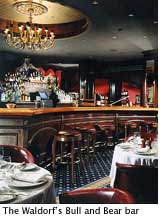 On a brief trip to Manhattan last week, we experienced two different eras of New York City cocktail culture. Still giddy from our discovery of the Marconi Wireless, we headed to the Bull and Bear bar at the Waldorf-Astoria (Lexington Ave. and 49th St.), the grand, old hotel where the drink was invented early last century. It was about 7 p.m., and we found a standing spot at the crowded, wraparound bar that is the centerpiece of the room. A stock ticker’s red, digital letters scrolled by on one wall, and the people sitting at the bar seemed to be serious about their drinking. I guess out of a lack of faith that the Waldorf’s modern bartenders would have an encyclopedic knowledge of the obscure cocktails invented there, we played it safe and ordered Manhattans. These came in huge stemmed glasses and were very cold and very good, if lacking a little in bitters. I wouldn’t want to do it every day, but once in a while, it’s fun to pay the $15-per-cocktail admission fee to chill out in a plush, steeped-in-history bar staffed by polite older men in ties.
The next night, it was a polite younger man in jeans who took care of us at East Side Company (49 Essex St. near Grand St.), a new East Village bar that is to the Bull and Bear what Scarlett Johansson is to Bette Davis. To be honest, we wound up there because we couldn’t get into East Side Co.’s nearby older sibling, Milk and Honey (134 Eldridge St.), a fabled “speakeasy” with no sign and an unlisted phone number. Along with Little Branch, these two bars comprise a mini-empire of intimate drinking dens established by Sasha Patraske, a mixologist-consultant a la Dale DeGroff (King Cocktail).
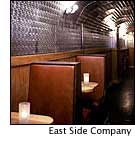 You enter East Side Co. through a heavy door that is almost indiscernably built into a wooden facade. You then find yourself in something like a windowless dining car lined in shiny, pressed tin and lit mostly by candles. The drink menu here is intentionally limited to about 15 cocktails, including fruit cups (i.e. a variation on a Pimm’s Cup), highballs, and standards. We started with a Presbyterian (bourbon and ginger-beer highball) and a Martini. When I ordered my Martini, I experienced the novelty of not being asked, “vodka or gin?” Our bartender, Anthony, simply made the drink as it would have been made 50 years ago — with gin. As at Milk and Honey, the barkeeps at East Side Co. freshly crack blocks of ice for each cocktail. A jagged-edged cube chilled my significant other’s second drink, a Manhattan, as he sipped it; Scott wasn’t sure about this method at first but took a shine to it once the cube had a chance to melt a bit. My second drink, a Negroni, was perfect, burnt orange peel and all. We were the only customers in the place; it was a Tuesday night and also way too early for the usual cool cats who frequent this bar. So, we exchanged life stories with Anthony, a native Chicagoan who is invited to drink with us up in Boston any time.
Posted in NYC | 1 Comment »
October 24th, 2006
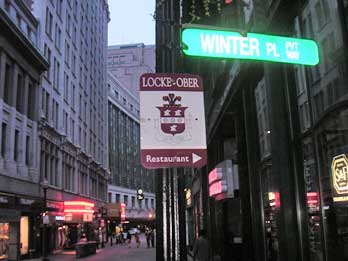
If you’re planning on turning to alcohol to help decision-making in the voting booth this Election Day, go out and order yourself a cocktail that was invented in Boston for just that reason: the Ward Eight (whiskey, lemon juice and a bit of sugar and grenadine). If you want to be really authentic, you can order this cocktail at Locke-Ober (3 Winter Place near Downtown Crossing), where it was invented circa 1898. According to cocktail historians Gary and Mardee Regan, the Ward Eight was created the day, ahem, before the election to celebrate the apparently forgone victory of influential Boston pol Martin M. Lomasney, aka “the Czar of Ward Eight,” in the race for the state legislature. The earliest recipe for the drink calls for a splash of OJ, but most cocktail enthusiasts think that’s a bad idea and stick to the less sweet, simpler version. Anthony Giglio wrote an intriguing Boston Magazine article earlier this year about the “great Ward Eight debate” that a group of local bartenders and cocktail aficionados had about the origins of the drink.
The Ward Eight is extra tasty with real grenadine syrup (made from pomegranate juice, sugar and a dash of orange flower water), which you can find at some of Boston’s best bars, including B-Side Lounge, Eastern Standard, Green Street and No. 9 Park.
Posted in Cocktails, Whiskey | 1 Comment »
October 24th, 2006
Established: 2005
Specialty: Cocktails
Prices: Moderate to high
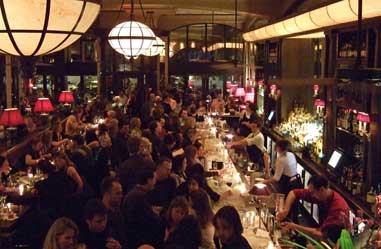
Atmosphere: Spacious, stylish bar with a pre-Prohibition era look, outstanding vintage cocktails, old-school professional service, and an American food menu suitable for many wallets.
See Best Boston bars for address and contact info.
Boston needed a place like Eastern Standard. The city is full of Irish pubs, cramped bars in exclusive restaurants, tony lounges catering to the Apple-tini set, and opulent hotel bars that only executives can afford. By contrast, Eastern Standard is a spacious, brasserie-style restaurant with a roomy bar area and a menu that has something for everyone but is not dumbed-down in the least. You can get a cocktail and a bar snack, like oysters or cod cakes; you can have a serious dinner with wine, dessert, the works; or you can have a beer and a dog. Owner Garrett Harker (formerly a partner with Barbara Lynch of No. 9 Park) and his staff run a pleasingly tight ship, with cocktails and service that are never half-assed.
The young, white-shirted bar staff, led by Jackson Cannon, are among a new breed of barkeep that takes mixology and service seriously. But they’re never over-earnest or snooty. For example, along with the historically correct Alaska and Filmograph cocktails on the menu, you have the Rat. This drink is made of the strong, bitter spirit Fernet Branca (what Cannon calls “Jagermeister for men”) and Coke and is named for the dive rock club that once stood on this spot in Kenmore Square. The bar crew is also knowledgable about wine, and they pour a stellar beer list that includes small (read: affordable) bottles of De Ranke XX Bitter from Belgium and draught Czechvar (aka Budvar). Eastern Standard is one of a handful of restaurants in the country chosen by the Czech brewery to introduce its delectable draught pilsner to the U.S. market.
Minor drawbacks: since Eastern Standard is connected to (but not owned by) the upscale Hotel Commonwealth, you’ll come across some corporado-types who make a show of ordering shots of the most expensive tequila before heading off to their box seats at the Sox game. And the background music is an impersonal mixed bag of jazz and soul designed not to offend.
Posted in Boston bars | No Comments »
October 22nd, 2006
When a certain good friend of mine and I go out, we like to start the evening with a Manhattan. We can’t help but notice that we’re among the few women at any given bar who are drinking whiskey. That’s why a couple of recent articles got my attention. First, Alex Witchel wrote a story in the New York Times last month, “Strong Drink Is Not for Men Alone,” in which she voiced her perturbation and amusement over being treated too daintily by bartenders and cocktail servers. She starts with a typical scenario: “When I was in college and went out with my oversize football player boyfriend, we’d order drinks, and every time I’d be served the frosty piña colada with the pink paper umbrella that he’d ordered, and he’d be served the tough-guy Scotch-rocks.”
Then, I saw a small piece in the Boston Globe by Liza Weisstuch, “Bourbon Takes a Bow,” touting the Whiskey Smash, a bracing mixture of bourbon, crushed ice, and muddled lemon and mint. The article starts with B-Side Lounge owner/bartender Patrick Sullivan, who put the drink on his fall menu, saying this: “When women are sitting around the bar drinking bourbon, you know something’s going on.” I’ll say! Are more women really discovering the pleasures of bourbon, scotch and rye? I’m going to keep an eye out for a trend and report back.
Posted in Booze in the news, Whiskey | No Comments »
October 17th, 2006
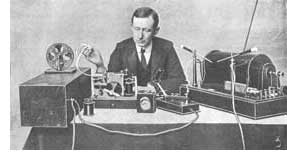 There are a million old cocktail recipes out there. Sometimes, you’ll stumble upon one that’s really intriguing, as I did recently with the Marconi Wireless. It’s not only tasty, it’s got all sorts of cool historical and cultural connections.
I was flipping through a 1957 paperback that my significant other, Scott, picked up at a flea market recently: The Art of Mixing Drinks (“Based on the famous Esquire Drink Book” exclaims the book’s cover). I was looking for a recipe using applejack; luckily the book has an entire section on applejack cocktails. The Marconi Wireless caught my eye: 2/3 applejack, 1/3 Italian vermouth, 2 dashes orange bitters. ‘Hmm, I bet that’s good. And it’s so simple!’ I thought. Sure enough, it was a snappy, satisfying drink, and we had to find out more about it.
Part of our excitement about the Marconi Wireless had to do with the fact that we visit Wellfleet, Cape Cod frequently and always pass Marconi Beach, the stretch of sand where Guglielmo Marconi transmitted the first transatlantic wireless message from the U.S. in 1903. Cocktails, Wellfleet, historic events — that combination jazzed us. We thought, ‘Man, every bar in Wellfleet should be serving Marconi Wirelesses!’
With a little digging, we found a 1992 New York Times article that William Grimes wrote on historic New York City hotel bars. It turns out that the Marconi Wireless was among several potions invented at the Waldorf-Astoria, and it is listed in the Old Waldorf-Astoria Bar Book. When was the cocktail invented? Perhaps when Marconi was feted by the American Institute of Electrical Engineers at the Waldorf in 1902 for his role in pioneering radio communication. Or maybe later, in 1912, when Marconi gave testimony at the Senate hearings at the Waldorf on the Titanic disaster. One of the things he was questioned about was how Marconi Company wireless operators who survived the wreck came to receive payment from the New York Times for their stories. In 1902, the cocktail would be an homage. In 1912, a jeer. Thoughts, anyone?
Fun sidebar: our research also led us to the term “cocktail party effect.” The term emerged in the early days of air traffic control, when the difficulty of discerning the intermixed voices of pilots over one loudspeaker was compared to that of zeroing in on one conversation amid the loud chatter of a cocktail party.
Posted in Applejack, Cocktails | 2 Comments »