Archive for the ‘Bartenders’ Category
April 27th, 2011
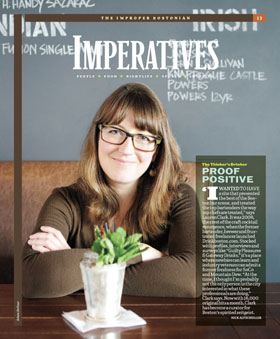 I’m tickled to be included in the annual “beloved bartenders” issue of the Improper Bostonian, which celebrates its 20th birthday this year. The profile refers to me as the “thinker’s drinker” and a “curator for Boston’s spirited zeitgeist.” Finally, someone who loves me for my brains, not just my liver.
Managing Editor Nick Altschuller, who conducted the interview, was doing double duty that day — he suggested we meet for midday drinks as he was in the midst of research for his column about embarking on a one-man revival of the martini lunch. (Nice reference to the notebook, Nick.)
Among the bartenders profiled are two of my personal faves: Emma Hollander of Trina’s Starlite Lounge and Evan Harrison of Deep Ellum. Congrats to them and all the other slingers who made this year’s cut!
Let me also heap praise upon the photographer who took this pic, Adam DeTour.
Tags: Improper Bostonian
Posted in Bartenders, drinkboston in the news | 9 Comments »
March 3rd, 2011
Bartender profile
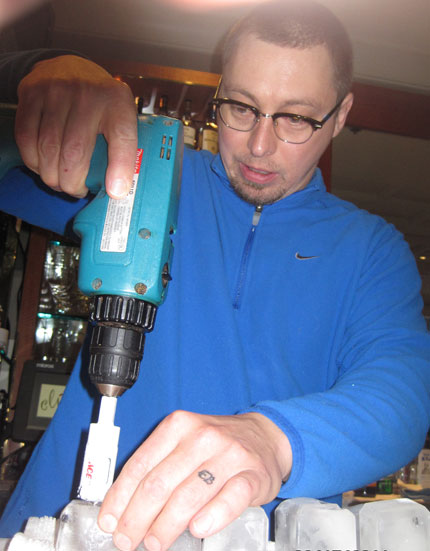
Much of the Boston fine-dining scene still neglects to put the kind of pizzazz into the bar that comes out of the kitchen. Todd Maul is changing that. With his tattooed forearms, Mercury-era NASA spectacles and tendency to recite from Embury’s The Fine Art of Mixing Drinks, he doesn’t seem like the kind of guy you’d find behind the slab at one of the city’s more haute dining rooms — Ken Oringer’s Clio. But he has in fact put that little bar on the map as a destination for serious and inventive cocktails.
I first met Todd when he was honing his chops and trying to sneak vintage potions like the Lion’s Tail onto the drink menu at Rialto, in Cambridge’s Charles Hotel. When his efforts hit a wall, he moved to Clio, where he steadily gained creative license. Chef Oringer told him, “If you can think it up, and it tastes good, do it”– oh, and don’t be afraid to raid the kitchen. With that mandate, Maul does things like “use ice as a garnish.” For gin and tonics, he’ll deposit loomi — dried Middle Eastern black lime — into patterns he drills on square cubes (see above), or he’ll put a cylinder of violet-infused ice in a Todd Collins (Old Tom & Old Raj 110 gins, lemon, seltzer, Benedictine-soaked cuke) so that it slowly turns your drink bright blue while you sip. In the past couple of years, Clio has gone from a brief list of mostly vodka-based mixtures that blended into the background to a fun, 80-item menu (with retro font and graphics) of both faithful and fanciful interpretations of classic recipes. It’s like an album of Great American Songbook standards, some sung by Frank Sinatra and others sung by Bjork.
Maul’s other passion is furniture making; he studied the craft at the prestigious North Bennet Street School. He compares knowing various types of wood and how to build a table with them to knowing, for instance, different types of whiskey and how to build a cocktail with them. “Had I not gone [to North Bennett Street], I probably wouldn’t have paid attention to bartending the way I did. It’s a trade — you’ve got to work at it.”
Hometown
Kinderhook, NY.
Past bartending jobs
Rialto, Boston Park Plaza, Four Seasons.
First drink you ever had
Genessee beer. It’s an upstate New York thing.
Favorite bar in Boston other than your own
No. 9 Park. I have always liked what they do there.
The drink you most like to make
One for a regular.
The drink you least like to make
The first/last drink for someone that you know is going to be a problem.
What you drink at the end of your shift
PBR tallboy.
If you weren’t a bartender, you’d be…
A furniture maker. My shop misses me.
Most beloved bartending book
If you’ve ever sat at my bar you already know: David Embury’s Fine Art of Mixing Drinks.
The best thing about tending bar in a fine dining setting is…
The conversations (it’s a little more mellow, so you can actually hear the person across from you), and seeing the milestone events in people’s lives.
The worst thing about tending bar in a fine dining setting is…
People can be intimidated by what they perceive as the culture in these restaurants.
People drink too much ________
What I call “lifestyle beverages” — when someone orders marketing, not booze.
People don’t drink enough ________
Old Raj 110.
Unlikely drink for a cold winter night
Dr. Cocktail.
The best thing about drinking in Boston is…
I can get a drink from Joe McGuirk somewhere where they don’t mind if my kid throws something on the floor.
The worst thing about drinking in Boston is…
That you can get spoiled by the other people on this list, and realize that they only work in Boston. The standard they set doesn’t always travel.
Tags: Clio, Ken Oringer, Todd Maul
Posted in Bartenders, Cocktails | 10 Comments »
January 6th, 2011
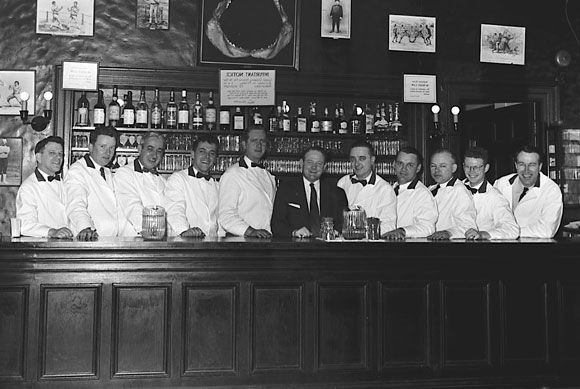
Don’t get the wrong idea from this vintage photo in the Boston Public Library’s print & photograph collection: women are well represented behind Beantown bars, and they and their male counterparts are getting organized.
First, our city’s own chapter of the U.S. Bartenders Guild will soon be official. Corey Bunnewith of Citizen Pub, Kirsten Amman of LUPEC Boston, Alex Homans of Russell House Tavern and Rob Hoover of Upstairs on the Square are helming this effort, which right now involves finding at least 40 members with $100 for annual dues to sign on. Meanwhile, April Wachtel, bar manager of the solid new South End restaurant & bar The Gallows, has started a less formal, local (and, for now, free) concern called the Boston Bartenders Collaborative.
I never knew the USBG existed before the craft cocktail movement got going. It was founded way back in 1948, and it’s affiliated with the 50-country International Bartenders Association, itself established in 1951. USBG sponsors seem to include every spirits conglomerate known to man — Pernod Ricard, Bacardi Ltd., William Grant, etc. — as Jonathan “Cocktail Guru” Pogash indicates in his summary of a recent field trip to Boston to help spark the USBG chapter here. Bunnewith says that although these companies obviously aim to promote their brands by sponsoring Guild events, they impose no restrictions on the use of spirits from lesser-known producers.
The four USBG-Boston officers mentioned above hosted a Pernod Ricard-sponsored meet & greet just before Christmas at Russell House Tavern to drum up interest, and several bartenders and others related to the industry (including this blogger) turned out. Lucky for me and a few others around town: we get our first year’s dues waived for having successfully completed the BarSmarts program. (The USBG has different membership categories, one of which is for people who aren’t actually bartenders.)
Why should you join? One reason is career advancement. “As the Guild gains a reputation in Boston, employers will recognize that members are knowledgable and passionate about alcoholic beverages and the operations of a bar,” says Bunnewith. The USBG also has an accreditation program that is recognized worldwide, in case you decide to pack your bar tools and move to Bratislava. Other perks include product-education classes, events, the occasional field trip and invitations to participate in cocktail competitions (i.e. create cocktails for liquor companies for free as you vie to win a cool trip). In earnest, the chance to network, taste product, and go to fun events with others who take the profession seriously seem to me like excellent reasons to get involved.
Those are the same reasons people in the local biz should take a look at the Boston Bartenders Collaborative. Wachtel envisions a symbiotic relationship between USBG-Boston and her grass-roots enterprise, which is focused on education and so far has about 15 volunteer participants. Most meetings take place in one of the members’ bars during a weekday. The next one, at Craigie on Main January 10, will feature John Mayer of Craigie and Tyler Wang of Drink talking about ice and dilution in cocktails. Other topics in the works include an interactive roundtable about cocktail formulas and discussions on speed and volume, guest relations and managing inventory. (See info about participating below.)
“There’s a good part of our community that wants to learn in ways beyond just informal visits to other bars. This is a chance to build something that has never existed in Boston,” says Wachtel, adding that the Collaborative aims to “have fun and not take ourselves too seriously.”
Sure, some people might chuckle at the notion of bartenders getting together to talk about ice and inventory, but think about it: Boston barkeeps are elevating their profession and trying to create a solid talent pool in this town. I, for one, am wicked psyched about that.
For information about joining USBG-Boston, go to the group’s Facebook page or email USBGBoston@gmail.com.
Most Boston Bartenders Collaborative seminars are members-only, but select seminars will be open to the general public. To receive notifications about seminars, or for more information, email April Wachtel at april@thegallowsboston.com.
Tags: Alex Homans, April Wachtel, Boston Bartenders Collaborative, Corey Bunnewith, education, guild, Kirsten Amman, Rob Hoover, USBG
Posted in Bartenders, Books & resources | 2 Comments »
November 23rd, 2010
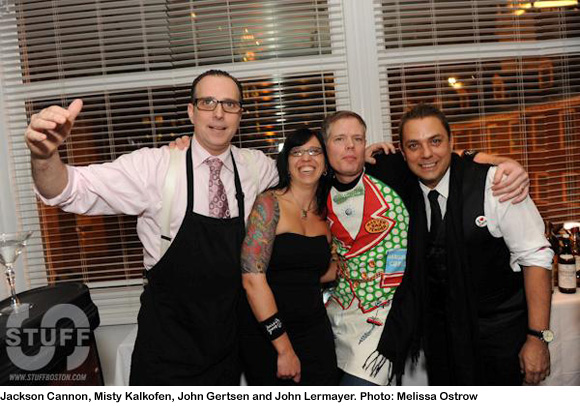
As my friend Senator John aptly tweeted during the grand finale of the year-long Cocktail Wars at Woodward Tavern in the Ames Hotel, “If you dropped a bomb on the Ames Hotel, we’d be drinking light beer and screwdrivers for months.”
Arguably Boston’s three best bartenders — Jackson Cannon of Eastern Standard and John Gertsen and Misty Kalkofen of Drink — competed against each other and Miami’s finest, John Lermayer, in a showdown that capped a series of drink-mixing battles between Boston bartenders (and sometimes their colleagues from other cities). And there to cheer the competitors on was seemingly every other bartender of note who wasn’t on the stick that night. Thankfully, no bombs were dropped. Except for this one: the guy from Miami won.
That’s right, John Lermayer, who tends bar at the Florida Room and consults for hotel bars around the world, bested his Beantown colleagues fair and square. I should know, because I was one of the judges. His winning cocktail, the Misty Morning Sour (see below), hit all the criteria admirably: quality, creativity, presentation and use of surprise ingredients — persimmon and Barenjager honey liqueur. Misty Kalkofen took second place for her mezcal-based Per Simon. In the quality department, all the cocktails got high marks on my ledger — particularly considering they were each created in an astonishing 20 minutes.
Here are some pics from the bash, plus the recipes that each of the four competitors came up with. What a pleasure it was to literally drink in their talents.
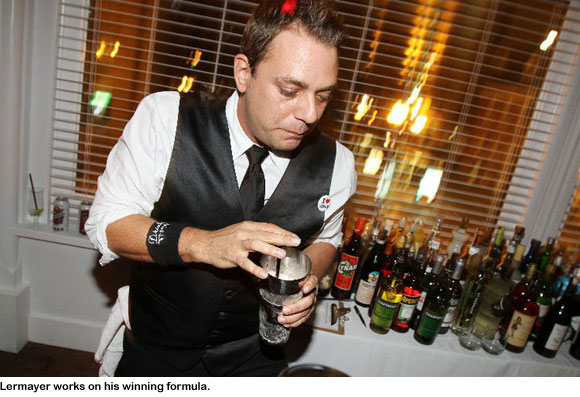
Misty Morning Sour
John Lermayer
Persimmon (a couple slices)
Strawberry (one or two)
1 1/2 oz Plymouth gin
3/4 oz Aperol
3/4 oz Barenjager
3/4 oz lemon juice
1/4 oz simple syrup
2 drops orange blossom water
Egg white
Muddle persimmon and strawberry in a mixing glass. Add remaining ingredients and dry-shake. Shake all again well over ice. Strain into cocktail glass with sliced strawberry and persimmon garnish. The name: inspired by how John imagined his fellow contestant, Misty, would feel the next morning.
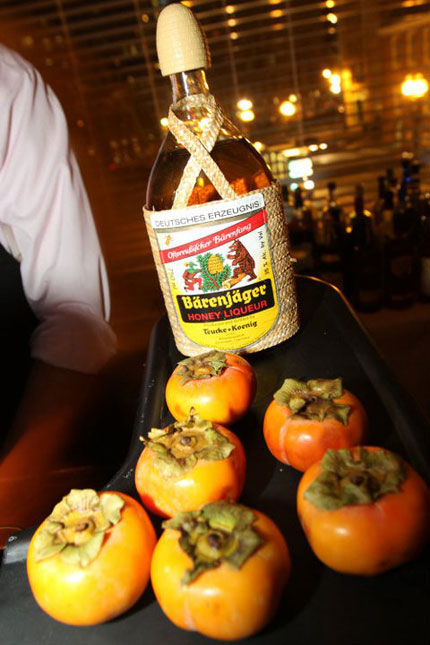
Per Simon
Misty Kalkofen
Half a persimmon
2 oz Del Maguey Mezcal Vida
1/2 oz Plymouth sloe gin
1/2 oz Barenjager
1/2 oz lemon juice
1/2 oz agave nectar
1/2 oz Amontillado sherry
6 drops Bittermens grapefruit bitters
Nutmeg garnish
Muddle persimmon in a mixing glass. Add all other ingredients except nutmeg and shake well over ice. Strain into a cocktail glass and garnish with fresh grated nutmeg. The name: a play on one of the surprise ingredients and on the name of one of the judges, Simon Ford, international ambassador for Plymouth gin.

Once in a Blue Persim-moon
Jackson Cannon
Persimmon (couple slices)
1 1/2 oz Barenjager
1 oz Plymouth gin
1/2 oz lemon juice
1 egg white
Dash Peychaud’s bitters
Sparkling wine
Dry-shake first four ingredients and strain through a tea strainer. Dry-shake strained ingredients with egg white. Shake all again with ice. Strain into a champagne flute, top with Peychaud’s and sparkling wine. The name: inspired by the blue moon in the sky that evening.
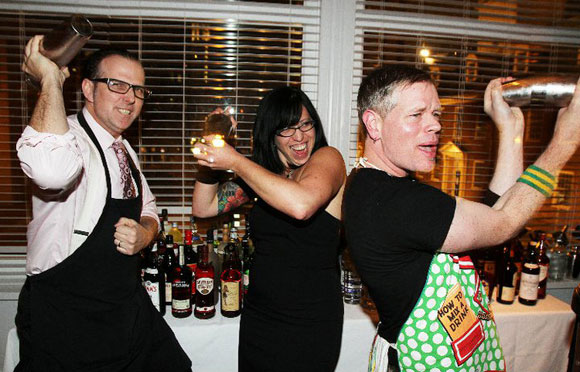
Wasp Bite
John Gertsen
2 oz persimmon infused* Plymouth gin
1/2 oz lemon juice
1/2 oz Barenjager
1 tsp black pepper
Barenjager soaked persimmon skin “twist”
Muddle pepper in mixing glass. Add all ingredients except twist. Add ice, shake and double strain into a chilled coupe. Garnish with the twist. The name: a play on Drink’s peppery Bee Sting, which is itself a play on the classic Bee’s Knees.
*The Plymouth Gin was infused using a quick infusion technique known as nitrogen cavitation. Gertsen used a 1 liter iSi profi whip canister, added 375 ml of Plymouth Gin and the pulp from 4 medium-sized persimmons, and charged the canister twice with nitrogen.
Except for top photo, all photos by Mark Andrew Deley of Crammed Media.
Tags: Ames Hotel, Barenjager, cocktail contest, Jackson Cannon, john gertsen, John Lermayer, Misty Kalkofen, persimmon, Woodward Tavern
Posted in Bartenders, Cocktails, Events, Liqueur | No Comments »
November 9th, 2010
Bartender profile
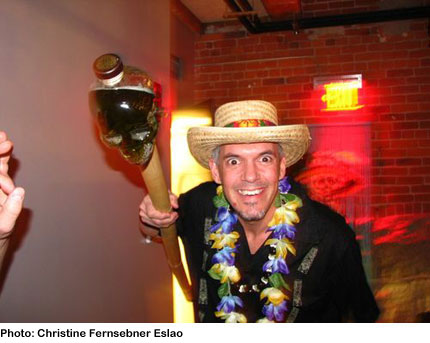
Confident, handsome and affable, Scott Marshall could’ve stayed at one of his former gigs — CityBar or Beehive, say — racking up “beloved bartender” awards and impressing the hell out of people who read Boston magazine. Instead, he got serious about mixology and joined the staff at Drink, where, as principal bartender, he has become a formidable talent. He combines a regular-guy knack for pleasing a range of human specimens with a fine-tuned palate for mixing exquisite cocktails.
Like his Drink colleague Misty Kalkofen, Marshall chose the bartending profession over the one for which he earned a master’s degree: accounting. He started down that career path not only because of innate math skills but because, growing up in rural Maine, “the person in town who made money was the accountant.” But he quickly discovered during his first job behind the stick, at the PourHouse (“class of ’99”), that tending bar was way more fun than accounting. “I never spent a day in a cubicle,” he beams.
He was working at the Oak Bar one day when Ryan Magarian of Aviation Gin came in and asked the free-pouring Marshall to make a series of measured cocktails. While Marshall was confident of his drink-making skills at that point — he had attended a James Beard Award dinner on the strength of a pomegranate-cucumber take on a Southside — this experiment with consistency and balance was eye-opening.
Once at Drink, he took full advantage of that establishment’s extensive training and advanced quickly, winning a scholarship to and acing the rigorous BAR spirits and mixology course. He can put his own spin on the complex layers of a classic tiki drink and show a 50-pound block of ice who’s boss. At the same time, he’s the guy who brings a skull full of Chartreuse to a bartending competition and who, with flirtatious gusto, fulfills the request of a group of Boston Opera House-bound cougars for six shots of tequila and one shot of chilled vodka.
Hometown
Stonington, Maine.
Past bartending jobs
Silvertone, CityBar, Beehive, Oak Bar, Cali Terra, PourHouse, Halfway Cafe.
Favorite bar in Boston other than your own
The one where a good friend is working that night.
The drink you most like to make
Old-fashioned Old Fashioned at Drink.
The drink you least like to make
Bloody Mary, anywhere, anytime.
Most memorable cocktail request
“My buddy over there left his wife for another woman. The other woman told him today that she never wants to see him again. We need two drinks … with bourbon.”
A famous person you’ve served
Paul Newman.
What you say at last call
If you’re not aware of what time it is, you don’t need another.
What you drink at the end of your shift
Reading Pennsylvania lager.
Worst bartending job you ever had
I’ve learned a lot everywhere I worked. It’s all timing.
If you weren’t a bartender, you’d be…
A beach bum.
Least-appreciated alcoholic beverage in Boston bars
Allen’s Coffee Flavored Brandy — fuck Kahlua!
Most overrated alcoholic beverage in Boston bars
Grey Goose [vodka] and Patron [tequila].
The best or worst pickup technique you’ve ever observed
Sending a girl a drink through the bartender from across the room. Grow a pair … get up and do it yourself.
The biggest myth about bartenders is…
That a customer has a chance of picking one up. I don’t know of a successful relationship that began with a customer giving their number to a bartender. We usually date each other!
Tags: Scott Marshall
Posted in Bartenders | 3 Comments »