When I mention to the uninitiated imbiber that I like Beefeater gin, I get strange looks. In the world of sexy, new-style gins like Hendricks and Tanqueray 10, whose flavors are designed to appeal to the juniper-shy, Beefeater is viewed as an old-man drink. But to people who actually put vermouth in their Martinis and enjoy an honest-to-goodness Tom Collins, Beefeater is a classic. The fact that Audrey Saunders endorses it doesn’t hurt, either.
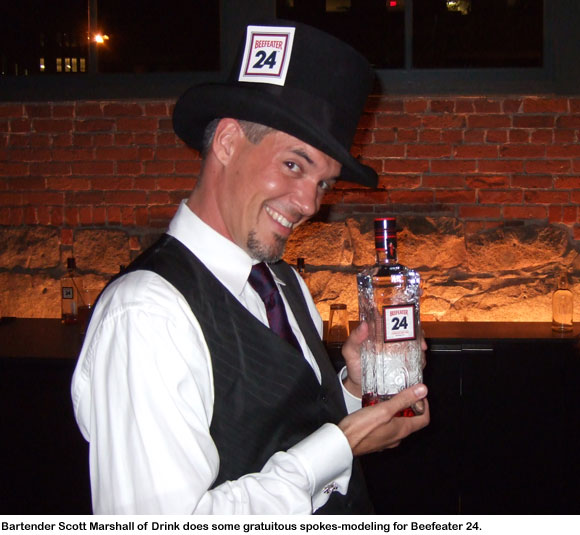
The brand recently launched a new gin, Beefeater 24, in Boston. “Distilled in the heart of England’s capital, Beefeater 24 takes its name from the unique 24-hour steeping process and the city’s 24-hour stylish and sophisticated lifestyle,” says the press release. I know, that “lifestyle” line is a doozy, but “stylish and sophisticated” perfectly describe the gin’s packaging. It’s more “swinging London,” less “British Empire.” Blessedly, though, the spirit’s flavor evokes the latter.
While Beefeater 24 adds three new botanicals (Japanese Sencha tea, Chinese green tea and Spanish grapefruit peel) to the original nine (juniper, Seville orange peel, lemon peel, angelica root, angelica seed, orris root, licorice, coriander seed and almond), it tastes quite a bit like regular Beefeater. The tea flavors are really, really understated and create a slight tannic finish; Beefeater’s traditional citrusy character gets a little more complexity from the grapefruit peel; and the 24 is softer in the mouth than the original. Otherwise, it’s as London-dry and cocktail-friendly as its parent. It’s also more expensive, of course, at $29/750 ml compared to $22 or so for the original. (The 24 cuts out more of the heads and tails, or beginning and end products of distillation, resulting in a smoother spirit.)
Beefeater master distiller and all-around nice guy Desmond Payne, who was in town for the launch, seemed pleased as punch by his new creation — the first recipe he has been called upon to devise in his 40+ years making gin, first for Plymouth, then for Beefeater. He mentioned that one of his favorite gin drinks is a Negroni, and he was excited about 24’s debut aligning with the resurgence in classic cocktails. The growth in demand for the flavors of old means that Payne could unabashedly create a new gin for the gin drinker.
Gin Old-Fashioned Created for the Beefeater 24 launch party at Drink
2 oz Beefeater 24
1/4 oz gomme syrup (2 parts sugar, 1 part water)
1 dash bergamot bitters (house-made)
1 dash Angostura orange bitters
Build in a heavy-bottomed rocks glass and stir well over a large lump of ice.
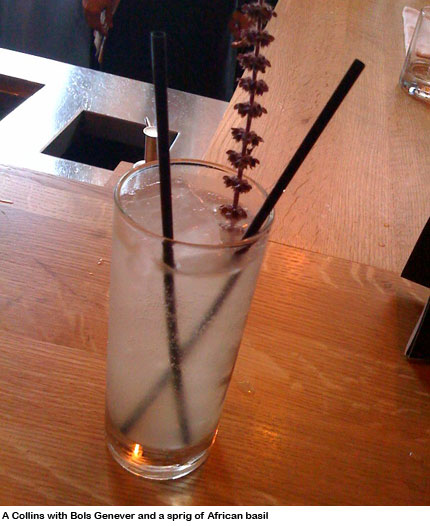
Liquors launched. Bols Genever and Absolut Boston launched in Beantown recently. You will see the former at the city’s best cocktail bars. You will see the latter everywhere else.
Genever is an old Dutch spirit that, while it gave birth to modern-day, London dry gin, is in its own category. You could call it the whiskey drinker’s white spirit. It’s made with malted grain, same as whiskey, so it has a depth of flavor even before botanicals are added. If you want to time travel back to the days when Jerry Thomas was mixing up Improved Holland Gin Cocktails, this is your vehicle. Cocktail Virgin Slut and C. Fernsebner of the Bostonist both did fine writeups of the Bols Genever launch party at Drink.
As for Absolut Boston, what can I say? It’s from the benchmark vodka brand whose brilliant marketing made it an icon and launched the category of premium vodka into the stratosphere. It’s part of a series of special-edition flavors inspired by cities, in our case black tea (historically apt) and elderflower (currently trendy). It’ll sell like gangbusters.
Bartenders on the move. Wow, where to begin? With the ladies — the Ladies United for the Preservation of Endangered Cocktails, that is. Joy Richard (aka Bourbon Belle) left her longtime gig managing Tremont 647 to manage and work the bars at both Franklin Cafes (South End and Southie). She is kicking cocktails up to a new level at these beloved neighborhood spots. Emma Hollander (aka Hot Toddy) also left Tremont 647 and will christen the shakers at Trina’s Starlite Lounge in Cambridge (where the Abbey used to be), whose soft opening should begin next week.
Now for the men. Andy “Hunter S. Thompson” McNees is moving from Green Street in Central Square to Toro in the South End. His esteemed colleague Nathan Bice (aka “just Bice”) is heading slightly northwest to Highland Kitchen in Somerville. Speaking of Highland Kitchen, I should also mention that Claudia Mastrobuono is leaving the bar there to go back to school. I’ll miss her skills and no-nonsense attitude. Meanwhile, joining Dylan Black and Emily Stanley behind the bar at Green Street are Colin Kiley, lately of Central Kitchen, and Joel Mack, lately of Deep Ellum in Allston (and Redbones before that). And to complete the circle, Patrick Sandlin just stepped behind the bar at Deep Ellum after managing Bukowski in Boston. Finally, Ben Sandrof will no longer be working behind the bar at Drink — or any bar at all for that matter (sniff). But he’ll remain a key figure in Boston’s booze world with his new career in wholesale at M.S. Walker. Whew! That was dizzying. If I’m missing anyone, let me know.
Manhattan & Montreal. If you missed Tales of the Cocktail and have a hankerin’ to schmooze and booze with fellow cocktailians from around the globe, you should get tickets to the Manhattan Cocktail Classic Fall Preview on October 3 and 4. This is a mini-conference to prep for a larger event in May, and, given the buzz I’ve heard, it could be a quick sellout. The details are still vague, but all you really need to know is that these are the organizers. Oh, I hear there are a few good cocktail bars in Manhattan, too. Tickets go on sale Labor Day weekend. Book your hotel now. Speaking of Tales and Manhattan, read On the Rocks, It’s a New Landscape in the New York Times if you haven’t already.
As for Montreal, I’m seeking news rather than reporting it. Specifically, does anyone know of any connections between the bar/restaurant scene in Montreal and the bar/restaurant scene in Boston? Like, Boston bar owners who are from Montreal, Boston bars that are using ice wine from Quebec, or dedicated barflies who divide their lives between the two cities… Anyone?
The number of bars in Boston that make serious cocktails is increasing despite the Great Recession (right, Lord Hobo and Trina’s Starlight Lounge?), which makes our livers quiver with excitement. But the truth remains that the vast majority of bars out there aren’t up on this classical mixology thing. That’s the case even for some of the establishments we love, as well as for places whose enticing cocktail menus belie their lack of bartending talent.
Take Aquitaine in the South End. Nice-looking brasserie with an intimate little bar at the entrance. I was thrilled to see they had the Scofflaw — the Chartreuse version! — on their menu, so I ordered one. The bartender free-poured it (not something you want to do with a drink containing green Chartreuse), added a mere dash of lemon juice (one of the drink’s primary ingredients), and proceeded to … stir the mixture. Oh my.
When you find yourself craving a cocktail in a mixologically challenged establishment, you need to have in the back of your mind a safety drink or two. You know, a simple mixture that even the most minimally stocked bar or dimmest bartender can make (or be instructed to make). This is an easy decision for a lot of people — hello, gin and tonic! Little chance for error there. But, inexplicably, I’ve never liked gin (or vodka) and tonic. Not even a little bit. So here’s what I order:
Negroni. All bars have gin and sweet vermouth, and most have Campari, so this is an old reliable. Plus, ordering one immediately gives you an aura of mystery, because the Negroni is still considered exotic in most bars. I was once at Red Line in Harvard Square watching the cute, young things behind the stick crank out Oatmeal Cookie shots. I had to walk one of them through a Negroni, but she managed. I enjoyed my drink and bought another for the DJ. (MC Slim JB, I know you disagree with me on this one, but I have had surprisingly good luck getting a decent Negroni in all sorts of places.)
Lowball. I only like a splash of soda in my whiskey, so I order one of these instead of a highball. Before I could reliably find Maker’s Mark behind any bar, I’d order a “Jack Daniels on the rocks with a splash of soda and a twist.” Especially at hinterland weddings and those occasions when I find myself at a bar in Weirs Beach, NH, during Bike Week, this is my go-to drink.
CC Manhattan. Yes, Canadian Club. Rocks (always safer than straight up). Twist or cherry depending on my mood or lack of will to specify. A pretty satisfying drink, and you can order it absolutely anywhere. I especially like asking for these in bars near touristy summer spots where everyone’s drinking Bahama Mamas. It’s kind of like wearing wingtips on the beach.
I love to know what other people’s safety drinks are, so feel free to weigh in.
I followed up my how2heroes video on Boston’s Ward Eight cocktail with this one on the Red Rot Cocktail. You may recall that Misty Kalkofen and I created this confection for a party at the Boston Athenaeum. It’s inspired by the “red rot cocktail” that book restorers use to bring musty, old, red leather-bound books back to life. Never thought you’d see footage of rotting book covers in a cocktail video, did you?
The great thing about the video is that we actually got to shoot it in the historic, Beacon Street building that houses the Athenaeum. If you’ve never been there, you should pop in someday and check out the first floor and gallery areas. Better yet, become a member and get access to the whole place. You can check out books, attend lectures (I’ve been to some really good ones) and other events, and bring your laptop and work in a spacious, art-and-antique-filled room overlooking the Granary Burying Ground. Contrary to any preconceptions you may have, you don’t have to be a blue-blooded retiree to join. All you need is a credit card and a couple of references.
As for the cocktail (recipe here): it’s pretty, it’s tasty, it’s balanced, and it’s accessible. Serve it to your vodka-swilling friends, and they will be converted to the ways of gin.
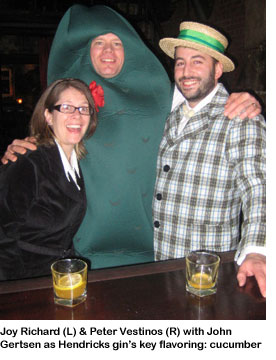
Tremont 647 director of operations Joy Richard, aka Bourbon Belle of the Boston chapter of Ladies United for the Preservation of Endangered Cocktails, deserves a shout-out. She recently traveled to L.A. to compete in the Hendricks gin Marvelous Limerick & Cocktail Competition.
You may remember how Richard qualified for this gig: by winning Hendricks’ Beantown Bartender Battle at Green Street last summer. Contestants mixed an original Hendricks cocktail that highlighted the botanicals used to flavor the gin, and they penned an accompanying limerick about their potion. Check out the recipe for Richard’s drink, Nobody’s Darling, and her limericks at LUPEC Boston’s blog.
“The competition itself was in this incredible bar called the Edison, which I believe was L.A.’s first electric company. The space was like nothing I’ve ever seen,” Richard said.
“We were judged on the following points: 1. costume (theme: Victorian Steampunk); 2. limerick; 3. cocktail name, and why you named it what you named it; 4. cocktail taste; and 5. showmanship.”
Alas, our clever Bostonian did not take home the trophy that night. It went to Peter Vestinos from the Wirtz Beverage Group in Chicago for his drink, A Cotswold Afternoon.
Meanwhile, a group of amateur mixologists competed in TV Diner’s annual cocktail contest on NECN. The entries in this competition fall largely in the silly-vodka-drink camp — first place went to the jailbait-appropriate Dreamy Banana Tini — but the classic cocktail revival made a showing with the second-place finisher, the Father’s Advice.
“I couldn’t believe that I placed at all. Seriously: gin and raw egg?” quipped the drink’s creator, James Slaby, who has been a regular at drinkboston.com and LUPEC Boston events. He presents his cocktail — “halfway between a Ramos Fizz and a Gin Flip” — in this clip from the show.
Father’s Advice (a morning-after tonic)
1 ½ oz Plymouth gin
¾ oz Baines pacharan (a Spanish cordial)
¾ oz fresh lemon juice
½ oz light cream
½ oz simple syrup
½ teaspoon Regan’s Orange Bitters
8 drops Fee’s Brothers Whiskey Barrel-Aged Bitters
1 fresh, whole egg
Healthy grind of fresh black pepper
1 dried star anise
Pour liquids into shaker half-full of cracked ice. Add egg and fresh pepper. Shake vigorously for 60 seconds. Strain into a well-chilled sour glass or rocks glass. Float star anise on top.
"Lauren Clark takes readers on a supremely sudsy tour of New England ales, lagers, pilsners, and porters. This is the New England the Puritans warned everybody about, but few have chronicled."
– Wayne Curtis, And a Bottle of Rum: A History of the New World in 10 Cocktails
 Bartenders on the move. Wow, where to begin? With the ladies — the