Archive for March, 2007
March 30th, 2007
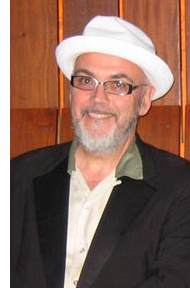 Bartender profile
Brother Cleve will probably be the only bartender profiled on this site who doesn’t actually work in a bar. File him under Influences. Not to get all hyperbolic, but the contemporary Boston cocktail scene as we know it wouldn’t exist without him. Dylan Black and Misty Kalkofen of Green Street, Patrick Sullivan of the B-Side Lounge, Jackson Cannon of Eastern Standard, John Byrd of the Alchemist, John Gertsen of No. 9 Park and a fair number of other Boston bartenders with a keen grasp of old-school mixology were directly or indirectly influenced by Cleve.
Actually, most people know this guy as a keyboardist, DJ, composer and pioneer of the international lounge scene. Unlike a lot of us, Cleve didn’t suddenly “discover” lounge music in the ’90s. He played the genre in the late 1960s, “when it was still current,” as a teenage keyboardist who sat in with lounge acts around Boston. Later, as a member of Combustible Edison, he toured the country seeking and preaching the Classic Cocktail and living life according to the First Manifesto of the Cocktail Nation, penned by Combustible Edison frontman The Millionaire:
We, the Citizens of the Cocktail Nation, do hereby declare our independence from the dessicated horde of mummified uniformity — our freedom from an existence of abject swinglessness. We pledge to revolt against the void of dictated sobriety and to cultivate not riches but richness, swankness, suaveness and strangeness, with pleasure and boldness for all.
BE FABULOUS.
Hometown
Born and raised in West Medford, currently residing in Dorchester
Past bartending jobs
First bartending I did was when I worked for the Mob … er, well it was a catering company that did a lot of Mob functions, so you always had to make sure you didn’t screw up any drink orders. Sadly, they were not all drinking Godfathers or Godmothers. Lotta scotch on the rocks and that type of thing. This was in the ’70s. I first got interested in classic cocktails in the mid-’80s; I was on tour with a band called the Del Fuegos, and we were in this diner in Cleveland where the menu had a cocktail list with Sidecars, Grasshoppers, Ward Eights, etc. on it. I was fascinated and immediately went out and bought an Old Mr. Boston drink book. A few years later a friend asked if I’d be interested in bartending at his restaurant, the Hoodoo BBQ in Kenmore Sq. I was, and the first thing I did was put classic cocktails on the menu. This was around ’88. Nobody bought them; instead everyone was drinking Woo Woos and Sex On The Beach. I hate peach schnapps. But within a few years there was a new band on the scene — Combustible Edison — who were leading the charge for a cocktail renaissance, calling their fans the Cocktail Nation and selling their own drink recipe books at their shows. They were the most fabulous act I had ever seen. When their first album was about to come out and their keyboard player couldn’t go on tour, they called me and offered me the spot. We spent the ’90s spearheading the cocktail movement in a fury of sound and liquid — we even had a Campari sponsorship. It was during those years that I met Patrick Sullivan, who got interested in the classics and later opened the B-Side Lounge. I designed the first menus there with him and also bartended there for the first few years it was open. I also created cocktail menus for the Lizard Lounge, Bill’s Bar, Pho Republique, Lilli’s, and the late great Lava Bar in Kenmore Sq.
First drink you ever had
My grandmother used to let me have sips of her Manhattans when I was a tot. It’s still one of my favorite drinks.
The drink you most like to make
My current fave at home is one I call the Maharajah’s Revenge: Old Monk rum from India, apricot brandy, and lime juice.
The best thing about drinking in Boston is…
There are some incredible bartenders in this town who know the classics but aren’t afraid to make some new concoctions, ones that aren’t “shots” or comprised of “flavored vodkas,” which are children’s drinks as far as I’m concerned.
The worst thing about drinking in Boston is…
There are still way too many toy bartenders, there’s still too much toy vodka on the shelves, and too many 1:00 a.m. closings.
Your favorite “cocktail music”
Bossa nova — old and new
Your favorite bar(s) in Boston for music
I always hear great music at Pho Republique and Om in Harvard Sq.
In Boston bars, you hear too much _____
Rock and Top 40
In Boston bars, you don’t hear enough ______
I really wish someplace played the kind of nujazz/soul/latin/hip hop/global beat sounds that you hear a lot in European and Asian lounges. It’s something that has never really caught on in America, with a few exceptions in places like San Francisco, LA, DC.
Posted in Bartenders | 8 Comments »
March 27th, 2007
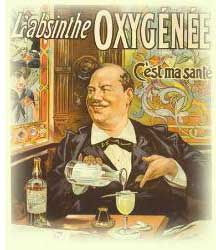 If you’re curious about absinthe, aka the “green fairy,” check out the Virtual Absinthe Museum. You could lose an afternoon there as easily as if you were actually drinking the stuff.
“It’s the fruit of many years’ research and is the largest and most authoritative site on the internet devoted to the history and lore of absinthe,” says David Nathan-Maister, who publishes the site and runs Oxygénée Ltd., a U.K.-based business devoted to all things absinthe, including both new and vintage bottles of the storied herbal spirit. The company takes its name from a poster advertising Cusenier’s Absinthe Oxygénée, “one of the greatest brands of the era” — the “era” being the time before absinthe was banned in 1915. The ban (which has been lifted in Europe but not the U.S.) and lots of other fun facts are covered in the site’s Absinthe FAQ. And you can buy nice, Art Nouveau posters there, too.
Posted in Absinthe, Books & resources, Liqueur | 3 Comments »
March 25th, 2007
When I was a brewer at the Cambridge Brewing Co., a brewery-restaurant in Kendall Square, two brothers named Todd and Jason Alstrom came into the bar, ordered all of the beer styles we made, and started taking notes. This was around 1997. The year before, the Alstroms had started a website where they and other enthusiasts could discuss and critique the dozens of styles and thousands of brands of beer brewed throughout the world. Ten years later, their site, BeerAdvocate.com, has attracted 100,000+ users around the U.S. and beyond. It is the world’s largest beer community. And the fact that it started here in Boston both reflects and feeds this city’s status as a craft-beer capitol. If you want evidence, check out beermapping.com’s greater Boston map of beer-friendly bars, restaurants, stores, etc.
Posted in Beer | No Comments »
March 23rd, 2007
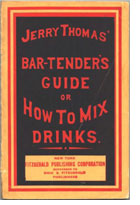 Todd Maul, who tends bar at the newly re-vamped Rialto in Cambridge’s Charles Hotel, emailed me recently, asking, “Could you do a posting on bartending books?” Specifically, he was curious about which books other ‘tenders around town found most useful. I decided to add to Todd’s idea and ask whether any of Boston’s libation gods and goddesses recommended a particular bartending school.
An informal, off-the-cuff survey yielded the following: 1) Dale DeGroff, Jerry Thomas (1825-1885), and Charles Baker (1895-19??) were the first-, second- and third-most cited bar-book authors; 2) bartending school is generally not recommended — but it’s not entirely dismissed. Survey respondents were Jackson Cannon of Eastern Standard, Brother Cleve (Boston-based cocktail historian), John Gertsen of No. 9 Park, Sean Holland of The Independent, Todd Maul of Rialto, Ben Sandrof of Noir and Max Toste of Deep Ellum. (Thanks, guys.)
Bartending books/authors
* More than one citation
Stanley Arthur – Famous New Orleans Drinks and How to Mix ‘Em
Charles Baker – Gentlemen’s Companion (aka Jigger, Beaker and Glass: Drinking Around the World) *
Harry Craddock – The Savoy Cocktail Book
Dale DeGroff – The Craft of the Cocktail *
David Embury – The Fine Art of Mixing Drinks *
Ted Haigh – Vintage Spirits and Forgotten Cocktails
Paul Harrington – Cocktail: The Drinks Bible For The 21st Century
Stan Jones – Jones Complete Bar Guide
Playboy Magazine – The Playboy Bartender’s Guide
Gary Regan – Joy of Mixology *
Ted Saucier – Bottoms Up *
Eugene Shewmaker – The International Bartender’s Guide
Jerry Thomas – How to Mix Drinks, A Bartender’s Guide *
Jack Townsend and Tom Moore McBride – The Bartender’s Book
Cannon likes Thomas for “the roots, philosophy of the trade and obscure recipe and ingredient info,” David Embury for “recipes and culture,” Gary Regan for “theory of drink relations, technique (watch his recipes though, not always sound)” and Dale Degroff for “recipe, technique and hospitality.” Holland likes The International Bartender’s Guide because, “For me, it’s organized in a way ‘my’ brain understands. I use it on the job for cocktail recipes I’m unsure of.” Maul notes that Bottoms Up has “some cool illustrations, a bit on the erotic side, but well done.” And Toste says he likes Famous New Orleans Drinks and How to Mix ‘Em for its “historical reference and background on cocktails, Craft of the Cocktail for its modern take on classic cocktails and history of barmanship, and the Playboy Bartender’s Guide for its huge volume of recipes.”
Bartending school
Cleve: “Go work for Misty (Kalkofen), John, Jackson, Ben or John Byrd.”
Cannon: “I don’t think bartending school is the way the go. I always recommend getting any job that is open in a bar/restaurant that you admire. Watch and learn from the bartenders and study [Degroff, Embury, Regan, Thomas].”
Gertsen: “I really don’t have much experience with bartending schools. I met recently with teachers from Johnson and Wales, and it seems like they are launching a great mixology program there. And finally a quote from the late Max Allen Jr. (Bartender Emeritus of the Seelbach Hotel): ‘It takes five years to learn how to bartend; the first two to learn what to do; the second two to learn what not to do, and the last year to learn how to do it nicely.'”
Holland: “Bartending schools?… well, never been. There was once a woman at [the Independent] who insisted that an Alabama Slammer was made with Absolut vodka… and she told me that she should know because she went to bartending school. If anything, I would recommend someone OPEN a bartending school — seems a lot of people go who never end up bartending.”
Maul: “Yes, I did go to bartending school. It was in 1992 in Albany, NY. I don’t remember what the name was or what it cost… I’m not sure I would recommend sending anyone to bartending school. I think picking up Sundays or that one ‘no one wants it shift’ as a bartender is the best way to get your foot in the door.”
Sandrof: “I went to the Professional Bartending School of New England. It was a week-long course consisting of five classes. I would not say that I consider it a complete waste of time, but I could teach someone all the info in a day if they wanted to learn. What it was good for, however, was allowing you to become familiar with bottles, speed pours and tools. We also had to memorize the top 30 drinks, and that came in handy. When someone asked me to make them a martini or a margarita, I did not have to stare back blankly. IT DID NOT, however, help to get me a job. I found that most people in the restaurant industry do not consider a bartending course important at all. It doesn’t hold a candle to actually having experience behind a bar. It just seems to be one more credential on a resume.”
Toste: “I don’t recommend it. I recommend going out and getting a job at a bar, watching and learning, going out to bars as a customer and observing other bartenders, reading books and stocking your bar at home. Good barmanship is as much about good service as good technique.”
Posted in Bartenders, Books & resources | 10 Comments »
March 20th, 2007
Established: 1985
Specialty: Cocktails, wine, beer
Prices: Moderate
Atmosphere: Serious food in an unserious setting, fresh-juice cocktails adorned with little plastic monkeys.
See Best Boston bars for address and contact info.
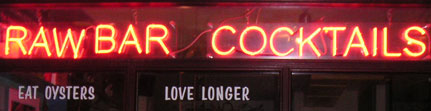
For many years, one of my life’s great pleasures has been to sit at the bar at the East Coast Grill, grazing on raw shellfish and drinking margaritas made with fresh citrus juice. The food and drink at this Inman Square institution are so consistently fresh and satisfying that I find myself thanking my lucky stars for the place every time I manage to nab a stool at the always — always — crowded bar.
In the contemporary Boston bar scene, ECG pioneered using fresh-squeezed lemons and limes (instead of powdered sour mix) to make its margaritas, plus fresh pineapple and mango puree for other tropical cocktails. These bright-tasting, not-too-sweet drinks are the liquid counterpart to the kitchen’s equally bright-tasting, equatorial, often fiery dishes. Owner and cookbook author Chris Schlesinger, a member of the nation’s grilling & barbecuing elite, says that the fresh-grapefruit Greyhounds he used to drink at a Key West bar called Pedro’s inspired his own drink-mixing practices. Patrick Sullivan, a bartender at ECG in the mid-’90s, brought the fresh-squeezed philosophy with him when he opened his own pioneering bar, the B-Side Lounge, in 1998.
That’s the other thing about the ECG bar — it has always had cool bartenders. Schlesinger describes his staff’s service as “unpretentious, hardworking and relentlessly friendly.” OK, that’s true, but senior bartender Nick Weinstock pinpoints the crux of the matter: “It’s non-corporate. You’re not dealing with canned personalities here.” Weinstock is a perfect example of this. In addition to being a total professional, he’s brash in a lovable way and amusing without being a suck-up. He and his colleagues genuinely appear to be having a good time behind the bar, and they manage to get the customers in on the fun without monopolizing anyone’s night out. It’s a nifty trick.
Most cocktails here are in the $8 range, and there are always a couple of good New England beers on draught (Buzzard’s Bay, Cambridge Brewing Co., Allagash), not to mention PBR tallboys. A really good, reasonably priced sparkling wine is always available for your oyster-eating pursuits, and the wine list is well tailored to the cuisine.
Posted in Boston bars | 4 Comments »