Archive for November, 2006
November 29th, 2006
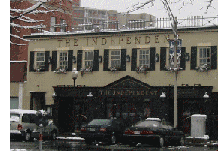 December 7: For a lot of younger people, fear of gin is simply fear of the unknown. Before you dismiss gin as weird, old-people’s booze, think of it this way: it’s the original flavored vodka. And you can test it out for free — yes, free — at the Independent in Somerville’s Union Square on December 7 from 7-10 p.m. The Indo and Plymouth Gin are hosting a cocktail party featuring some of my all-time favorite gin drinks, including the Negroni (equal parts gin, Campari and sweet vermouth, with orange peel), the French 75 (gin, lemon juice and bitters topped off with Champagne and lemon peel), and the Aviation (gin, lemon juice, and maraschino liqueur), which is like Art Deco in a glass. If you ask nicely, they may also mix you a Gin and It. More and more Boston-area bars, especially those that care about classic cocktails, are stocking Plymouth Gin. I’ve come to favor this smooth, balanced spirit in my Martinis over Bombay Sapphire. If you want to go to the party, RSVP by calling the Indo at 617-440-6022.
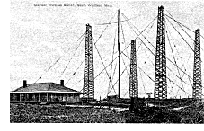 December 15: When I first wrote about the Marconi Wireless, I declared that since its namesake, radio pioneer Guglielmo Marconi, sent his first transatlantic radio signals from Wellfleet, Cape Cod, the drink should be featured on the menu of every Wellfleet bar. (On the right is Marconi’s station, now demolished, pictured on an old postcard.) Here’s a start: drinkboston.com and the Flying Fish Café (29 Briar Lane, Wellfleet) will host a Marconi Wireless cocktail party on the evening of Friday, December 15. For more info and to RSVP for the party, call the Fish 508-349-7292.
Posted in Events | No Comments »
November 28th, 2006
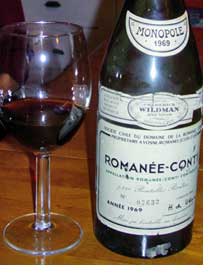 The only serious study I’ve given to wine was during a Cambridge Adult Ed class I took back in ’94, so I had little idea how to react to a bottle of Burgundy with “Monopole 1969 Romanée-Conti” on the label. All I knew was that our friend D. had invited us over to celebrate his birthday on Thanksgiving night with an old French wine salvaged from his late father’s cellar. The bottle somehow escaped being uncorked when D. graduated from college, and later when he got married. So he decided to make his 42nd birthday memorable — and remember dad — by sharing the wine with his wife and four friends. We were honored.
Like a lot of people, we appreciate wine, but our feet are set firmly in the non-vintage, under $20-a-bottle territory. Our thoughts on this night were less “I wonder if this wine’s tannins will overwhelm its fruit” and more “How much does a bottle of this go for?” Between about $1500 and $4000 as it turns out. (Ten bottles of this vintage sold at a 2004 Sotheby’s auction for $23,500.) Romanée-Conti is “possibly the most desired vineyard on the planet” according to a recent issue of New York magazine. Not that we knew that at the time. All we were hoping was that any lapses in proper storage hadn’t turned this rare beverage into vinegar.
They hadn’t. The wine’s light reddish-brown color looked a little like vinegar, but its aroma was pleasantly raisiny. How do I describe the flavor? A delicate dried-fruit character dominated, and there was a lot of other really subtle old-love-letters-in-the-attic stuff going on. I recognized the basic structure of the pinot noir grape, but the acidity that is prominent in a younger Burgundy was greatly softened. This was a wine that compelled me to roll it around on my tongue, like it needed to be taken for a stroll. For me, that was the cool thing about the experience. Were any of us totally blown away by the Burgundy’s flavor? No. But none of us had tasted anything like it, and we all savored the mystery of a beverage that had been evolving in its bottle for 37 years before our friend, at a happy and generous moment in his life, decided to share it with us.
Posted in Wine | 1 Comment »
November 22nd, 2006
 Our latest mission took us to two of the posh Charles Hotel’s watering holes: the bar at Rialto restaurant and the cocktail lounge Noir.
It had been quite a while since I’d ventured over to the elegant brick fortress in Harvard Square. I remember, when Rialto opened in 1994, how gaga everyone was about chef Jody Adams’ Mediterranean-inspired cuisine. The restaurant was a lot of people’s Special Occasion destination, including mine. Greater Boston has exploded with new bars and restaurants since then, and I have to admit that the whole Charles Hotel complex came to seem beige and corporate over time. Even a cool-looking, low-lit lounge like Noir had an uptight vibe to it. Then I happened to meet two barmen — one from Rialto and one from Noir — who said, “Come and check out what we’re doing.” Any iffy impression I have about a place gets shoved aside when I’m sitting across from a bartender who knows what he’s doing. So I headed to the Charles.
First stop, Rialto at happy hour. Trays of complimentary bruschetta with succulent prosciutto were being passed around the bar. Nice. Todd Maul, a North Bennet Street School grad who makes furniture when he’s not on the stick, handed us a cocktail menu. It featured stuff that is popular in high-end restaurants, drinks using ingredients like blackberry puree, pear nectar, and pomegranate juice that sound more complex than they really are. Todd told us about his mission to infiltrate the upcoming winter menu with a few interesting vintage cocktails, like the Gin Fizz. We tried one, and it was deliciously silky, thanks to egg white shaken up hard with dry gin, sour mix, sugar and a splash of soda. We also tried a Diabolique Bourbon Manhattan ($11) with locally produced Diabolique infused bourbon (Maker’s Mark with figs, cinnamon and vanilla), sweet vermouth, and fresh figs for garnish. This drink was spicy and rich, like hot gingerbread right out of the oven. I’d call it a perfect beginner’s Manhattan, since it lacked the hard edge of straight bourbon.
Todd has an easygoing, unphony but polite way with customers, who during our visit ranged from younger couples on a date to well-heeled, Martini-with-olive guys in town for the annual Harvard-Yale football game. Instead of stirring his cocktails, he gently shakes them until they’re nice and cold. The vibe in this bar was warm and friendly, and we’re looking forward to seeing what Todd has up his sleeve this winter, particularly in February when Rialto reopens after a month-long facelift.
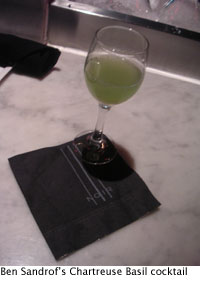
We went to Noir on a Sunday to catch Ben Sandrof in action. Hired as a manager just six months ago, he’s only behind the bar Sunday and Monday nights. Too bad. He’s a suave guy, which I mean in the good sense, i.e. “effortlessly gracious.” And he’s passionate about mixology. Noir has one of the few cocktail menus I’ve seen that manages to please disparate constituents: people who like their drinks pretty and accessible, classic cocktail enthusiasts who like strong, vintage spirits (yeah, that’d be me), and those who prefer hybrid mixtures that combine new and old ingredients. My favorite drink of the evening actually fell into the last category: a concoction that Ben invented called the Chartreuse Basil ($12). When I saw the ingredients — green Chartreuse, fresh lime, basil and simple syrup, shaken and served straight up — I thought, ‘Oooh, that’s going to be too sweet. And possibly too basil-y.’ But I was wrong. It was well balanced, tasty, original and, like most good cocktails, more than the sum of its parts. Then there was the Champagne Cocktail. While the idea of paying $13 for a drink with no hard liquor in it gives me pause, this thing was damn good. ‘Just because you’re dumping bitters, sugar and lemon juice in it doesn’t mean you shouldn’t use the Louis Bouillot Grand Reserve,’ is what I’ve always said.
OK, the Charles Hotel might still come across as a bit too slick, but I know I can get good drinks and friendly service there, and that’s enough to bring me back.
Posted in Bartenders, Boston bars, Cocktails, Gin, Liqueur | 1 Comment »
November 17th, 2006
Does this mean war? I hope so. In Boston Magazine’s November issue, Liquids columnist Anthony Giglio throws the glove down in “The Bitters Truth.” After a somewhat systematic evaluation of cocktails in Boston and Cambridge bars, he says, “I’ve come to realize that Cambridge is to cocktails what Berkeley, California, is to food — the little city in the big city’s shadow that’s the breeding ground for creativity, integrity, and dynamism. I’ve never met so many scholarly barkeeps in my life as I have in Cambridge. And after much scholarly research of my own, I can now say with absolute certainty that Cambridge makes better cocktails than Boston.”
Of course, this isn’t exactly news to us. Many of the bars and bartenders lauded on this site for their cocktail prowess are the same that Giglio cites in his article: Green Street (where drinkboston.com recently had its launch party), which boasts three of the Boston area’s best bartenders (Dylan Black, Misty Kalkofen and Joe McGuirk); B-Side Lounge, which, as a training ground for serious barmen and women, is to the local bar scene what Harvard Law is to the U.S. Government; plus Chez Henri, the Blue Room, etc. Giglio points out that “the great Boston exceptions — John Gertsen at No. 9 Park, Jackson Cannon at Eastern Standard, Nathan Bice at Beacon Street Tavern, and John Byrd at the Alchemist — all perfected their trade in Cambridge.”
So, what is it about Cambridge that nurtures a great cocktail culture? Cheaper rents and bar ownership by individuals rather than restaurant groups or hotels mean that bars can afford to make drinks with quality ingredients and take risks like not stocking Apple Pucker; a quirky, discerning population that appreciates variety and challenges to the palate; and the community of bartenders themselves, “a tight circle of avant-garde drink experts who pass down their expertise and help aspiring mixologists start out on their own,” writes Giglio.
What all this means, I hope, is that more Boston bars will get jealous of the praise being heaped on Cambridge drinking establishments and decide to rise to the challenge of making drinks that break out of the safe, chocolate-mint-martini mold. The prospect of a Mixologist War between Boston and Cambridge should have us all salivating.
Posted in Bartenders, Booze in the news, Boston bars, Cocktails | No Comments »
November 15th, 2006
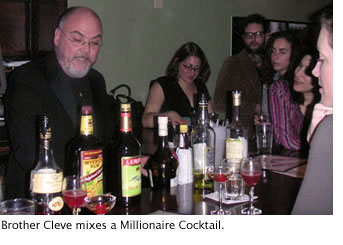
Here are the recipes for the drinks featured at drinkboston.com’s launch party, along with highly condensed versions of each bartender’s remarks about his/her drink. In order they were:
The Jack Rose (mixed by Jackson Cannon)
Some recipes call for lemon, some for lime. Applejack, a nearly forgotten spirit, is the base. Do not attempt to mix this drink without real pomegranate grenadine.
2 oz Laird’s Applejack
3/4 oz handmade grenadine (see recipe below)
1/2 oz fresh-squeezed lemon juice
one dash Peychaud’s Bitters
Shake over ice and strain, garnish with a lemon twist.
Grenadine: 2 parts pomegranate juice, 1 part cane sugar. Bring to boil, reduce heat and simmer to thicken slightly. Remove from heat and finish with a touch of orange flower water. Let chill, store in refrigerator.
The Sazerac (mixed by John Gertsen)
Born of the mishmash of New Orleans culture in the early to mid-1800s and believed by many to be the first cocktail. Antoine Peychaud was an apothecary whose proprietary blend of medicinal bitters was mixed with cognac before rye became the preference (rye was America’s whiskey before bourbon became more popular).
1 sugar cube (4-7 grams)
7 dashes Peychaud’s Bitters
1 oz water
3 oz Sazerac rye whiskey
A few drops of Herbsaint (pastis)
Muddle first three ingredients in mixing glass. “Rinse” a pre-chilled, old-fashioned glass with Herbsaint (pour drops of Herbsaint into glass, swirl and discard). Add rye to mixing glass and fill with ice. Stir well for 30 seconds and strain into Herbsaint-rinsed glass. Squeeze lemon twist over glass and rub around rim. Discard peel.
The Widow’s Kiss (mixed by Misty Kalkofen)
Drinks like this fell out of favor as people’s tastes moved to fruit-flavored liqueurs rather than “scary” herbal liqueurs like Chartreuse and Benedictine. There’s no real story behind this drink (it probably originated in 1895). Let’s make one up!
1 & 1/2 oz Calvados
3/4 oz Benedictine
3/4 oz yellow Chartreuse
2 dashes Angostura Bitters
Stir. Strain. Garnish with a cherry.
The Millionaire Cocktail (mixed by Brother Cleve)
This is but one of several widely varying drink recipes that go by the name “Millionaire.” It appears in Vintage Spirits & Forgotten Cocktails, by Ted Haigh (aka Dr. Cocktail).
1 & 1/2 oz Myer’s Original Dark Rum
3/4 oz apricot brandy
3/4 oz sloe gin
juice of one fresh lime (about 1 oz)
Shake well in an iced shaker. Strain into cocktail glass. Garnish with lime.
Posted in Applejack, Calvados, Cocktails, Events, Liqueur, Rum, Whiskey | 2 Comments »